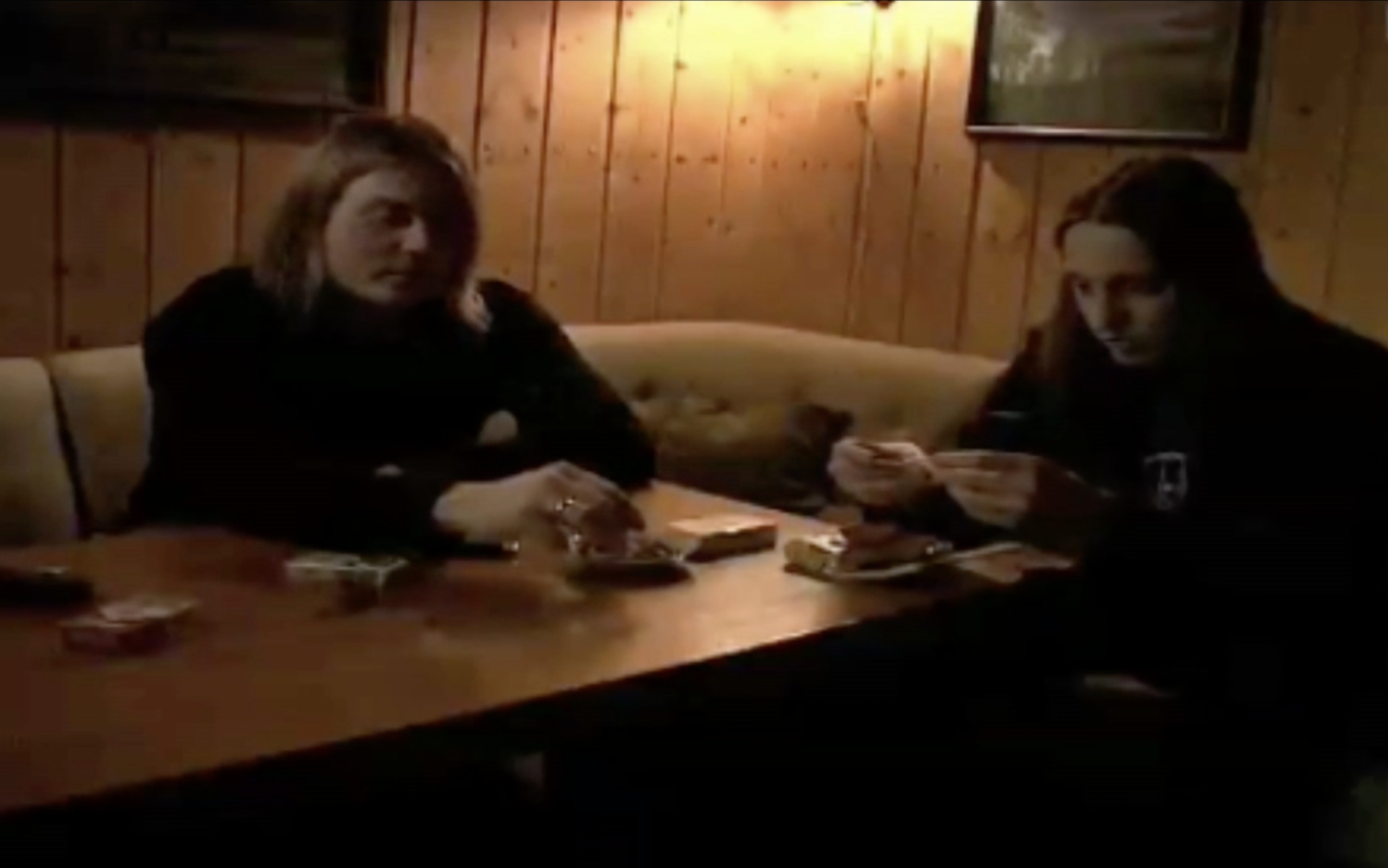
In the beginning, we were the music police. We could freeze out bands.
Gylve Fenris «Fenriz» Nagell, Lydverket spesial: Black metal, 2003. My translation.
Gylve Fenris “Fenriz” Nagell and Ted “Nocturno Culto” Skjellum are sitting on opposite sides of the beige corner sofa in a simple cabin in Trysil. Ted has just lit up his finished cigarette, picked from one of the packs lying in front of them on the pine living room table. Gylve is rolling his own from the roll-your-own tobacco pack that is also on the table next to a lighter and a half-full ashtray. On the paneled walls behind the sofa hang a couple of framed paintings.
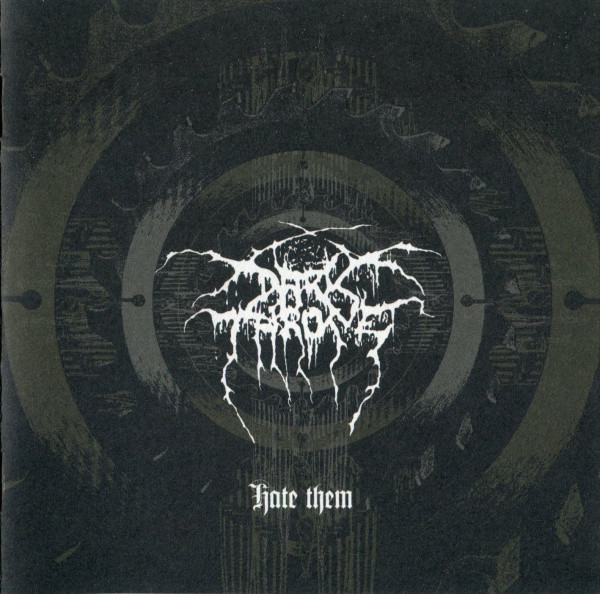
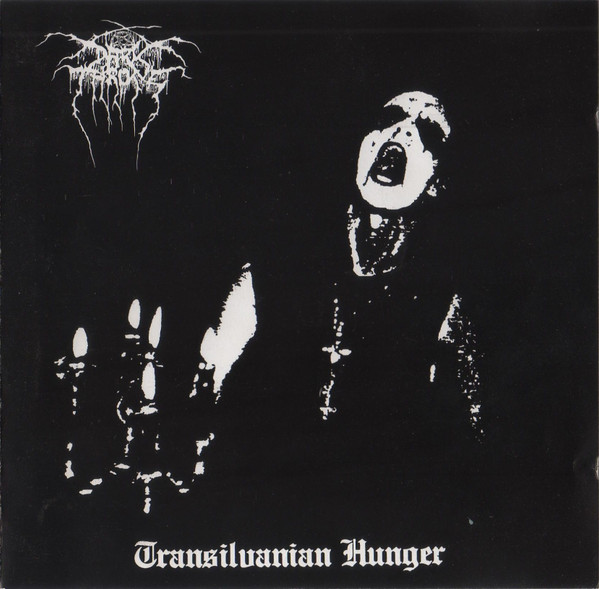
Darkthrone have traveled away to film a CD-rom for the re-release of their fourth album Transilvanian Hunger (1994), and NRK’s music program Lydverket has joined them to make a special broadcast called Black metal. It is the winter of 2003, and the TV pictures show that the guys are also discussing the cover of their ninth album Hate Them (Darkthrone, 2003) which was released in March of that year.
The practice of freezing out bands was reportedly quite widespread in the early phases of black metal history. If any readers have other examples than the ones I present here, please give me a tip. I will continuously insert corrections, suggestions and details into the article, marked with date and name if desired. So if any of you readers have tips, suggestions, objections, questions or more details, write it in the comments field below, or send me an email at helge@kaasin.no. And if the artists mentioned are interested in sharing their thoughts, nothing would be better.
Chapters
- Ulver, Mysticum, Fleurety and Wind of Centuries
- Sons of Satan
- Why be the music police?
- Relational aggression
- Normative behaviour
- Conclusion
- Sources
Nagell continues his lesson about black metal’s rough beginnings.
If we didn’t like something we could just have a general attitude, because there were so few of us. If the attitude was that one of the bands sucked, then it was just that it was hard for that band to get through. It sounds completely fucked up, but that’s how it was.
Gylve Fenris «Fenriz» Nagell, Lydverket spesial: Black metal, 2003. My translation.
One of the bands that felt such ostracism in the earliest days was the two-man band Fleurety from Ytre Enebakk.
Ulver, Mysticum, Fleurety and Wind of Centuries
In May 1993, the demo cassette Black Snow began circulating in black metal’s avid cassette swapping circles. Black Snow was recorded at Grim Sweeper Studio in March 1993. The band members of Fleurety called themselves Varg and Nebiros.
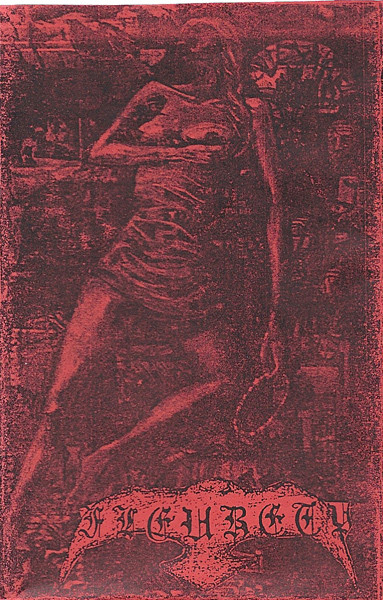
Behind these pseudonyms, Alexander Nordgaren and Svein Egil Hatlevik hid respectively.
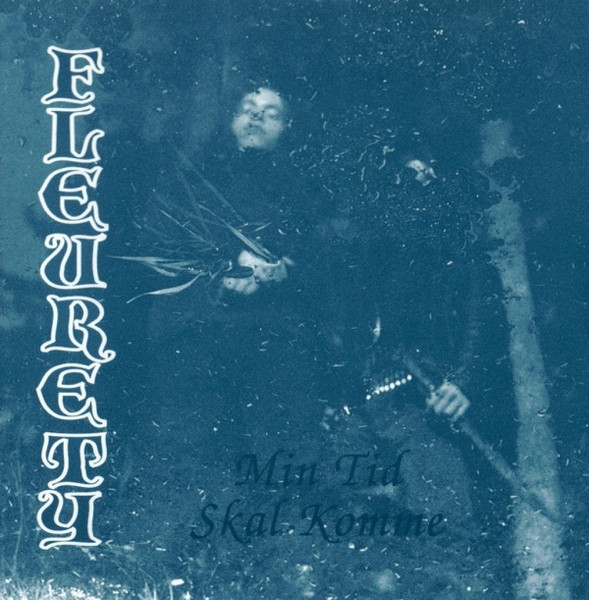
Coincidentally, the famous Kristian “Count Grishnackh” Vikernes – popularly and in the media called “Greven” (The Count) after church fires and the murder of bandmate Øystein “Euronymous” Aarseth on August 10, 1993 – officially changed his name to Varg Vikernes in March 1993, just before Fleurety’s Black Snow was released. After this, there were probably few good reasons for Alexander to keep the stage name Varg. So when his debut LP Min Tid Skal Komme was released in 1995, not only was the stage name Varg gone, but also the stage name Nebiros had disappeared, and the band members of Fleurety appeared under their own names.
The names Nebiros and Fleurety are taken from the same source, namely from lists of prominent demons in Hell as they appear in grimoires – books that describe magical beliefs and practices – such as Grimorium Verum and The Grand Grimoire, both written sometime in the 19th century, but with sources going back several hundred years. Black metal’s most popular magician, Aleister Crowley, helped popularize the wisdom of these grimoires and their supposed originator, namely King Solomon.
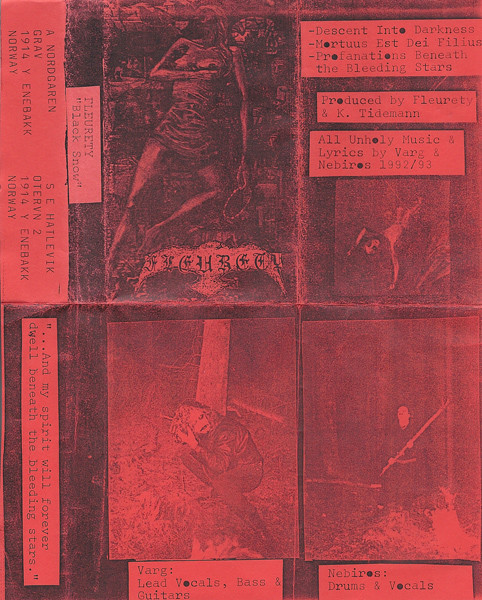
One of the bands that rejected Fleurety was Ulver. On the cover of the demo cassette Vargnatt (1993), recorded between October 15 and 17, 1993, they make it clear that they do not appreciate the band.
We do not salute…
Fleurety & Wind of centuries… Guess you’ve not got to the point of understanding…
You will remain nothing until the day you are nothing…
Ulver, Vargnatt (1993).
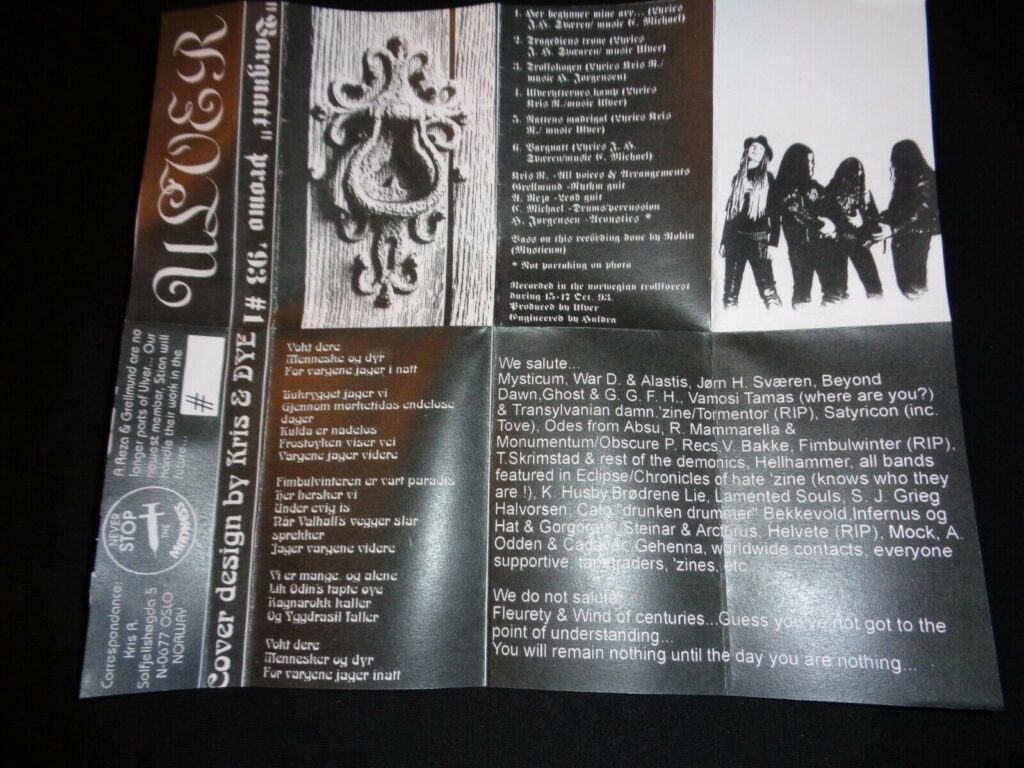
Nordgaren and Hatlevik were thus pushed out of black metal’s inner dark circle in the time after their demo cassette Black Snow was released. But why? Obviously because they were not TRVE enough, not real black metallers enough. They were reportedly not fanatic enough in their devotion to black metal’s strict code. A code that paradoxically there was little consensus about.
Patterson (2013, p. 417) claims that it probably also had something to do with how Fleurety sounded on Black Snow:
However, what really sets the demo apart from pretty much anything is the insanely shrill, piercing vocals produced by Alexander. Unsettling, even painful, they make the demo very much an acquired taste. This, coupled with the duo’s distance from the rest of the Norwegian black metal scene, provoked a level of hostility usually reserved for death metal or Christian bands, with criticisms thrown by both Mysticum and fellow envelope-pushers Ulver. As if that wasn’t enough, Svein even ended up being attacked at his home by some disgruntled members of another local black metal band.
Patterson (2013), p. 417.
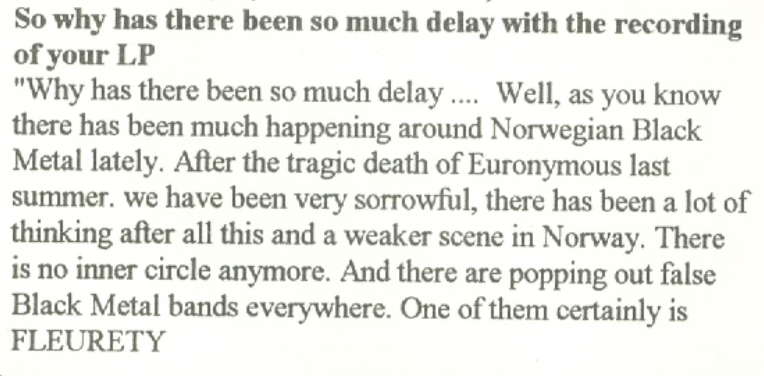
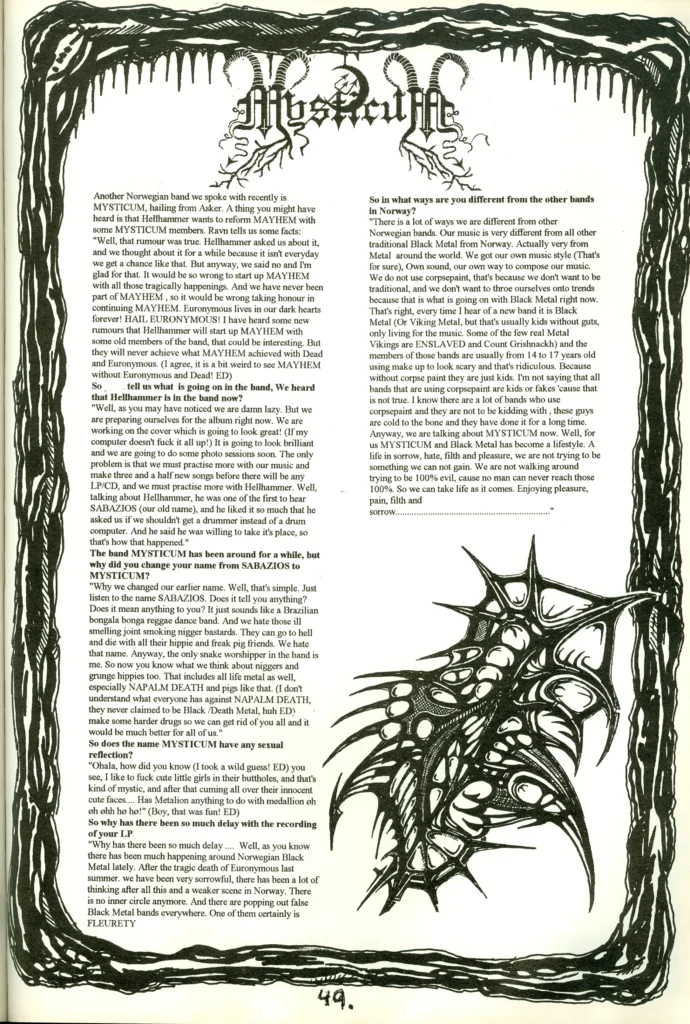
As Patterson (2013) mentions, the Asker band Mysticum also distanced themselves from Fleurety. The only (sub)official instance I have found where they make a negative statement is in Slayer magazine #10 (1994):
After the tragic death of Euronymous last summer we have been very sorrowful, there has been a lot of thinking after all this and a weaker scene in Norway There is no inner circle anymore. And there are popping out false Black Metal bands everywhere. One of them certainly is FLEURETY.
Interview with Mysticum in Slayer magazine #10 (1994).
Although the threats were real enough for Hatlevik, Rygg downplays the seriousness behind Ulver’s condemnation of Fleurety on the demo Vargnatt (1993) in Patterson (2013, p. 401).
”It didn’t take much to fall out with someone,” he admits, “in a weird way it was almost like we were striving for enemies in addition to the obvious common enemy we had in Christianity or society. I have to laugh thinking about all this… it really defied logic, the mindset that most of us adhered to. It was outlined by some sort of feeling or consensus that was absolutely ludicrous, but made perfect sense at the time; the evil thing. There were times when it was uncomfortable and it was also hard to live up to the ideals we set for ourselves. We were young and living at home with our folks so you had this sort of double life, this world with these people on the one hand, then going to school and chasing Christian skirt on the other – not so pure in retrospect. I guess ‘theatrical’ is a key word, staging yourself to a big respect.”
Patterson (2013), p. 401.
Compared to his own stated attraction to bands that sounded different at the time, his own condemnation of Fleurety and Winds of Centuries makes no sense. These were bands that were just different.
“I was really into bands that sounded different,” comments Kristoffer […], “and I think in those days that was a major criterion; to be a force to be counted on in the scene you had to create your own thing. This latter day perception othat true black metal only sounds like Darkthrone is just fucking silly, it’s a lot of distortion on the original idea wich included stuff like Mercyful Fate, for crying out load. The charisma of the music was really paramount. […].”
Patterson (2013), p. 400.
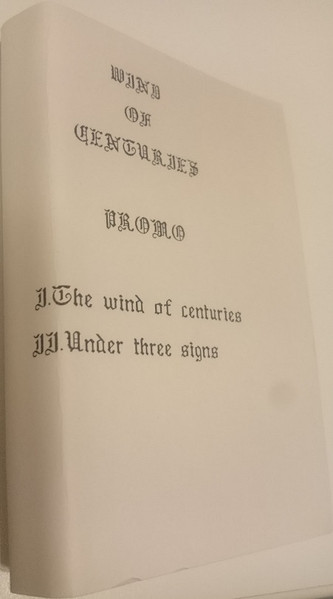
Winds of Centuries, the second band to be reviewed on Ulver’s demo Vargnatt, was the one-man band of Even Hauen, who in recent years has made a name for himself with the podcast Taakeprat. Winds of Centuries released their only release, the demo Promo in 1993, before going into history. Hauen continued his musical interests in Moon Lore.
When asked if it was anyone other than Ulver who raised their fist after Wind of Centuries, Hauen replied:
There wasn’t much more after that incident, but this was a period of a lot of fear and violence in the environment in general.
Even Hauen in the Facebook group Extreme Metal Norway, 28.04.2022. My translation.
And so it was this fear and violence that Hatlevik from Fleurety felt that winter in 1994 when four boys from the Askim band Strid knocked on the door of his childhood home in Ytre Enebakk.
Sons of Satan
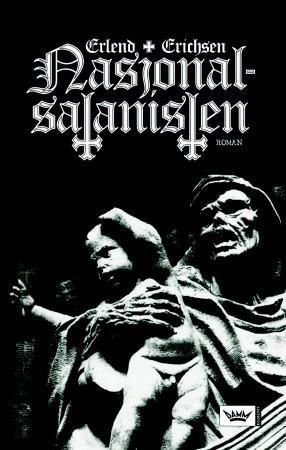
In a good and insightful analysis of the foundations of black metal baked into an interesting review of Erlend Erichsen’s novel Nasjonalsatanisten (2005), Hatlevik recounts the experience with the guys from Strid. I reproduce here the parts that deal with the experience itself, but recommend reading the entire original text. The essay “Sønner av Satan” (Sons of Satan) was originally published in Morgenbladet 09.12.2005, and was reprinted in Ballade 16.12.2005 (https://www.ballade.no/populaermusikk/sonner-av-satan/).
For the record, finding out where Hatlevik or Nordgaren lived wasn’t difficult. Both of their addresses were printed on the cover of the demo cassette, as was common at the time.
It’s Friday night, about half past eleven. MTV is showing Beavis & Butt-Head, a cartoon comedy show in which two loser teenagers from an American suburb comment on music videos. I’ve drawn the curtains in front of the living room windows; I don’t want anyone to know that I’m watching a comedy show on TV – it’s not appropriate for someone like me.
I’m 16 years old, and my life is all about Black Metal. (I picked up the habit of capitalizing Black Metal around this time.)
I think I hear someone sneaking around the house. The doorbell rings. Outside are four young men. They look to be three or four years older than me. They are wearing Black Metal uniforms – black leather jackets, heavy boots and studs.
— Are you Svein? one of them asks.
I’ve never seen any of them before. “Damn, everyone has longer hair than me,” I think.
They have driven from Askim to Ytre Enebakk, a distance of two and a half miles. The four young men are members of the band Strid.
— It’s me, Svein Egil, I clarify.
— Are you the one playing in Fleurety?
Fleurety is the band a friend and I started a little over two years ago. Fleurety is the name of a demon, by the way; the lord of hallucinogenic herbs, who can perform any task in one night.
— Yes.
— You are hereby dissolved.
I don’t think before I answer.
— Go to hell.
[…]
The one who spoke runs towards me, and I try to close the front door. But he has already put his foot in the doorway. My head hits the wall panel. The stranger screams; I don’t remember exactly what. If it wasn’t “I’ll fucking beat you!”, it was “I’ll fucking kill you!”.
Then Dad comes into the hallway. He and Mom have of course been woken up by the doorbell. Dad is wearing only panties, patterned in blue and orange, a pattern reminiscent of rose painting. He is bald, wears glasses, is compact and below average height.
He chases all four strangers away. They have to return home to Askim with unfinished business. The knives they had hidden under their jackets were of no use.
[…]
Actions like this, beating up a normal person, gave prestige in the Black Metal community. For a Black Metaler, it was important to show that you were not a normal person – you had to be real. And nothing was worse than a fake Black Metaler: a poser or a trend-setter.
The reason four young men traveled from Askim to Ytre Enebakk one Friday night in 1994 was because they had heard someone claim that we, the members of Fleurety, were not real Black Metalers. This mixture of music police and lynch mob was not sent on anyone’s orders; they acted on their own initiative. This was a way to show their devotion to the ideology of Black Metal.
[…]
One evening, a few weeks after Strid had visited, I received a phone call. A fake, dark voice declared, “You’re going to die. Horrible.” I decided to take a long walk in the woods to think.
When I returned, I had figured out what had to be done. The next day I went to school with a knife with an 8-inch blade inside my coat. I got a spray can of tear gas, which I kept in the small compartment of my backpack. That was how I was equipped for the next year.
In the meantime, I allowed myself to be interviewed in foreign fanzines, and like Vinterblod [one of the two main characters in Erichsen’s novel Nasjonalsatanisten, ed.] I needed my own custom-made ism. I declared that I was an evilist. My ideology was to be the most extreme of them all. I claimed that I cultivated evil for evil’s sake, without selfish interest.
I struggled to fill my new, hard-line ideology with content. It wasn’t easy. How do you combine an ideological commitment to wishing other people’s suffering with being a polite boy who did all his homework?
With Fleurety we had recorded the single A Darker Shade of Evil, which was supposed to be released on the German label Malicious Records. But our single was never released on Malicious Records, and the reason, as far as I know, is that the owner of the label received threats from Strid. (Malicious Records released Strid’s only official release, a vinyl single in 1995, and Gorgoroth’s second album, Antichrist, in 1996.)
A few months later I realized that I couldn’t come up with a satisfactory definition of the term “evil”, and the evilist project was terminated. Our single was released on the English label Aesthetic Death Records, and to this day I still can’t come up with a satisfactory definition of the term “evil”. Actually, I (still) think that “evil” is a nonsense term.
[…]
The year is 2000. I’m sitting on the subway on my way home. A strange man approaches me just before the train stops at Høyenhall station, the last one before Manglerud, where I’ve been planning to get off.
— Aren’t you going to get off here? asks the stranger.
— Well, yes, I answer.
The stranger turns out to be my neighbor, and lives 200 meters down the road. He was one of the guys in Strid and has cut his hair since last time. During the walk home it becomes clear that he is keen on reconciliation.
Svein Egil Hatlevik, excerpt from the essay “Sønner av Satan” which was originally published in Morgenbladet 09.12.2005, and later reprinted in Ballade 16.12.2005, https://www.ballade.no/populaermusikk/sonner-av-satan/. My translation.
This double life, in the balance between being an evil black metaller while also being a school student and living at home with your parents, which both Rygg and Hatlevik comment on, is something Per Amund Solberg, session bassist in Fleurety and NRK colleague, also highlights when I ask him why Ulver didn’t like Fleurety:1
Moreover, I was on the periphery of Fleurety – while Svein Egil and co. wanted to “combine “evilism” with being “a polite boy who did all his homework””, I was the polite boy who did all his homework and also played football and had a short haircut. 😉.
Per Amund Solberg in an email to me, 07.03.2022. My translation.
Why be the music police?
What are the reasons for being a music police as we have seen took place at least in the early period of Norwegian black metal history? It seems that there are two mechanisms at play here simultaneously. Firstly, a clique establishment that provides in-group and out-group constellations, and which naturally provides outsiders for some individuals and groups. Secondly, this clique establishment provides a value basis and guidelines for what is accepted and falls within the clique’s norms, and what falls outside.
In his essay, Hatlevik explains Strid’s attack on him and Fleurety, and by extension the entire appeal of black metal, with German theologian Rudolf Otto’s concept of “mysterium tremendum et fascinosum” from his book Das Heilige (1917). Hatlevik translates it as “the mystery of that which makes you tremble (with fear) and which at the same time attracts you”, and later as “joy mixed with horror”. Otto seeks to circle the core of religion, which he believes is man’s encounter with the numinous. The divine is “das ganz Andere” which is both attractive and deterrent.
Hatlevik seems to believe that this religious experience can invite a feeling of exaltation and chosenness, and subsequently fanaticism, something that is not latent in Otto’s concept.
[M]any of us who were connected to the Black Metal movement at the beginning of the 90s were fanatics. Like other fanatics, we divided the world into two: us and the others. The belief in Black Metal dominated life, and signals from the outside world that contradicted Black Metal were rejected. The fanatical Black Metaler abandoned his strait friends, he would rather go for walks in the forest at night than go to a party. But unlike most other fanatical movements, Black Metal did not only demand conformity from its true believers, but also individuality.
Hatlevik (2005). My translation.
This tension between individuality and conformity within the group is recognizable, and probably not only attributable to the social interaction of black metal. In the article “The Individual Within the Group: Balancing the Need to Belong With the Need to Be Different” (Hornsey & Jetten, 2004), Matthew J. Hornsey and Jolanda Jetten discuss different strategies for meeting the need to both belong and be different. Both they and the rest of the research are clear that these are two fundamental needs:
In summary, the literature suggests that people have a fundamental need to belong to social groups and, at the same time, have a fundamental need to defend their individual identities.
Hornsey & Jetten (2004), p. 250.
However, it does not seem that the religious experience and the subsequent fanaticism can fully explain the establishment of a music police within black metal. We must bring in more psychological mechanisms, and also take into account the fact that the black metal performers at that time were young, with all that that implies.
Relational aggression
Tove Flack investigates in her doctoral thesis Relational aggression in adolescents: Exploring the associations with status goals, status stress, perspective taking and empathic concern within the framework of social goal theory (Flack, 2018) whether relational aggression can be a functional, albeit negative, strategy for achieving popularity among adolescents.
To become independent individuals who are able to take responsibility for themselves and master social life challenges, adolescents must gradually become more independent from their parents and establish their own social network among their peers. Making friends, being accepted, and gaining support among their peers is therefore of utmost importance for adolescents, writes Flack in the introduction (Flack, 2018, p. 1).
Youth, she continues, must figure out how they fit in and how to deal with challenges that arise in their relationships with peers. Hierarchies always emerge within such social systems. Some peers establish high status, while others have average or low status. In the process of establishing different roles, not all social interactions among peers are positive. Although many youth establish good friendships and experience social well-being, others experience harm and exclusion from their peers in the group.
Relational aggression is, according to Flack (2018, pp. 1–2), a well-known phenomenon that involves behavior that intentionally harms others’ interpersonal relationships (e.g. by spreading negative gossip and purposefully excluding others). Relational aggression peaks in adolescence, according to many scientific studies. These also show that relational aggressive behavior can be very harmful to the well-being of the individual, and the emotional and social development of both victims and perpetrators. However, relational aggressive behavior also seems to provide some benefits for the perpetrator. Popularity in the peer group is clearly associated with this type of behavior.
According to Flack (2018, pp. 2–3), the research literature distinguishes between two distinct dimensions of social status. On the one hand, we have sociometrically popular youth who are popular in the sense that they are considered the most liked by other peers, and that because they are kind, helpful and supportive. On the other hand, we have youth who are popular not because they are nice to others, but because they have status, prestige and power within the group. Peers often describe them as “cool” and “dominant”, and many peers admire them, imitate their behaviour and style and want to be just like them. Although youth in this group are highly admired, they are often poorly liked.
Peers typically consider these to be “the most popular,” and in research they are referred to as perceived popular adolescents. It is important to note, writes Flack, that only perceived popular adolescents are associated with relational aggressive behavior. The connection between relational aggressive behavior and perceived popularity has led researchers to suggest that relational aggressive behavior can be used to achieve social status. According to social goal theory, people behave in ways that are consistent with the pursuit of their goals. People evaluate situations and determine whether these situations can help them achieve their goals.
Particularly when adolescents have a strong desire for popularity, Flack writes, relational aggressive behavior may function as a strategy to achieve their status goals. Research suggests that already popular adolescents may maintain their status by using their dominant position to include and exclude peers according to their own will, and enhance their status by engaging in relational aggressive actions. On the other hand, unpopular adolescents may engage in relational aggressive behavior to enhance their status when group leaders are relational aggressive.
Adolescents may also react with relational aggressive behavior when they perceive a threat to their social position in the group. As perceived popularity becomes very important during adolescence and competition for status among peers increases, individuals may develop concerns or insecurities about their social position, which Flack terms status stress. The prospect of being left alone and unsupported can be very frightening and destructive to an individual’s well-being.
Normative behavior
Social identity, as opposed to individual identity, is a cognitive mechanism that functions to enable group behavior, as opposed to individual behavior.2 Group behavior is characterized by perceived similarity between group members, cohesion, a tendency to cooperate to achieve common goals, shared attitudes or beliefs, and conformity to group norms. Once an individual characterizes himself as a member of a group, he will see himself as depersonalized and similar to other group members along the relevant stereotypical dimensions. In this process, the individual will – to the extent that group members see his interests and goals as similar – begin to embrace such interests and goals as his own.
Norms are rules within a group that set boundaries for what is appropriate, accepted, required, or prohibited for different members in different contexts. Norms typically manifest themselves in common actions that are held in place by social sanctions. Once a person adopts a norm, it functions both as a rule that guides behavior and as a standard against which behavior is evaluated. Not least, individuals are motivated to enforce the norms they adopt, and thereby participate in regulatory practices such as punishment and the assignment of blame. Such practices, in turn, help to stabilize the community’s social arrangements and the norms that structure them.
Such regulatory practices are responses that appear to be rooted in a dedicated psychological function—a norm system—that makes people sensitive to certain types of social stimuli (behavior, context, and roles) that reliably produce characteristic multifaceted responses (physiological, inferential, and behavioral) that correspond to these. Research shows that children from a very early age have such sensitivity, and quickly learn that certain types of behavior, context, and roles are governed by norms.
Enforcement and punishment include correction, non-cooperation, communication of disapproval through body language or explicit criticism, ostracism or gossip about norm violators, or even physical violence. Thus, individuals become responsive to norms and the social pressures through which they are enforced, and motivated to apply social pressure on others who transgress.
How strictly and loosely the norms are followed and punished has also been researched, and there are variations from culture to culture, and probably also from subculture to subculture.
Group-specific norms related to shared perceived interests and goals have two functions, among others: to minimize perceived differences between group members, and to maximize differences between the group and outsiders. Once such norms are formed, they will be stable cognitive representations of what is correct behavior for a group member. Group identity is built around group characteristics and behavioral standards, and therefore any lack of conformity to the group norm will be seen as a threat to the legitimacy of the group. Categorizing oneself as a member of the group accentuates the similarities between one’s own behavior and that prescribed by the group norm, which creates conformity in addition to a disposition to control and punish violators. Within this schema, group norms are obeyed because the individual identifies with the group, and conformity is mediated by the categorization of oneself as a group member.
Conclusion
We have now examined the two mechanisms I identified that can explain the motivations for being a music police as we have seen took place at least in the early period of Norwegian black metal history. We have seen how the establishment of a clique creates in-group and out-group constellations, which naturally creates exclusion for some individuals and groups. We have also seen how the establishment of a clique establishes a value base and guidelines for what is accepted and falls within the norms of the clique, and what falls outside.
The need to identify with a group and to establish and fight for one’s position in the group with relational aggressive behavior is particularly strong in youth, and coincides with the age of those who most strongly practiced this type of music police behavior at the time we are discussing. It is easy to imagine that such a central figure in the group around the Helvete record store as Øystein “Euronymous” Aarseth functioned as a perceived popular youth who himself practiced and at the same time encouraged relational aggressive behavior. And there are several examples.
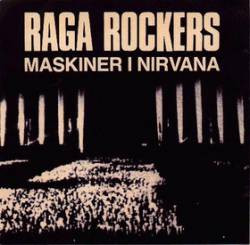
As a group, the black metal performers at this time were in strong opposition to social structures that subjugated and held down the individual in a state of indifference. In and of itself, a very ordinary reason for a youth rebellion. A diluted, lax and institutionalized Sunday school Christianity that in its time distinguished between the profane and the spiritual and thereby demystified the world, while at the same time robbing us of the Norse world of gods and a respect-based value base with a warrior code, quickly became the culprit for the condition that the Norwegian rock band Raga Rockers at the same time called Maskiner i Nirvana (1985), an emotionally blunted adult universe without spirit and with a herd mentality. Musically, the black metal performers found their opponent in death metal, which they believed had lost its fervor when it was commercialized. Both of these perspectives were something the actors had grown up with and benefited from. Both were something that was close to their hearts, and which they now identified as part of an adult universe they had to distance themselves from and free themselves from.
The need to rebel against the status quo naturally created a fairly strict norm regime where, through negation, one clearly distanced oneself from the status quo and created clear normative guidelines for what was within and what fell outside the group’s value set.
In such an environment where a new musical genre was born, and where a number of bands simultaneously attempted to step into the spotlight, there naturally arose competition and strong status stress, with subsequent increased radicalism and aggressiveness in sanctioning behavior.

It should also not be overlooked that there was a cultural modernization of Norway at this time, which also involved extensive secularization. Thomas Bossius (2003, pp. 32–34) has an interesting discussion of these aspects, where he uses sociological analyses by Thomas Ziehe and Thomas Luckman.
Ziehe argues that in the process of cultural modernization, society’s traditional and shared patterns of interpretation or worldview will break down, lose their footing or be made impossible, and what was once shared becomes individual. This disengagement from the traditional patterns of interpretation is individual, and the task of choosing new ones is also placed on the shoulders of the individual. As a result, a complex jungle of different patterns of interpretation or worldviews grows.
The dissolution of the old patterns of interpretation and the establishment of a multitude of new patterns of interpretation is a challenge for the individual, who must find a coping strategy. According to Ziehe, these can be categorized into three different types. Firstly, the individual can, by actively and consciously opposing the modern, exploit it and drive it forward. Secondly, the individual can deny and close his eyes to the modern, and claim that deep down the old patterns of interpretation lie intact. Thirdly, and this is the coping strategy that Bossius finds most interesting, the individual can make use of what Ziehe calls cultural orientation attempts. These can also be divided into three types.
The first, Ziehe calls subjectification, consists of a striving for closeness.
Closeness to other people, to oneself, one’s own life, one’s appropriate feelings and one’s own true self. In closeness to others one tries to counteract the impersonality and alienation in modern society.
Lossius (2003), p. 33. My translation.
The second attempt at orientation, which Ziehe calls ontologization, is characterized by a striving for certainty.
One searches for solid ground to stand on in a host where everything is floating. Those who choose the ontologizing orientation attempt experience the loss of meaning as the greatest threat. To the ontologizing sphere Ziehe attributes such things as “attempts at remystification, e.g. new religious groups and a growing interest in spirituality” (Ziehe 1986: 355). One searches for the whole, the authentic and the original.
Bossius (2003), p. 33. My translation.
The third orientation attempt Ziehe calls potentiation.
To potentiate: “means to artificially charge something with meaning. Here one does not seek proximity, nor certainty, but intensity” (ibid.: 356).
Bossius (2003), p. 33. My translation.
Thomas Luckmann criticizes the understanding of the secularized human as a person who has lost his or her religiosity, and believes, in line with Ziehe, that a common religious understanding linked to religious institutions has been lost, but that the individual, in his or her reorientation in the jungle of new interpretation patterns, builds his or her own individual worldview and thus privatizes religion.
Luckmann’s belief is that everyone’s worldview contains “unarticulated and incomplete perceptions of what cannot be understood and which form a sacred sphere for the individual” (Gustafsson 1981: 5). He calls the content of these sacred spheres the invisible religion, and believes that the dominant form of religion in modern society is a multitude of individual, invisible private religions.
Bossius (2003), p. 34. My translation.
There is little doubt that processes like this have played a major role in the formation of black metal’s ideological foundation, a foundation that, while being strict and normative, was also searching, diverse and private.
Bossius (2003, p. 137) also confirms my above analysis of the origins of black metal’s music policing, links it to modernity and the challenges of secularization, and – like me – extends it to being an important driving force for the entire subculture’s expression.
The driving force behind religion in black metal culture is primarily to be found in the fundamental problems of adolescence. That is, the needs for identity and security that arise in connection with breaking free from the family and starting to stand on one’s own two feet. Intimately intertwined with this are also the problems that modernity and secularization give rise to.
Bossius (2003), p. 137. My translation.
Sources
See Sources.
Notes
- Another NRK colleague, Tommy Hjelm, plays in the Norwegian grindcore band Beaten To Death, which has made a song about the feud between Fleurety and Strid, “Dere er herved oppløst” from the release Agronomicon (2018). The song contains, among others, the words «Strid. / Askimbandet Strid / Antakeligvis noe drit» which can be perceived as offensive and in line with the topic this article discusses. However, I perceive the song as humorous. The full text is as follows:
Ytre Enebakk
Året er 1994
Midnatt på vinterstid
Fire nek skal gjøre noe trve
Strid. Askimbandet Strid
Antakeligvis noe drit
Bevæpnet med kniv
Banker de på:
“Ja, god kveld
Er det du som er Svein?
Spiller du i Fleurity?
Dere er herved oppløst!”
Stridgutta vil slåss
Svein Egil prøver å lukke døra
Til slutt jager faren hans dem bort
I bare underbuksa
Dere er herved oppløst
“Hva med å spørre om Svein vil spille trommer?”
“Nå er vi voksne og ikke teite lenger”
“Møtte ham på Manglerud T-bane forleden”
“Hei! Svein! Kom!
Bli med!”
Dere er herved oppløst!
(Ytre Enebakk
The year is 1994
Midnight in winter
Four neks are going to do something trve
Strid. Askimbandet Strid
Probably something shit
Armed with a knife
They knock:
“Yes, good evening
Are you Svein?
Do you play in Fleurity?
You are hereby disbanded!”
The fighting guys want to fight
Svein Egil tries to close the door
Finally his father chases them away
In only his underwear
You are hereby disbanded
“How about asking if Svein wants to play the drums?”
“Now we are adults and not stupid anymore”
“Met him on Manglerud subway the other day”
“Hi! Svein! Come!
Join us!”
You are hereby disbanded!)
The song summarizes the course of events, and the paradoxical fact that Hatlevik is now playing in Strid. It comes with acid comments that the guys in Strid are some jerks and not stupid anymore, and that they also play some shit, as mentioned earlier, but this type of assumptions and baseless slander puts the finger on the phenomenon I am discussing in this article, that they were youthful pranks that (probably) lacked well-founded and – in an adult world – weighty reasons. In this sense, the song takes the theme of this article to heart. It is worth noting that this type of textual slander is not found in the actual songs of the black metal bands of the time we are discussing, at least not as far as I have been able to find out. The slander was reserved for covers and interviews. ↩︎ - The following is based on Kelly & Setman (2021) and Bicchieri, Muldoon & Sontuoso (2018). ↩︎
Leave a Reply