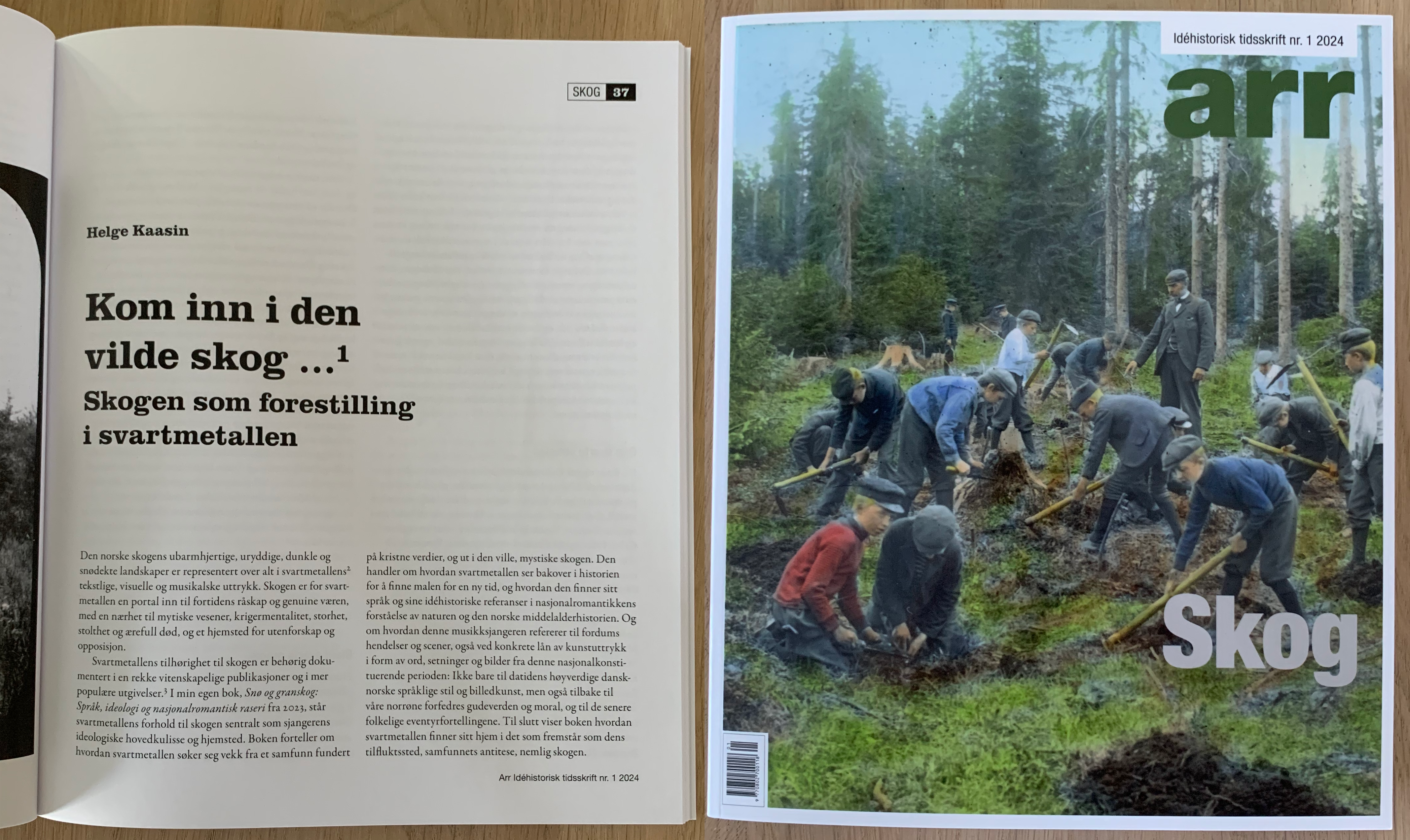
In November 2023, I was contacted by Thomas Østerhaug, editor of Arr – idéhistorisk tidsskrift (a journal of the history of ideas), who had taken a look at my book Snø og granskog (Snow and Spruce Forest) and found it interesting – asking if I would be willing “to write an article for Arr on the use of forests/notions of forests in black metal […] preferably with historical-philosophical references to National Romanticism and the Middle Ages – insofar as they can be linked to forests” I felt this was a unique opportunity to write for a critical and academically educated audience, and naturally I couldn’t let that chance slip by. Consequently, the winter of 2023/2024 turned into a writing marathon, and I rediscovered that writing concisely and to the point is a difficult exercise.
On 29 May 2024, issue 1/2024 of Arr – idéhistorisk tidsskrift, entitled “Skog” (Forest), was published. My article “Kom inn i den vilde skog …: Skogen som forestilling i svartmetallen” (Come into the wild forest …: The forest as a concept in black metal) can be found on pages 37 to 55. The journal is available to purchase at arrvev.no. Available only in Norwegian.
The theme of the article is perhaps best summarised in the introduction to the article itself:
Følger vi forestillinger om skogen i den europeiske kultur- og idéhistorien bakover i tid, helt tilbake til antikken, så oppdager vi flere interessante likhetstrekk mellom hvordan skogen og dens mytiske beboere er fremstilt i kunsten og i svartmetallens musikalske, tekstlige og visuelle uttrykk enn det jeg undersøker i min bok [Snø og granskog] – likhetstrekk som heller ikke er belyst i svartmetallitteraturen generelt. I denne artikkelen skal jeg ta for meg tre motiver jeg bare så vidt nevner i boken min, men som har stått sentralt i svartmetallen helt fra starten, og som har sin kulturhistoriske opprinnelse langt tilbake i tid. Alle er tett knyttet til skogen, dens utforming og mytiske innbyggere: Lysningen i skogen som en representasjon av sivilisasjonen og den kristne gudens lys, inverteringen av lysningen til skogstjernet hvor drukningsånden nøkken bor, og svartmetallkarakteren som en primitiv og brutal villmann fra skogene. Men først skal jeg redegjøre kort for svartmetallens historie, dens karaktertrekk, samt et teoretisk rammeverk jeg også benytter i boken min som hjelper oss å forstå hvordan svartmetallen låner og dramatiserer kulturhistoriske symboler for å etablere sitt eget språk og sitt ideologiske ståsted.
If we trace perceptions of the forest in European cultural and intellectual history back in time, all the way to antiquity, we discover several interesting parallels between how the forest and its mythical inhabitants are portrayed in art and in the musical, lyrical and visual expressions of black metal – parallels that go beyond what I explore in my book [Snow and Spruce Forest] – similarities that have not been highlighted in black metal literature in general either. In this article, I shall examine three motifs that I merely touch upon in my book, but which have been central to black metal right from the start, and which have their cultural-historical origins far back in time. All are closely linked to the forest, its layout and mythical inhabitants: the clearing in the forest as a representation of civilisation and the light of the Christian God; the inversion of the clearing into the forest lake where the water spirit Nøkken dwells; and the black metal character as a primitive and brutal savage from the woods. But first, I shall briefly outline the history of black metal, its characteristics, and a theoretical framework that I also use in my book to help us understand how black metal borrows and dramatises cultural-historical symbols to establish its own language and ideological stance.
Leave a Reply