In February 1995, the supergroup Storm1 released their debut album Nordavind, a fusion of old traditional folk tunes and black metal. The Norwegian words storm and nordavind mean “storm” and “north wind” respectively in English. Storm started as a duo consisting of Sigurd “Satyr” Wongraven from Satyricon, and Gylve Fenris “Fenriz” Nagell from Darkthrone. Towards the end of the process of creating Nordavind, they brought in vocalist Kari Rueslåtten from The 3rd and the Mortal.2 This added finesse and musical sophistication to the release, but also led to a bitter dispute. More on that later.
This article is speculative. It asks a number of questions that the performers this article discusses would probably be able to answer if asked, but it also asks a whole series of questions and makes claims that they probably would not be able to answer. Cultural structures affect individuals without them necessarily being aware of it. In addition to being speculative, I want the article to live. I will continuously place corrections, suggestions and details in the article, marked with date and name if desired. So if any of you readers have suggestions, objections, questions or more details, write it in the comments field below, or send me an email at helge@kaasin.no. And if the artists mentioned are interested in sharing their thoughts, nothing would be better.
Chapters
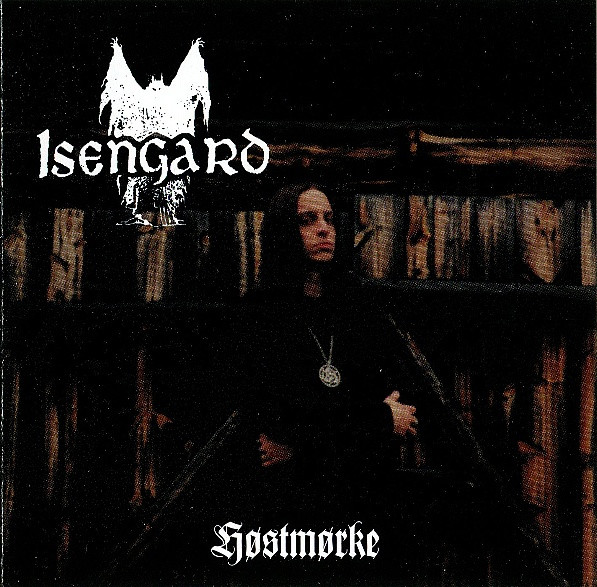

Nordavind is perhaps the high point of Norwegian black metal’s attraction towards national romantic poetry and traditional folk tunes, in a year with several challengers. In 1995, Ulver released Bergtatt – Et Eeventyr i 5 Capitler, the band Wongraven – fronted by Sigurd Wongraven – released Fjelltronen, and Isengard – Gylve Fenris Nagell’s solo project – released Høstmørke. In this context, it is also worth mentioning Darkthrone’s tribute to Tarjei Vesaas on the last song “Snø og granskog (Utferd)” on the album Panzerfaust. The Vesaas poem “Snø og granskog / Snow and Spruce Forest” can be interpreted national romantically, even though it is of a more modernist cast.
Norse ideology, and national romantic lyrics and imagery were of course already an integral part of Norwegian black metal, but the lyrics are most often drawn from their own chest, heavily inspired by folk beliefs, fairy tales and medieval culture in general. The music, in turn, is rarely based on, but only inspired by, folk tunes. On Bergtatt, Ulver not only uses lyrics inspired by the old bergtatt folk belief, written in old Gothic Danish-Norwegian, but uses many stylistic musical techniques and instruments (mainly flute, acoustic guitar and polyphonic singing) taken from the folk tunes of the late Middle Ages.
Storm and Isengard take the whole thing a musical step further towards the expression of Norwegian folk music, but with an important difference between them. For although Isengard on Høstmørke partly uses texts from famous Norwegian poets, only Storm uses both text and tone from the Norwegian musical folk heritage.
It seems as if this fusion of folk and black metal was something that had to be given vent to in the genre, as a kind of catharsis, a cleansing. In any case, the main players Wongraven and Nagell more or less put this alloy aside in the years after 1995.
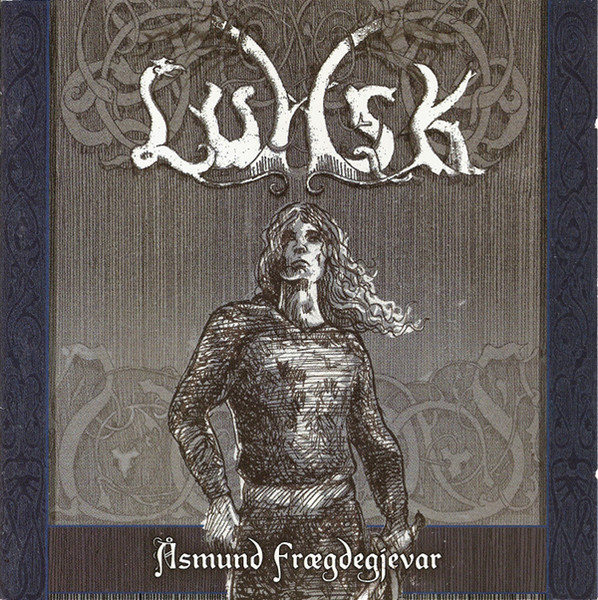
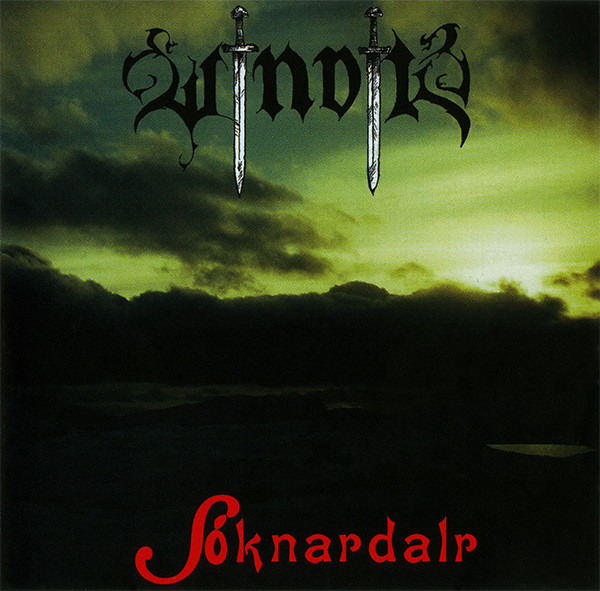
The ties between national romantic folk music and black metal were nevertheless so close that other players emerged in the wake of Wongraven and Nagell’s pioneering work with Norwegian folk tunes. Windir came with Sóknardalr in 1997, Gåte with Jygri in 2002, Lumsk with Åsmund Frægdejevar, Glittertind with Evige Asatro, and Ásmegin with Hin vordende sod & sø, all in 2003, as well as Myrkgrav with Trollskau, skrømt and kølabrenning in 2006, to name a few of the Norwegians. None of these mentioned probably lived up to the standard Nagell set for what is good folk metal many years later in the commentary track to Høstmørke:
Folk metal should in most cases be deleted. I think it’s a horrible form of music actually. And I might have contributed to that. I might also have contributed to […] make decent folk metal songs that aren’t spastic and merry and all that junk that came later on in the nineties.
Isengard (1995), commentary track for «Over de syngende øde moer».
Nagell’s statements fit well with the standard he and Wongraven also set for what is real folk metal in the booklet that is part of the cover of Nordavind:
Storm was created by S. Wongraven because of his love for Norway and a hunger for playing folksongs [sic.] from his own shores. Nagell joined him and together the melted the music style they are used to with old folksongs [sic.]. Right before “Nordavind” was finished Wongraven found Kari Rueslåtten and she he [sic.] had the same feeling for this as they had and she joined. Mixing this [sic.] styles has never been done before in this way, and it can not be done either if it does not come straight from your heart. The musical performances on “Nordavind” comes straight from the heart and and [sic.] there is a lot of feeling in it from the artists side. It was meant to turn out exactly the way it did. “Nordavind” is Storm’s hymn to Norway and must be looked upon in that way. As probably many of you know, all the members have their own bands but will still continue with their crusade for Norway through Storm. The future looks Norse.
Storm (1995), p. 5 in the CD booklet.
The requirement for real folk metal is that it comes from the heart. Just like black metal itself. It has to be true, as in true Norwegian black metal. There are several interesting aspects to this text that was also used as a promotional text and press release at the launch of Nordavind in February 1995. I will get into this a little later.
That both Wongraven and Nagell had a strong interest in folk music at this time is evident, also in the releases leading up to Nordavind. It is noticeable that Wongraven in Satyricon uses folk tunes as inspiration both on his debut Dark Medieval Times and on his sequel The Shadowthrone, both from 1994.
Nagell also seems inspired by folk music in his work with Darkthrone, but mostly lyrically on the second and third releases Under a Funeral Moon (1993) and Transilvanian Hunger (1994), and more lyrically and musically on Panzerfaust (1995) as previously mentioned. After this, the folk music seems to diminish somewhat for both Satyricon and Darkthrone with the releases Nemesis Divina (1996) and Total Death (1996), respectively, although “Ravnajuv” would be included on the national romantic compilation release Crusade from the North (1996) as we will see later.
Both Wongraven and Nagell usually channeled their interest in folk music into other projects, outside their main band, including outside their joint project Storm.
Through the three demos Spectres over Gorgoroth (1989), Horizons (1991) and Vandreren (1993) which together constitute Isengard’s first release, the compilation Vinterskugge from 1994, we see Nagell’s development from rough black metal with metal riffs to more folk-influenced songs such as the instrumental “Fanden lokker til stupet” which is based on a traditional song.
Also in the side project Dødheimsgard, where Nagell plays bass on the first release Kronet til Konge (1995),3 the folk tones appear in the intro to the song “Midnattskogens Sorte Kjerne”. Here Nagell also does a vocal that is very similar to the chanting and pure vocal style he uses on Høstmørke, on Nordavind, and on “Snø og granskog (Utferd)” on Panzerfaust. We also hear a very virtuoso bass playing especially on this song, probably inspired by the same thing that he himself says inspired him on Høstmørke, especially on the song “Over de syngende øde moer”, namely bassist Gary Thain’s playing on Uriah Heep’s album Sweet Freedom from 1973 (Uriah Heep, 1973).4
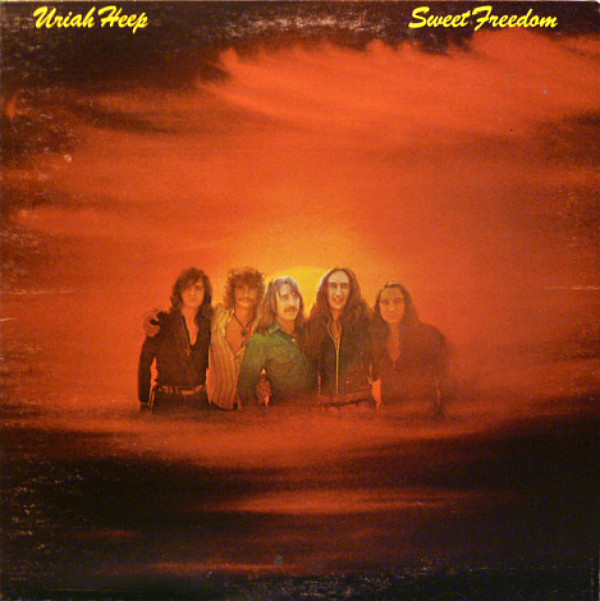
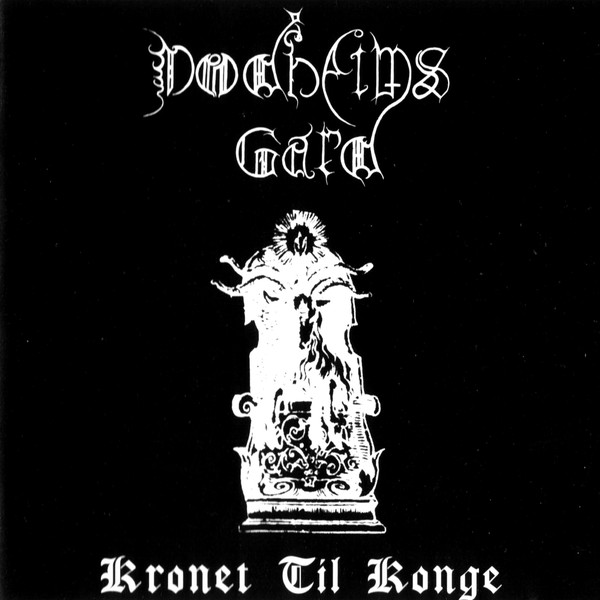
We also see an emerging experimentation with synthesizers at this time. On Vinterskugge it is used on the instrumental songs “In the Halls and Chambers of Stardust the Crystallic Heavens Open” and “Bergtrollets Gravferd”. On Isengard’s second release Høstmørke, the synthesizer is only used on the instrumental song “I ei Gran borti Nordre Åsen”. It is unclear who plays the synthesizer on “Intro” and “Outro” on Dødheimsgard’s Kronet til Konge, but neither Bjørn “Aldrahn” Dencker nor Yusaf “Vicotnik” Parvez are listed on any releases as having contributed on keyboards. It is therefore likely that it is Nagell who plays the synthesizer on Kronet til Konge.
For Nagell, the use of synthesizers reached its peak on the two releases Caravans to Empire Algol (1994) and Transmissions from Empire Algol (1995) with the dark ambient solo project Neptune Towers, released on Moonfog Productions, Sigurd Wongraven’s record label.5 In Darkthrone, synthesizers were not used until the previously mentioned song “Snø og granskog (Utferd)” from Panzerfaust (1995). Since then, synthesizers have not been used on any Darkthrone release until the song “Lost Arcane City of Uppåkra” as the fifth and final song on Eternal Hails…… (2021).6 There, Nagell uses a Moog synthesizer.
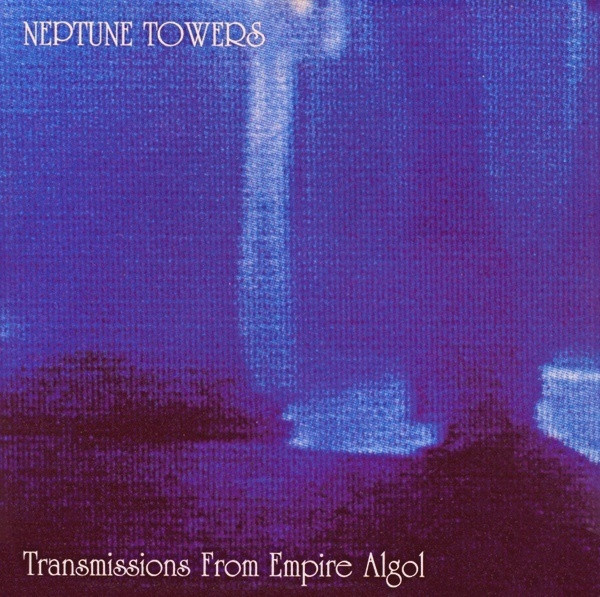
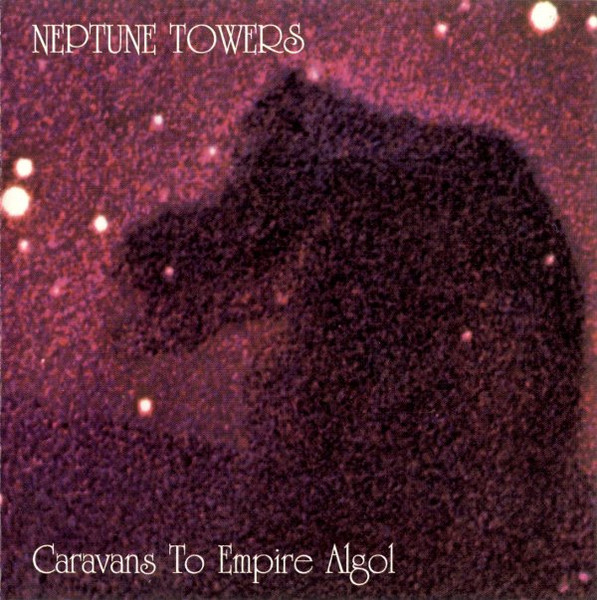
At the same time, Wongraven also explores the synthesizer and releases the album Fjelltronen (1995) with the supergroup Wongraven on his own label Moonfog. Wongraven also consisted of Vegard Sverre “Ihsahn” Tveitan from Emperor and percussionist Hans-Kristian Kjos Sørensen. Dark ambient or dungeon synth is something Tveitan’s Emperor partner Håvard “Mortiis” Ellefsen made his preferred expression from his debut release Born to Rule from 1994 and to this day.
Synthesizer is also used on Nordavind, but is only audible on “Innferd” and “Utferd”, the two short instrumental songs that start and end the album. It is Wongraven who treats the synthesizer on Nordavind. It seems as if both Wongraven and Nagell believe that the synthesizer has more to do as an instrument that sets the mood in the more dreamy and calm musical sequences than in the folk tunes themselves. Either as independent intro and outro songs, or as intro, outro or bridges in other songs.
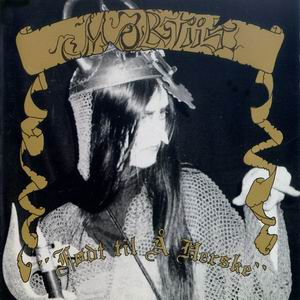
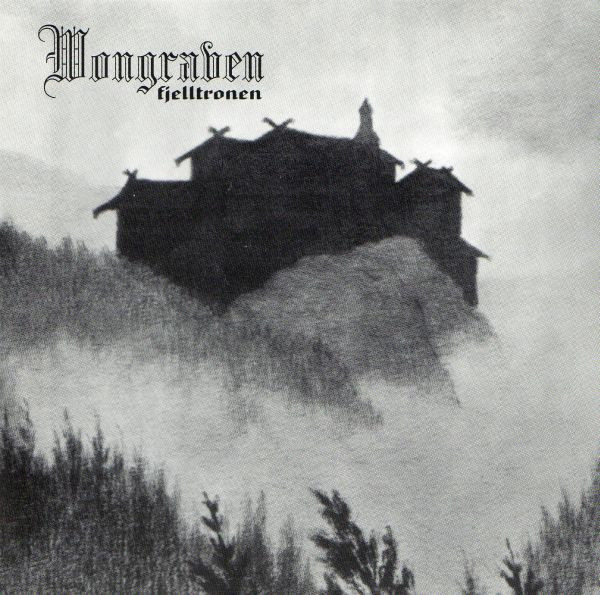
The controversy
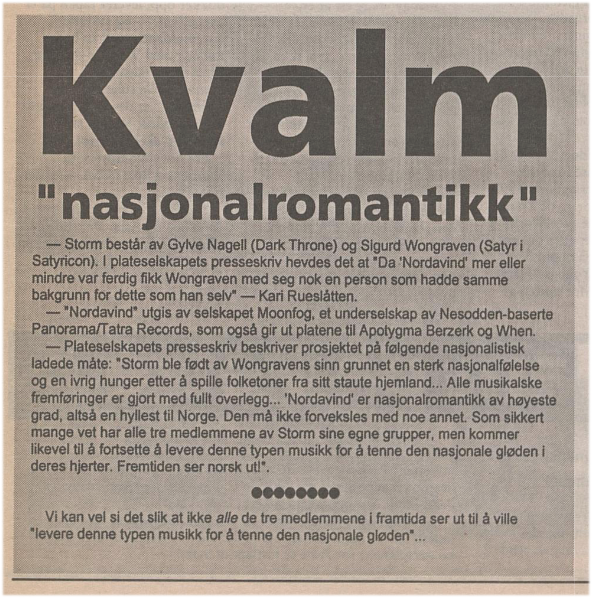
«Kvalm “nasjonalromantikk”» (Nauseating ‘national romanticism’) was what the music newspaper Puls called Nordavind when it came out in February 1995, and quotes the press release that is identical to what is printed on the booklet for the release, and which I quoted above:
The record company’s press release describes the project in the following nationalistic way: “Storm was born from Wongraven’s mind due to a strong national feeling and an eager hunger to play folk tunes from his proud homeland… All musical performances are done with full deliberation… ‘Nordavidn’ is national romanticism of the highest degree, that is, a tribute to Norway. It must not be confused with anything else. As many probably know, all three members of Storm have their own groups, but will still continue to deliver this type of music to ignite the national glow in their hearts. The future looks Norwegian!”
Puls (1995), nr. 7, p. 9. My translation.
Puls rounds off the note with the following laconic remark:
We can say that not all three members in the future seem to want to “deliver this type of music to ignite the national glow”…
Puls (1995), nr. 7, p. 9.
So it is Storm’s third member Kari Rueslåtten who, according to this notice, will no longer be a part of the band, and who created one of many controversies in the Norwegian black metal scene in the 1990s. But before we delve deeper into this spicy matter, I will say a little about the music newspaper Puls’ relationship with black metal.
Black metal had a pretty bad reputation in the otherwise solid music magazine. Puls’ hard rock oracle Thor-Rune Haugen is not kind when he discusses death and speed metal in the article “Speed metal under lupen” (Speed metal under the magnifying glass) from 1987.7 He thinks Venom should have been a parody band, and he “laughs at them 10 times as much as at Bad News and Spinal Tap combined”.
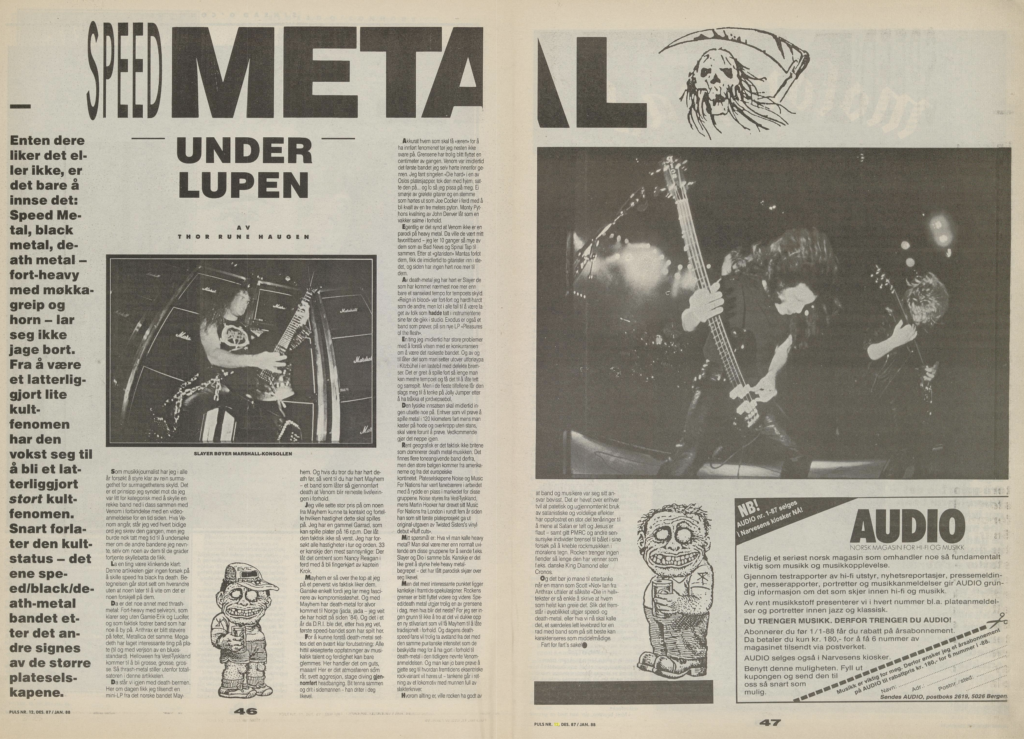
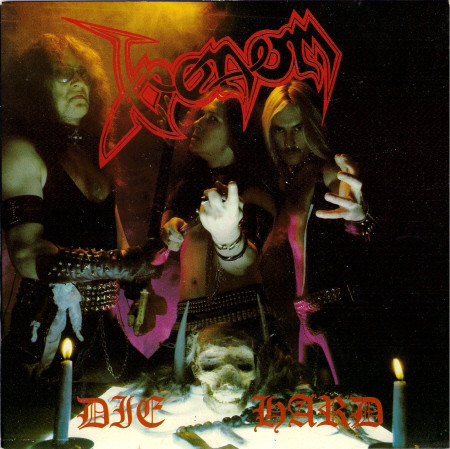
The first time he put on the single Die Hard (Venom, 1983), he writes that he laughed until he peed himself: “A mess of mushy guitars and a voice that sounded like Joe Cocker about to be strangled by a three-meter python.”
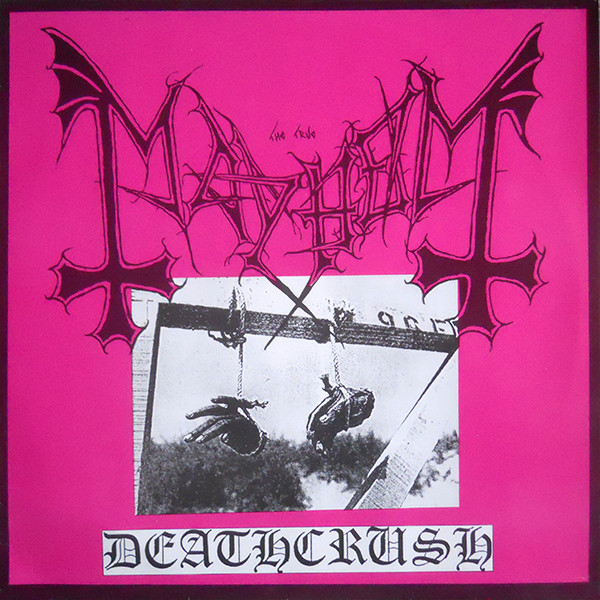
Regarding Mayhem and their debut release Deathcrush (1987), which he claims to like quite a bit because they “are so over the top”, he asks them to get in touch so they can “tell me what speed this should be played at”. He eventually finds out that 33 rpm is the most likely speed to play the record at, but even at that speed “it sounded a bit like Nancy Reagan about to be fingered by Captain Hook”.8
“Black metal” is mentioned only 38 times in the lifetime of the newspaper Puls, from 1978–1996, and then mostly in notices and a few reviews. It is a bit strange when this phenomenon that was to become worldwide happened right outside the windows of the editorial office of Norway’s most distinguished music magazine at the time. I would call it a sin of omission. The most that was ever written about black metal in Puls was the case of Kari Rueslåtten’s showdown with the other two in Storm, Sigurd Wongraven and Gylve Fenris Nagell, in the spring of 1995. This case received two large spreads, as well as two notices.
Rueslåtten regrets
The first story was published in issue no. 7, which covers the week from February 24 to March 3, 1995. Under the pun-like headline “Storm rundt ‘Nordavind’” (Storm around ‘Nordavind’), a heartbroken Rueslåtten regrets that she has participated in the Storm album Nordavind which, according to Puls, “awakens nationalist associations”. Puls (1995), issue no. 7, p. 9. Rueslåtten is afraid that her planned solo project after her recent departure as vocalist in The 3rd and the Mortal will be ruined.
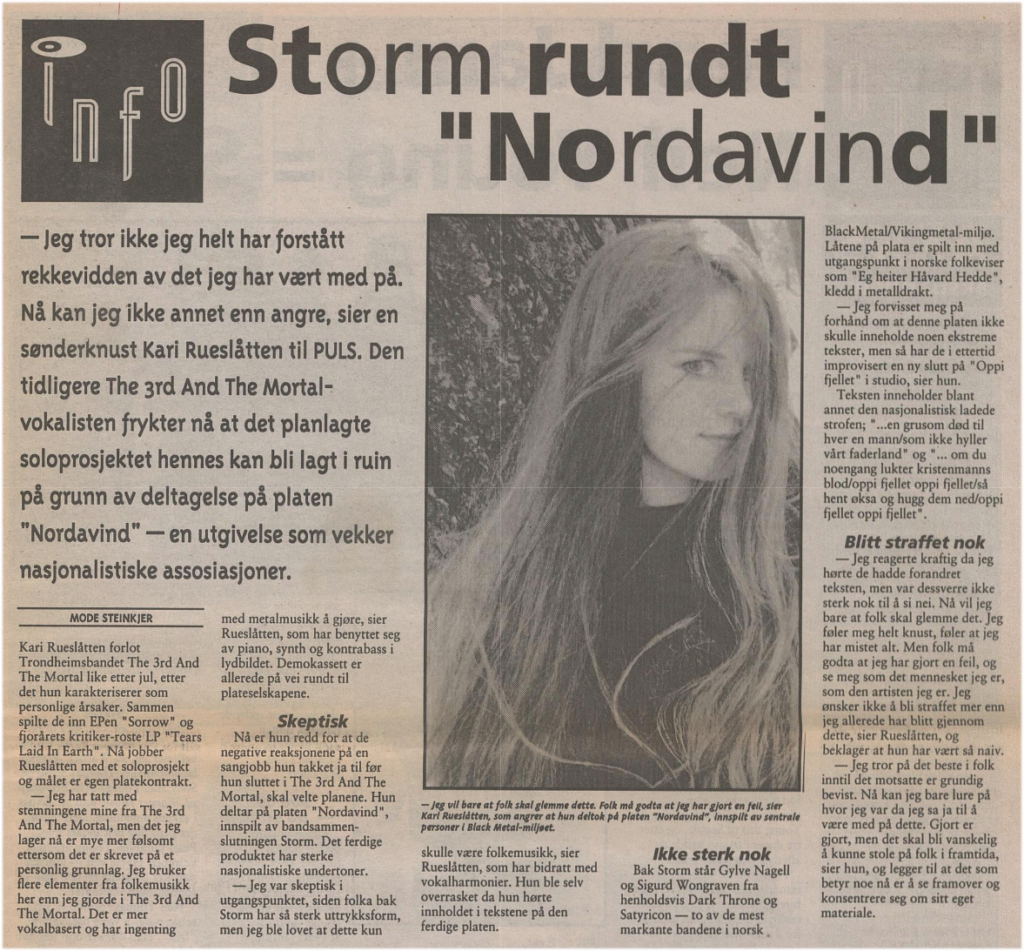
She tells the music magazine:
I made sure in advance that this album would not contain any extreme lyrics, but then they improvised a new ending to “Oppi fjellet” in the studio afterwards[.] […] I reacted strongly when I heard they had changed the lyrics, but unfortunately I was not strong enough to say no. Now I just want people to forget about it. I feel completely devastated, feel like I have lost everything. But people have to accept that I have made a mistake, and see me as the person I am, as the artist I am.
Puls (1995), no. 7, p. 9. My translation.
The magazine, with journalist Mode Steinkjer behind the pen, further writes about “Oppi fjellet” that:
The text contains, among other things, the nationalistically charged stanza; “…en grusom død til hver en mann / som ikke hyller vårt faderland” (…a cruel death to every man/who does not pay homage to our fatherland) and “… om du noengang lukter kristenmanns blod / oppi fjellet oppi fjellet / så hent øksa og hugg dem ned / oppi fjellet oppi fjellet” (… if you ever smell the blood of a Christian / up the mountain on the mountain / then take the axe and chop them down / up the mountain on the mountain).
Puls (1995), no. 7, p. 9. My translation.
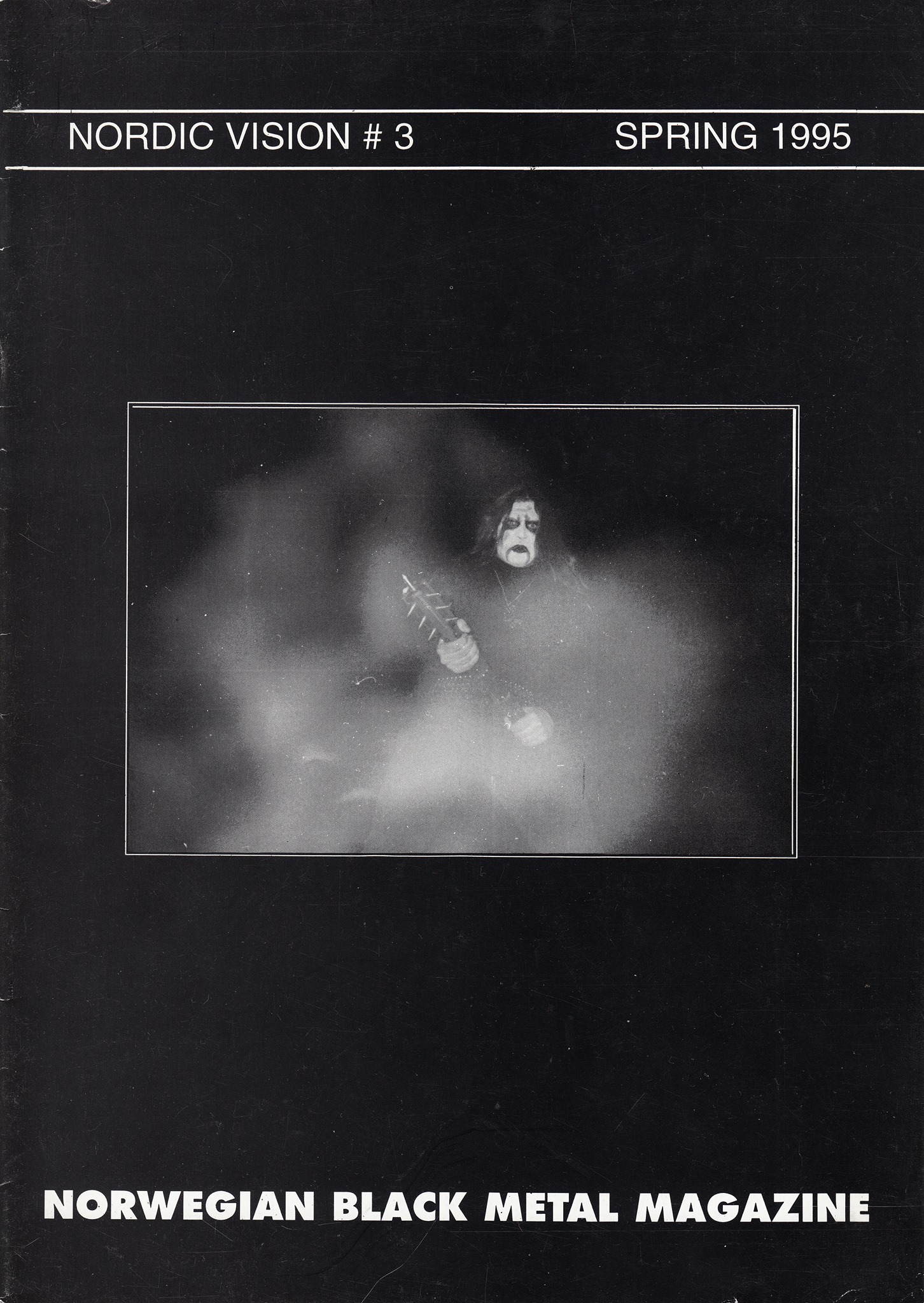
I mars samme år kom Sigurd Wongraven med et tilsvar til Puls og Mode Steinkjer i den norske svartmetall-fanzina Nordic Vision. På spørsmål om hvordan reaksjonene på utgivelsen Nordavind har vært i Norge sier Wongraven:
– The reactions have been very good, and we have got a lot of press coverage. The lefties do of course hate us since we hail our nation. Storm is intelligent, grim music for intelligent Norwegian citizens and everybody else who has some interest in Norway and this type of music. If we were a bit more simplistic and pathetic I guess the rock scene in Trondheim would love us, hah!
Nordic Vision, 1995(3). See: https://members.tripod.com/black_metal/satyricon/storm.html.
When asked how the release has been received by the Norwegian press, he says:
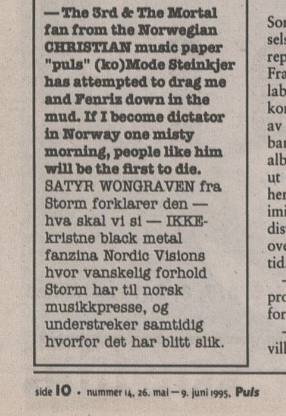
–It’s a bit early to say anything. The 3rd and the mortal fan from the Norwegian christian music paper “Puls” (ko)Mode Steinkjer has attempted to drag me and Fenriz down in the mud. If I become dictator in Norway one misty morning, people like him will be the first to die.
Nordic Vision, 1995(3).
This death threat is referred to in a notice in Puls no. 14, week of May 26 to June 9, 1995, on page 10.
But before this notice appears in Puls, the matter is followed up further by Mode Steinkjer in the issue after Kari Rueslåtten came forward as repentant, i.e. in Puls no. 8, 3rd to 10th March 1995. And this time Wongraven launches a weak counterattack. Storm (with Wongraven as spokesperson) repents too!
Wongraven regrets
Wongraven is incomprehensible that Kari Rueslåtten could sing on an album and spend three months on a collaboration without knowing what the lyrics are about.
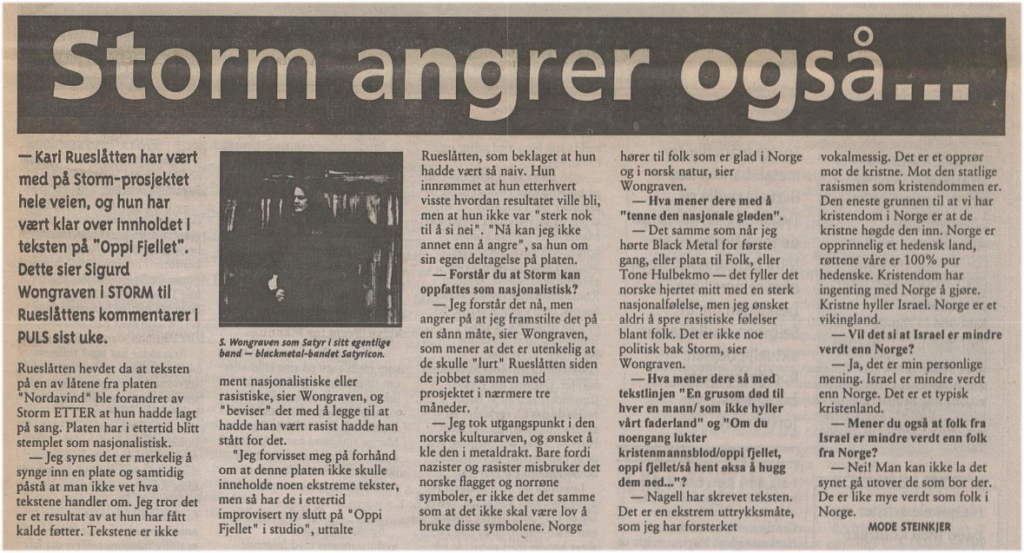
When asked if he understands that Storm can be perceived as nationalistic, Wongraven replies:
– I understand it now, but I regret that I portrayed it in such a way[.] […] – I took the Norwegian cultural heritage as my starting point, and wanted to dress it in a metal suit. Just because Nazis and racists misuse the Norwegian flag and Norse symbols, that doesn’t mean it shouldn’t be allowed to use these symbols. Norway belongs to people who love Norway and Norwegian nature, says Wongraven.
Puls (1995), no. 8, p. 7. My translation.
It should be said that Wongraven’s defense of his own portrayal on Nordavind following this key sentence, as well as the response to Mode Steinkjer in the fanzine Nordic Visions probably following this interview, indicate that he does not regret how he portrayed his own national sentiment on the Storm release.
In a brief moment in the interview, when he is asked what Storm means by the lyrics “En grusom død til hver mann / som ikke hyller vårt faderland” (A cruel death to every man / who does not pay homage to our fatherland) and “Om du noengang lukter kristenmanns blod / oppi fjellet oppi fjellet / så hent øksa og hugg dem ned” (If you ever smell Christian blood / up in the mountains / then pick up the axe and chop them down), Wongraven first responds apologetically by saying that it was Nagell who wrote the lyrics, but then pulls himself together from unequivocally shifting the blame onto his partner by saying:
It is an extreme way of expression, which I have amplified vocally. It is a showdown against the Christians. Against the state racism that Christianity is. The only reason we have Christianity in Norway is that Christianity raised it. Norway is originally a pagan country, our roots are 100% pure pagan. Christianity has nothing to do with Norway. Christians pay homage to Israel. Norway is a Viking country.
Puls (1995), no. 8, p. 7. My translation.
Here, Mode Steinkjer is such an experienced journalist that he does not let the invitation to reflect on the Israel issue go unused. He asks if that means that Israel is less valuable than Norway, and Wongraven replies:
– Yes, that’s my personal opinion. Israel is worth less than Norway. It’s a typical Christian country.
Puls (1995), no. 8, p. 7. My translation.
But to the follow-up question from Steinkjer about whether Wongraven believes that people from Israel are worth less than people from Norway, Wongraven wisely answers:
– No! You can’t let it affect the people who live there. They are worth just as much as people in Norway.
Puls (1995), no. 8, p. 7. My translation.
Fenriz enters the scene
The following week, in Puls no. 9, Gylve Fenris Nagell enters the scene. And he does so with a double page spread. That is, one and a half times as large a spread as Wongraven received. Nagell is fed up with being labeled a racist and wants to speak out in what is his first public interview in three years. Again, it is Mode Steinkjer who writes the whole thing.
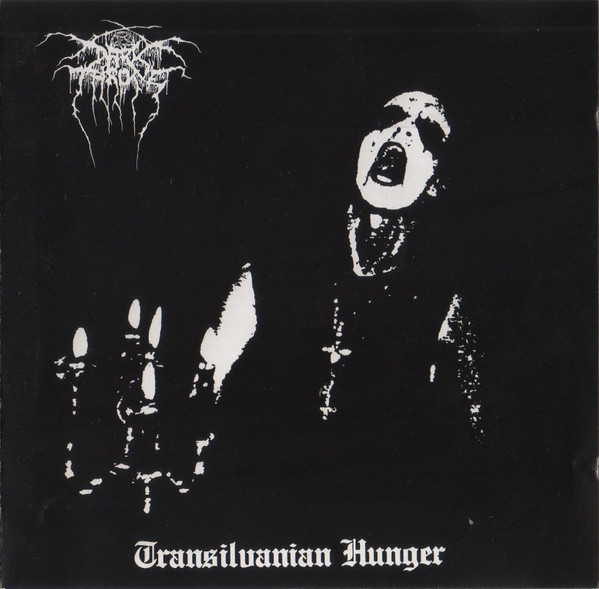
Here it may be worth recalling two things that probably explain Nagell’s absence from the public eye during these three years. Firstly, there were many in the black metal community who were low-key both during and after the legal proceedings from 1993 onwards. These ended, among other things, with former Mayhem bassist and sole member of the one-man band Burzum, Varg “Greven” Vikernes being sentenced to 21 years in prison for the murder of Mayhem colleague Øystein “Euronymous” Aarseth, attempted arson at Storetveit Church in Bergen and for several other minor offenses. Secondly, there had been a great uproar with the subsequent racist and Nazi label on Darkthrone after controversial statements on and in the wake of the release Transilvanian Hunger in 1994. So let’s take a look at this last issue before we move on.
On the first edition of Transilvanian Hunger, on the back of the cover, in large text in Gothic letters at the very top, it says “True Norwegian Black Metal”. Below the list of songs in two columns (A and B sides), it says “Norsk Arisk Black Metal” (Norwegian Aryan Black Metal) in equally large Gothic letters. Directly below in smaller text it says “Darkthrone / Is For All / The Evil / In Man”.
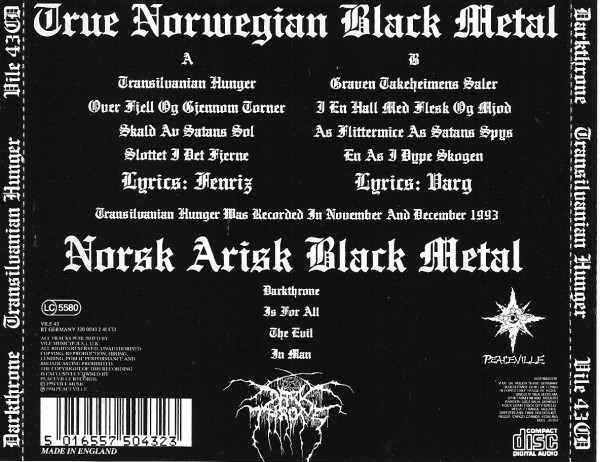
After negative reception and pressure from distributors, “Norsk Arisk Black Metal” (Norwegian Aryan Black Metal) was removed from later releases of Transilvanian Hunger. However, Nagell also wanted to include another controversial statement on the cover:
We would like to state that Transilvanian Hunger stands beyond any criticism. If any man should attempt to criticize this LP, he should be thoroughly patronized for his obviously jewish behaviour.
The press release is reprinted in Moynihan & Søderlind (1998/2003), p. 350.
This caused a stir for Peaceville Records and its manager Paul “Hammy” Halmshaw. In a press release – which also included Nagell’s demands – Peaceville made it clear that they did not want to censor the release, but at the same time refused to promote it.
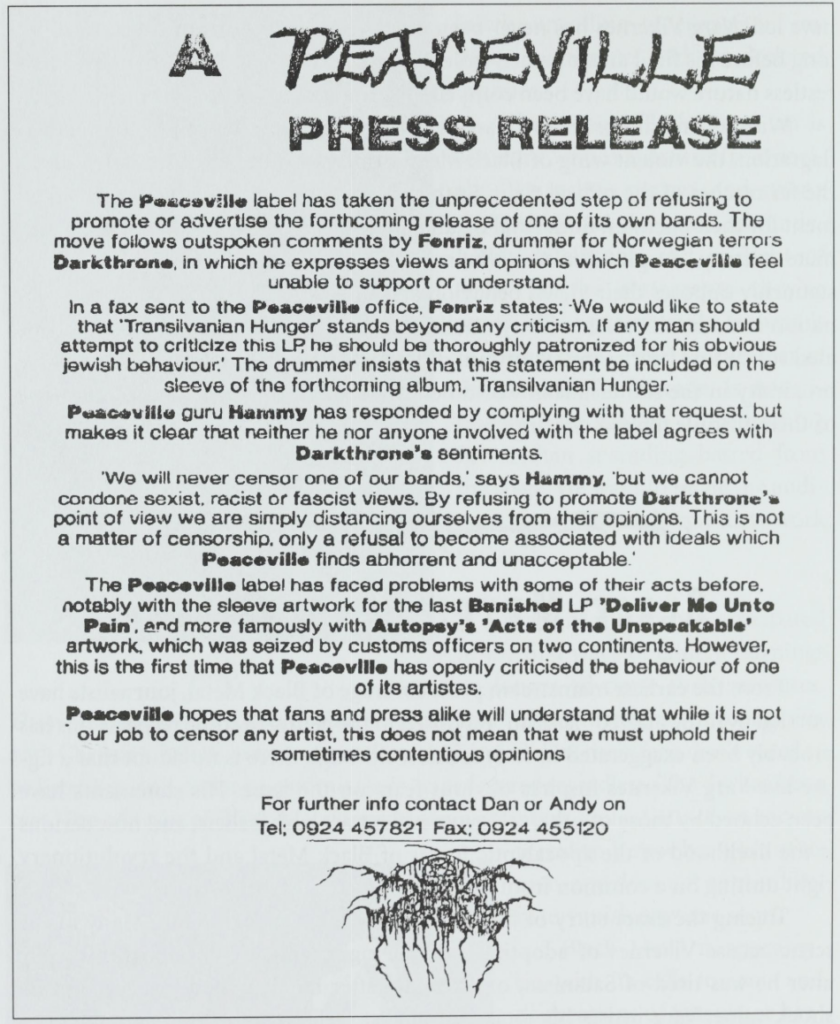
Darkthrone then issued an official apology, claiming that the use of the word “jew” was intended as slang for “idiotic.” In some circles at the time, and possibly even today, the very use of the term “jew” is intended as a derogatory term, something that is foolish, and doesn’t necessarily carry any of the old connotations that led to the Holocaust. But it’s obviously not right to use such a heavily loaded word in a derogatory way in an official statement.
In addition, the press release states that the person who used the word “jew”, i.e. Nagell, does not read newspapers or watch television news and therefore “had no idea of the [racism] situation in the rest of Europe” and therefore “couldn’t have had any idea that the word ‘Jew’ would offend anyone”. Well, that’s a thin excuse.
Sources refer to different events in this story. Moynihan & Søderlind (1998/2003, pp. 350–351) print facsimiles of both the Peaceville press release and the subsequent one from Darkthrone, but claim that “no one seemed to take much notice of […] that the album in question still featured the words ‘NORWEGIAN ARYAN BLACK METAL’ prominently printed across the sleeve”. This means that they do not interpret the inscription as the start of the controversy, but rather – as the Peaceville press release might suggest – use the statement that “obviously Jewish behaviour” was the start of the controversy. I have used Peaceville’s own explanation of the incident, and they are clear that it was “Aryan” and not “Jewish” that started the incident.9
It is still a bit unclear to me whether the determinative “this statement” in the sentence “The drummer insists that this statement be included on the sleeve of the forthcoming album, ‘Transilvanian Hunger’” refers to the sentence about “obviously jewish behaviour” or to the sentence about “Aryan Black Metal” (which is not mentioned) in Peaceville’s press release. It also states that Peaceville boss Hammond is “complying with that request”. Whether this means that he allowed the sentence with “jew” to be printed in addition to the sentence about “Aryan” or whether it just meant that the sentence with “Aryan” should be included is unclear. This may be one of the root causes of the different accounts of the events. In any case, it is not correct, as Wikipedia (the English version) claims, that Darkthrone apologized for the use of “Aryan” on the release in the press release. They only apologized for the use of the word “jew” in the press release that Peaceville referred to.10
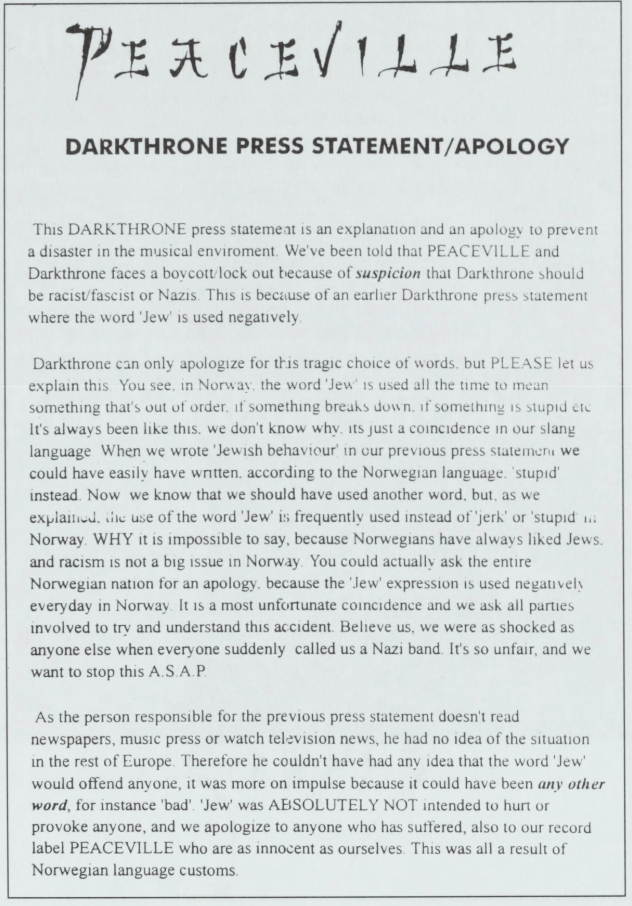
Peaceville also did not find Darkthrone’s apology very convincing. The band then decided they would only work with Norwegian artists and switched to the Norwegian record label Moonfog, co-owned by Sigurd Wongraven.
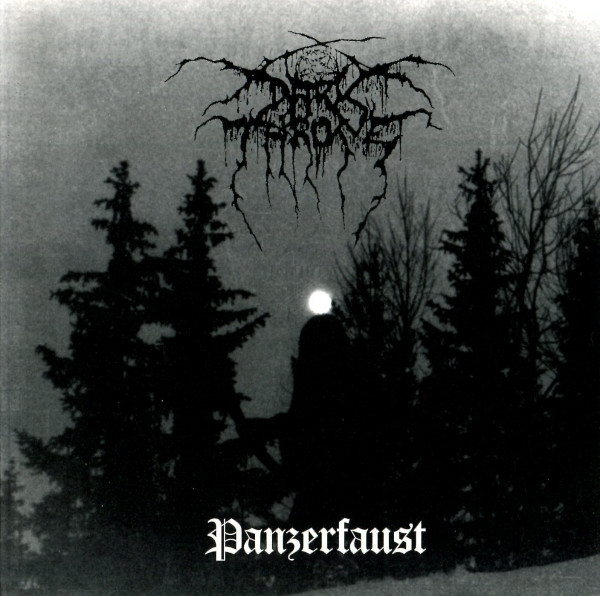
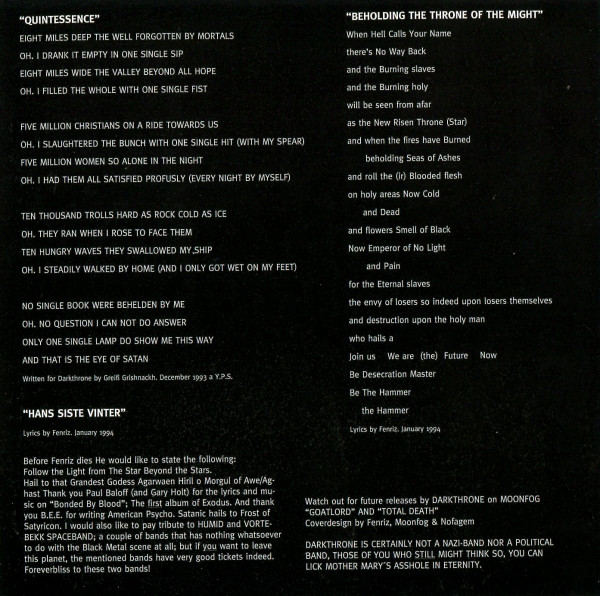
On their first release on Moonfog, Panzerfaust, Darkthrone therefore wrote on the back of the album cover:
DARKTHRONE IS CERTAINLY NOT A NAZI-BAND NOR A POLITICAL BAND, THOSE OF YOU WHO STILL MIGHT THINK SO, YOU CAN LICK MOTHER MARY’S ASSHOLE IN ETERNITY.
Darkthrone, Panzerfaust (1995).
Gylve Fenris Nagell has since also been clear that the statements in the controversy with Peaceville do not represent his opinion and has described them as disgusting.11
Anyway, in March 1995 Nagell is ready to deny the rumors about himself as a racist in the music newspaper Puls. The article promises “Fenriz i fri flyt” (Fenriz in free flow), and that is exactly what we get. It is important to remember that humor has and is incredibly important in Nagell’s life and work, and in this article it is what comes out most clearly. As we have seen, this humor and loose use of words and expressions can be directly damaging to the reputation of Nagell and Darkthrone, but in this article it all turns out more positively for Nagell.
He swings around with statements that he reads the comic magazine Bamse, which he claims the then-deceased vocalist Per Yngve “Pelle/Dead” Ohlin in Mayhem also read with great pleasure. He refers to Saint Olaf as “Olav den Grelle” (Olav the Gaudy), and believes that Varg Vikernes’ murder of Øystein “Euronymous” Aarseth “kom som ekorn(!) fra klar himmel” (came like a squirrel(!) out of the blue).
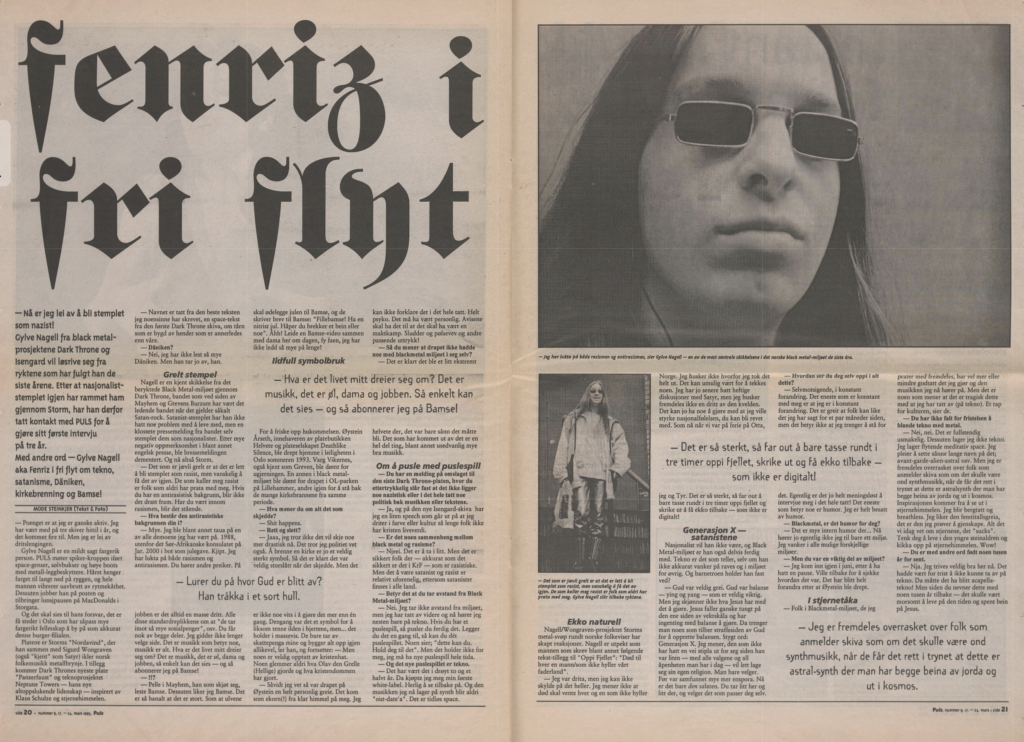
During the interview, Mode Steinkjer touches on the topic of the already quoted statement on the Panzerfaust release that Darkthrone is not a Nazi band. Nagell then says the following:
– Yes, and on the new Isengard album I have a little speech that goes like I don’t give a damn about color or culture as long as people don’t have Christian values.
Puls, no. 9, 1995, p. 20. My translation.
The surprising thing here is not the opposition to Christianity, of course, but rather that he is said to have given such a speech on the Isengard release Høstmørke. At this time, Høstmørke had not yet been released. It was first released on July 3, 1995. Is there actually such a message on this release? I will look at that in more detail in an article about Høstmørke that will come later.
Nagell makes no further major attempts to deny the rumors about himself as a Nazi, other than pointing out that he has participated in an anti-racist demonstration where he was fined by the police, and that those who point out that he is a racist have never spoken to him. And then he talks about what a searching personality he is:
– Contradictory, constantly changing. The only thing that is constant about me is that I am constantly changing. It’s okay if people like what I said a couple of months ago, but that doesn’t mean I have to stand by it. Actually, it’s completely pointless to interview me at all! The only thing that matters is humor. I am completely obsessed with humor.
Puls, no. 9, 1995, p. 21. My translation.
Let’s get back to Storm and the controversy with the added lyrics on Nordavind. In particular, it is the text that was added at the end of “Oppi fjellet” that has been hard to swallow for Kari Rueslåtten and for the common people. Mode Steinkjer cites – in line with Wongraven – Nagell as the originator of the phrase “Død til hver en mann / som ikke hyller vårt faderland” (Death to every man / who does not pay homage to our fatherland). Nagell comments:
– I was drunk, but I can’t blame myself for that either. I don’t think death should await everyone who doesn’t pay tribute to Norway. I don’t remember why I took it all out. It couldn’t possibly have been to please anyone. I later had heated discussions with Satyr, but I still don’t remember a damn thing about that evening. It might have something to do with me wanting to strengthen national sentiment, you can get carried away. Like now, when we were on holiday in Otta, Tyr [Satyr, sic.]. It’s so strong, so far out to just walk around for three hours in the mountains and scream out to get an echo back – which isn’t digital!
Puls, no. 9, 1995, p. 21. My translation.
This is an interesting statement. First, it points to the trip to Otta and Pillarguritoppen that resulted in photographs of Nagell that were used both on the booklet of Storms Nordavind, but also as the cover of Isengards Høstmørke. More on this later. Second, and of greater importance, is how Nagell roots the national feeling in close contact with nature and the mountains, and how such a transcendent and intoxicating experience can help to provide such a strong expression of a love of nature and a subsequent national feeling. We know that even at this time Nagell was concerned with being in nature.
Nagell says later in the interview, which reinforces the understanding of black metal as a retrospective and national-romantic movement, that through his new meditative space synth project he is attempting to recreate the soundscape of the fifties and the overwhelming feeling of grandeur that people in the Neolithic era got by looking up at the starry sky without modern scientific concepts to understand what they were actually seeing.
When asked by Mode Steinkjer if he was born a few thousand years too late, Nagell replies:
Well. I feel very comfortable here now. […] But since you mention this thing about a few thousand years ago – it would have been fun to live in that time and trip up Jesus.
Puls, no. 9, 1995, p. 21. My translation.
After this little kick in the pants against Christianity, we have laid the foundation for what is to come, namely an analysis of Nordavind with a focus on lyrics and melody. In particular, we will delve into the question that was the starting point for me to start dealing with the Storm release in the first place: Nordavind is based on Norwegian folk tunes. Which are these, and in what way do they differ lyrically and musically in Storm’s versions?
On Nordavind
Let’s – before we get into the lyrics – look at how Storms Nordavind came about.
The release was recorded at Waterfall Studios in November 1994. The running time is 33 minutes and 20 seconds. It was produced by Sigurd “Satyr” Wongraven, and the engineer is Kenneth Moen.12 The album was released in February 1995 on CD and LP, on Moonfog Productions.13 I am referring to the CD release when I describe the cover and booklet.
Sigurd “Satyr” Wongraven is stated to play all guitars, bass, synth and vocals. “Herr Nagel”, as Gylve Fenris Nagell calls himself on this release, is stated to play all percussion, and also vocals. Kari Rueslåtten is stated to have vocal contributions, but like Wongraven and Nagell has contributed to the lyrics, or as it says: “Addisjonell lyrikk av Nagell/Wongraven/Rueslåtten” (Additional lyrics by Nagell/Wongraven/Rueslåtten):
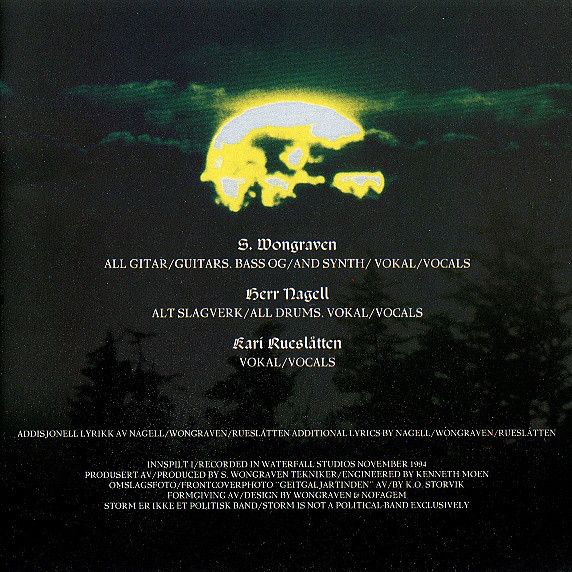
“Wongraven & Nofagem” are listed as the designers of the cover of Nordavind. Nofagem is a fitting renaming of the design firm Megafon for this type of dark assignment. And Nofagem is one of many aliases for designer Halvor Bodin who has done countless cover designs for many Norwegian releases. Under the alias Nofagem he has also done Wongraven’s Fjelltronen, Isengard’s Høstmørke, Darkthrone’s Panzerfaust, and Satyricon’s The Shadowthrone, all published by Moonfog Productions in 1995.
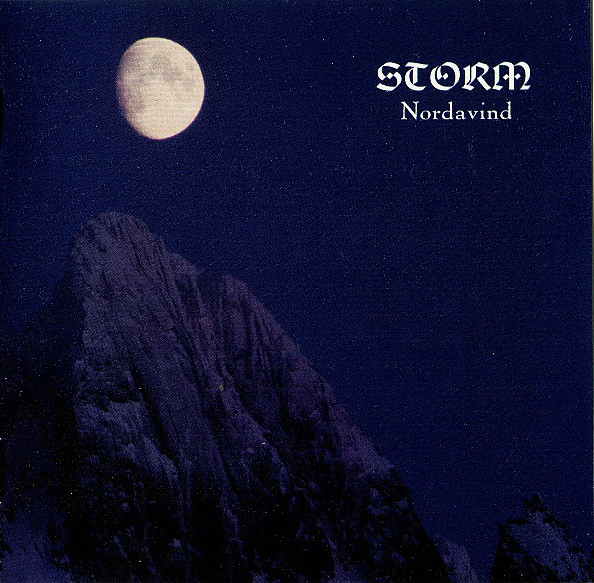
The front cover of Nordavind shows the highest peaks of a snow-covered alpine mountain at night with a large, almost full moon behind. The blue tones are turned up a lot and the cover appears to be mainly dark blue and purple with a distinct white-yellow moon. The mountain in the photograph is Geitgaljartinden, which is also stated in the credits on the Nordavind booklet. The mountain is located in the Trolltind massif at the very end of the Austnesfjord on Austvågøy, and rises 1084 meters above sea level. The Trolltind massif contains many of the highest mountains in Lofoten. The neighboring mountain to Geitgaljartinden is Higravstind (1146 m), which is Lofoten’s highest peak. Geitgaljartinden is considered the best mountain for hiking in Lofoten.
The photographer of Geitgaljartinden is also credited in the booklet of Nordavind, and is photographer Kjell Ove Storvik. He grew up and still lives in Lofoten. In his career, he has been on many expeditions as a photographer, including with Børge Ousland in Antarctica.
I contact Storvik, and we have a very pleasant email exchange. When I ask him if he knew that his picture was used on a Norwegian black metal release, he answers the following:
I’ve never heard of this band, have no idea who they are or where they belong. I also don’t remember selling a picture to them. Now it should be said that in the years 1993–1997 I spent a lot of time in Antarctica and South America, Canada, Siberia and other places far from home. So it may have been that others in the family have arranged this.
The picture, and several similar ones, have been used in brochures, as far as I remember for, among other things, Nyvågar Rorbuhotell sometime around 1990. The brochure was printed in Tromsø. I believe the person who ordered the picture was Sverri Dahl, (his father was from the Faroe Islands) who previously lived in Svolvær and played in a band here. There may be a connection there, but … 🙂
Email from Kjell Ove Storvik, December 25, 2021. My translation.
Cover designer Halvor Bodin assures me that the photograph was paid for. He writes:
I don’t remember the details, but Moonfog definitely paid straight for the use and it was a proper high-resolution scan. Whether it came from a photo agency I don’t remember. We also wrote full credits and an explanation of where it was on the cover[.]
Email from Halvor Bodin, December 28, 2021. My translation.
Til høyre på forsiden av omslaget står det «STORM» i versaler, i en gotisk utseende skrifttype som designer Bodin informerer meg om på mitt spørsmål:
The font in STORM is called San Marco Roman (a slightly calligraphic Blackletter font from Linotype), not custom. Designed by the now deceased calligrapher and typographer Karlgeorg Hoefer.
Email from Halvor Bodin, December 28, 2021. My translation.
Under the Storm logo, it says “Nordavind” in a more modern and simple serif font. Halvor Bodin informs me which font it is in a later email:
The name of the second font is Pabst, designed by Frederic Goudy in 1902.14
Email from Halvor Bodin, February 4, 2022. My translation.
On the penultimate page of the booklet, after the list of credits that I just reviewed, it says:
Storm er ikke et politisk band/Storm is not a political band exclusively.
Storm, Nordavind (1995).
A statement that definitely attempts to take the sting out of what is to come.
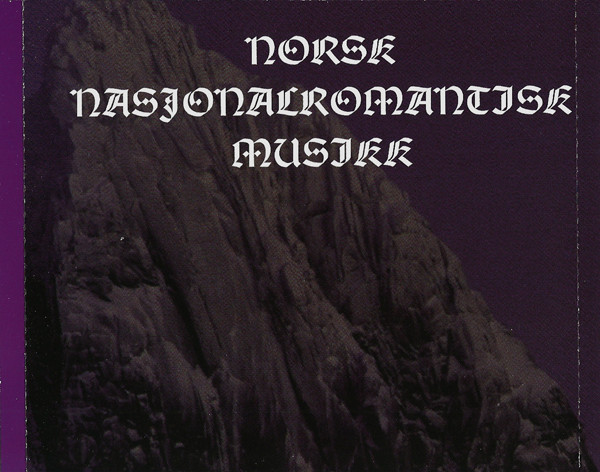
On the inside of the cover – under the CD – there is a section of the mountain Geitgaljartinden taken from the front of the cover, which shows a smaller part of the mountain and some sky. Above the picture it says: “Norsk nasjonalromantisk musikk” (Norwegian national romantic music) in the same San Marco Roman font as the Storm logo is written in. When in addition a Norwegian flag in the form of a sun cross is printed on the CD itself (and on the LP label), then it is obviously set for trouble. And Wongraven and Nagell must have known that. Halvor Bodin says the following about this:
I remember the label that I perhaps regretted a little. But there are some nuances there.
Email from Halvor Bodin, December 28, 2021. My translation.
In a later email, he clarifies what he means by nuances:
What I mean is that using a historical and very interesting symbol that eventually became reasonably charged was a difficult and ambivalent decision.
Email from Halvor Bodin, February 4, 2022. My translation.
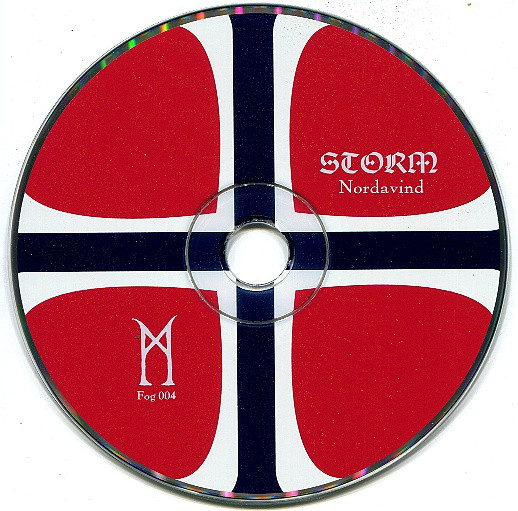
The sun cross, or wheel cross, is an equal-armed cross inscribed in a circle, where the ends of the cross arms touch the circle. Wikipedia can tell you that the sun cross is one of the oldest and most widespread graphic figures in existence, and is known as a magic-religious symbol and decorative element in all major cultures and all over the world. We know the symbol in Norway from rock carvings, church walls, seals and heraldic emblems from ancient times, all the way back to the Bronze Age, around 1500–500 BCE.

But we also know it from World War II when Vidkun Quisling15 chose the symbol as the emblem for his nationalist fascist party Nasjonal Samling. Since then, the symbol has often been associated with Nazism and right-wing extremism.
It is therefore not very difficult to imagine that Storm wants to point out that the use of the sun cross, the national romantic claim, as well as some of the texts in Nordavind are not of a right-wing extremist character, but refer to something original Norwegian. It is interesting to remember that before the war there was disagreement in Nasjonal Samling about the use of the sun cross as an emblem. “For the pagan left wing, led by Hans S. Jacobsen, the symbol was too Christian, and he wrote in the magazine Ragnarok no. 3 in 1937 that it was un-Ordinary,” writes the Norwegian Wikipedia.16
It has not been further proven, Wikipedia further writes (in my translation), and contrary to Jacobsen’s claim, that it “has been claimed that in ancient times in the Nordic countries a circle with a cross was perceived as a form of “Odin’s Cross”. The figure is thus linked to both the sun and Odin as a sky god.”
Wikipedia also writes:
With the introduction of Christianity from around 1000 AD, the circle with a cross took on a new symbolism. When a church was consecrated, forms of this figure were drawn, carved, or painted on the church wall. The figure could then be interpreted as a symbol that the church was the property of Christ. The figure was used as a symbol of consecration and could be interpreted as keeping demons or evil powers away.
Wikipedia, https://no.wikipedia.org/wiki/Solkorset. My translation.
Here I believe we are on the explanation of why Storm uses this hated symbol on Nordavind. It does not point to Quisling’s nationalist and fascist use, but rather back to the Norse pre-Christian era, and black metal ideology believes that the symbol was stolen from the golden Viking age by the Christian invaders. This also partly explains Mayhem’s Legion Norge shirt, which has arms adorned with the Norwegian national coat of arms and the SS’ Totenkopf symbol, while the back shows a variant of the emblem of the Rikshirden, the political soldiers of the National Samling. In Mayhem’s version, the symbol has incorporated two inverted crosses instead of swords. The shirt connects the black metal army that is to crush Christianity. As such, the use of the solar cross is both a provocation and a historical point at the same time. To present this criticism is impossible without taking back the use of the symbol with the meaning it is now attributed to. At the same time, it also necessarily becomes a provocation. It is therefore wrong and too simple to promote a criticism of Storm’s use of the solar cross as provocative, when they believe that it is precisely the later use of the symbol that is provocative, not the original one that Storm wants to bring back.
Bernhard Ellefsen discusses some of the same arguments in his criticism of Ottar Grepstad’s book Brent ord: Bokbål mot språk i Noreg 1912–2005 (Burnt word: Book bonfire against language in Norway 1912–2005) (2022) in Morgenbladet no. 3, 21–27 January 2022. Ellefsen is strongly critical of Grepstad equating the Nazi book bonfires in Germany with high school students burning Nynorsk word lists after completing their Nynorsk exams in Norway: “A book bonfire is a book bonfire is a book bonfire – that is the claim that is the basis for Grepstad’s book”.17 In our case, one can thus put the following claim in the mouths of critics of Storm’s alleged nationalism: A sun cross is a sun cross is a sun cross. According to Ellefsen, Grepstad’s condemnation of the book burnings in the Norwegian language conflict is only justified as an aesthetic condemnation, and not as a condemnation on the same grounds as the Nazi book burnings as part of a racially motivated genocide. When asked why the Norwegian high school students chose the book burning as their means of action, Ellefsen himself answers: “Because it is insulting.” In the same way, I believe that black metal’s use of inflammatory symbols can be summarized, in some cases, as with Storm, with a small addition, namely that they wanted to resort to an earlier non-Christian or non-fascist, primordial Norwegian use of the symbols, and where the use of these symbols was precisely necessary to get this point across. In this respect, black metal can sometimes be said to be a bit more elaborate in its use of symbols than the average high school student’s book burning, even though the aesthetic judgment can hit just as hard: it is often more distasteful than is actually necessary.
Now, of course, it is debatable whether black metal’s fight against Christianity is political or not. I believe that it necessarily is if one uses a broader political term. It may well be that black metal does not see itself as a political weapon, but more as a movement outside the sphere of politics. I will write more about this in the article “Den levende døde“.
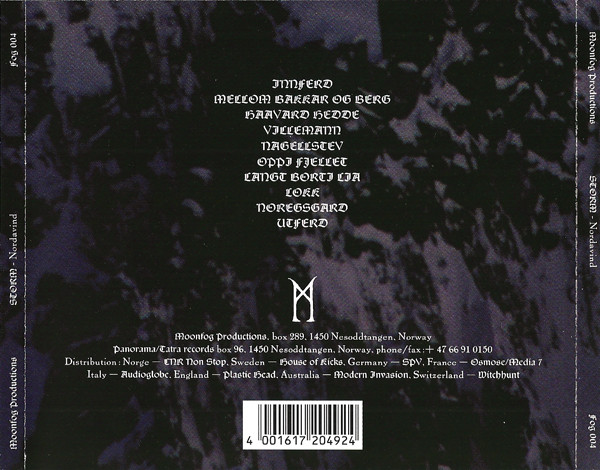
On the back of the Nordavind cover, the songs are listed in capital letters, also in the San Marco Roman font:
- Innferd
- Mellom bakkar og berg
- Haavard Hedde
- Villemann
- Nagellstev
- Oppi fjellet
- Langt borti lia
- Lokk
- Noregsgard
- Utferd
Addresses to record companies and distributors are listed in the same font. All on the background of a section of the mountain Geitgaljartinden, again taken from the front cover, and which only shows mountains and patches of snow.
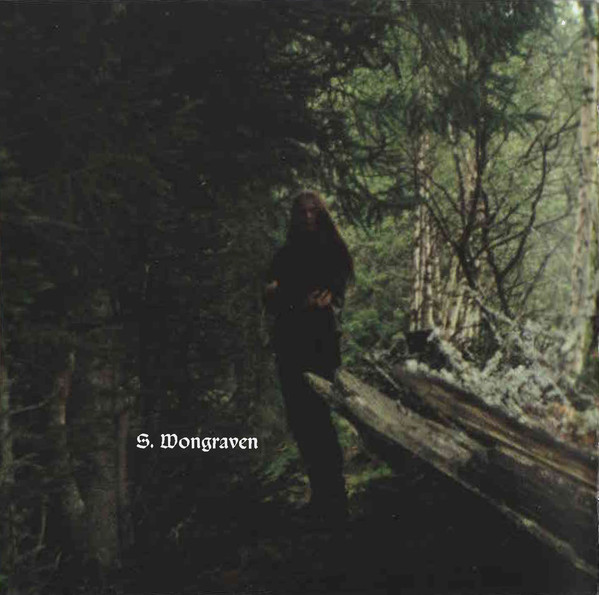
The booklet for Nordavind, which has a total of eight pages, of course consists of the cover I have already mentioned. Page 2 shows a picture of Sigurd “Satyr” Wongraven standing in a forest with his arms crossed. I will say a lot more about page 3 in a moment.
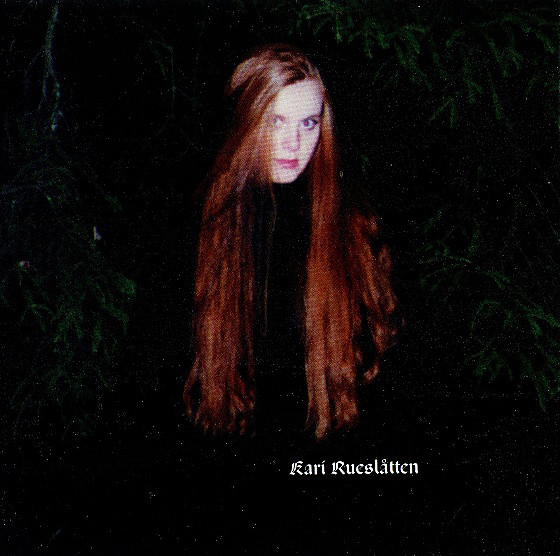
Page 4 shows a picture of Kari Rueslåtten, also in the forest with fir branches surrounding her reddish-brown hair and an illuminated face in the darkness surrounding her.
Pillarguritoppen and Folque
Page 3 shows Gylve Fenris Nagell with his arms crossed in front of the doors of an old farm building at Pillarguritoppen, a hill near the village of Otta, north of Gudbrandsdalen. The photo was taken in September 1994 by Wongraven. We know this because a photo in the same series of photographs is used on the cover of Isengard’s Høstmørke, and the back cover of that publication reads as follows:
Front cover photo taken by Satyr during Fenriz’ and Satyr’s glorious mountain trip in September 1994. Desolate norwegian [sic.] landscapes rules.
Isengard, Høstmørke (1995).
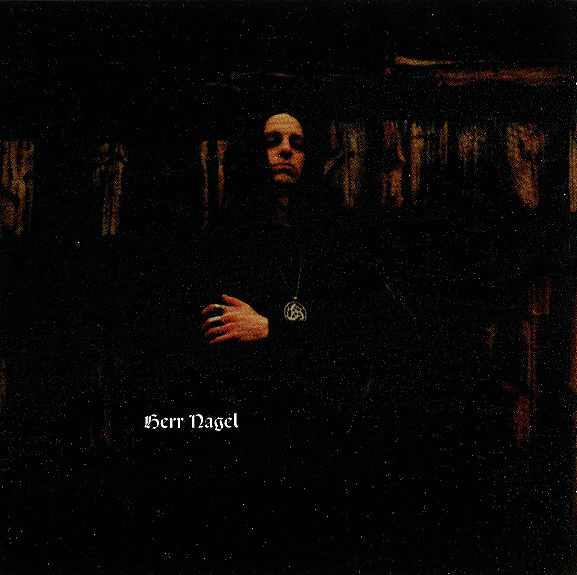
That the place they traveled to was Pillarguritoppen near Otta is revealed in the commentary track for “Neslepaks” in the extended version of Høstmørke:
The album cover was … photo taken by Satyr on a trip he set up for us in September of ‘94 to go to Pillarguritoppen, also known from the seminal folk album from the Norwegian band Folque from the seventies. And that is really my hard line when it comes to folk rock. It’s absolutely fantastic. Folk rock from the sixties and seventies. Great. Folk rock. Great. Folk metal should in most cases be deleted. I think it’s a horrible form of music actually. And I might have contributed to that. I might also have contributed to […] make decent folk metal songs that aren’t spastic and merry and all that junk that came later on in the nineties.
Isengard, Høstmørke (1995), commentary track to “Neslepaks”.
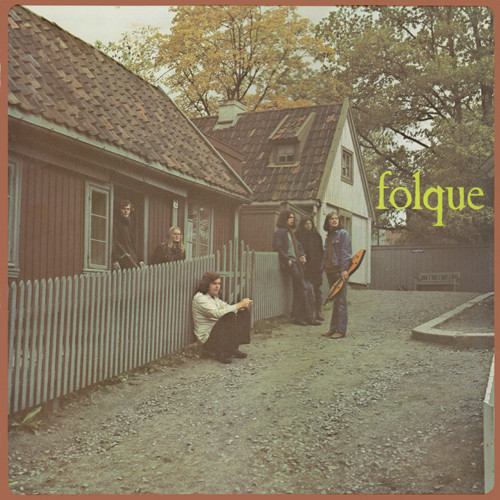
The connection to the Norwegian folk rock group Folque is quite complex, but as we will see, I attach great importance to it. On their self-titled debut album Folque from 1974, there is a song called “Sinclairvise”.
The text refers to a true story about Captain George Sinclair18 and his company of Scottish soldiers who were hired by the Swedish king to fight against Denmark-Norway in the Kalmar War of 1611–1613. The Scottish train, as the group was called, was ambushed by Norwegian farmers in Kringen just south of Otta in Gudbrandsdalen on 26 August 1612, while they were on their way through Romsdalen and Gudbrandsdalen towards Sweden after landing at Åndalsnes. Most of the Scots who were captured were executed at Skottelåven in Kvam, and only 18 of the 300–400 Scottish soldiers survived and were sent to Copenhagen.
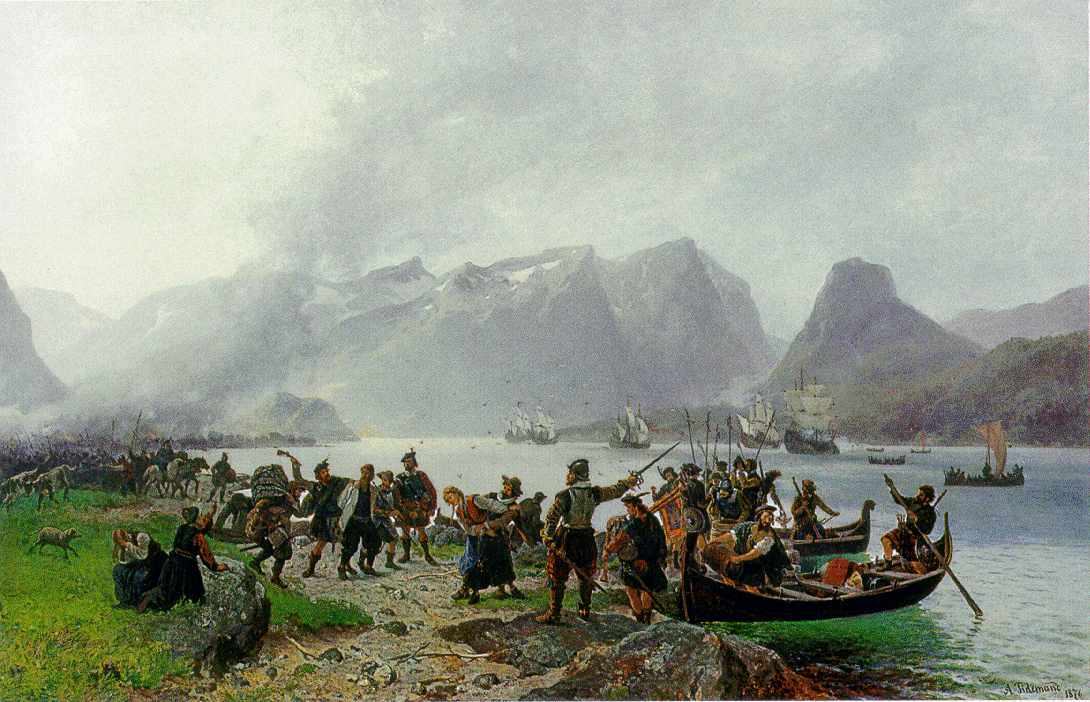
According to the story, there was a woman whose task was to give the signal when the Norwegian peasant army could start the attack on the Scottish army. She reportedly did this by standing on a hill and blowing a horn. According to the legend, her name was Pillarguri or Prillar-Guri. The hill of 852 meters above sea level, which is located directly above the farm Selsjord on the west side of Gudbrandsdalslågen, opposite Kringen on the east side, was called Selsjordkampen until the 19th century. Today, the hill is called Pillarguritoppen.
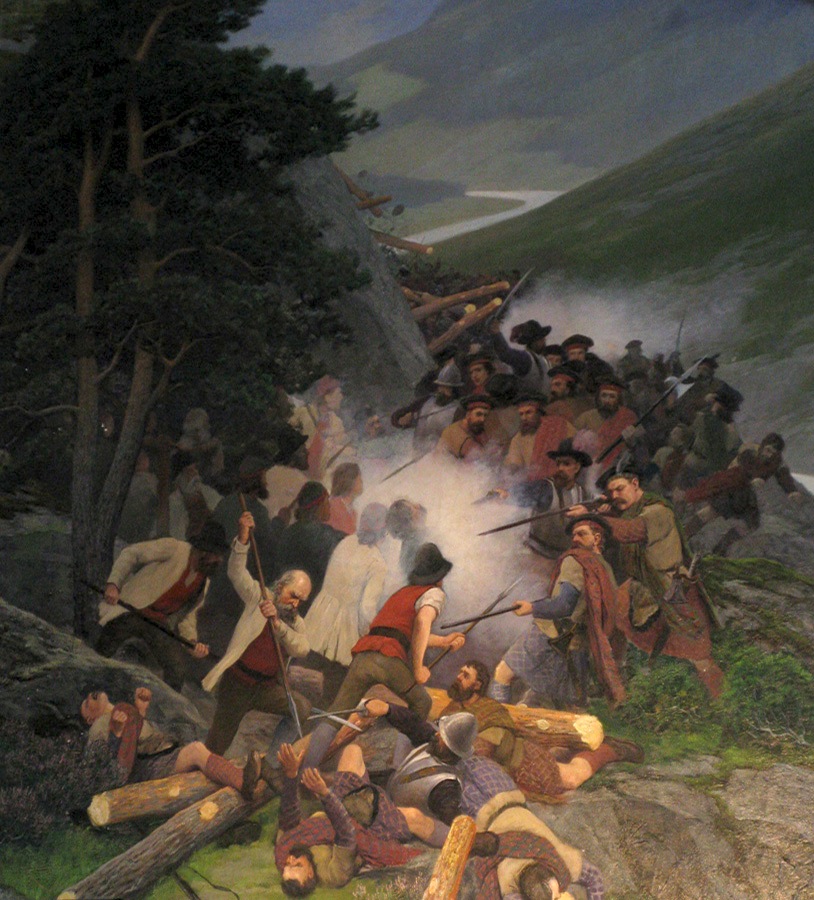
At the end of Folque’s version of «Sinclairvise» the following is stated:
Ei noen levende sjel kom hjem,
Som kunne sin landsmann fortelle
Hvor farlig det er at besøke dem
Der bor i blandt Norriges fjelde.19
Not a single living soul came home,
Who could tell his countryman
How dangerous it is to visit them
There live among the mountains of Norway.20
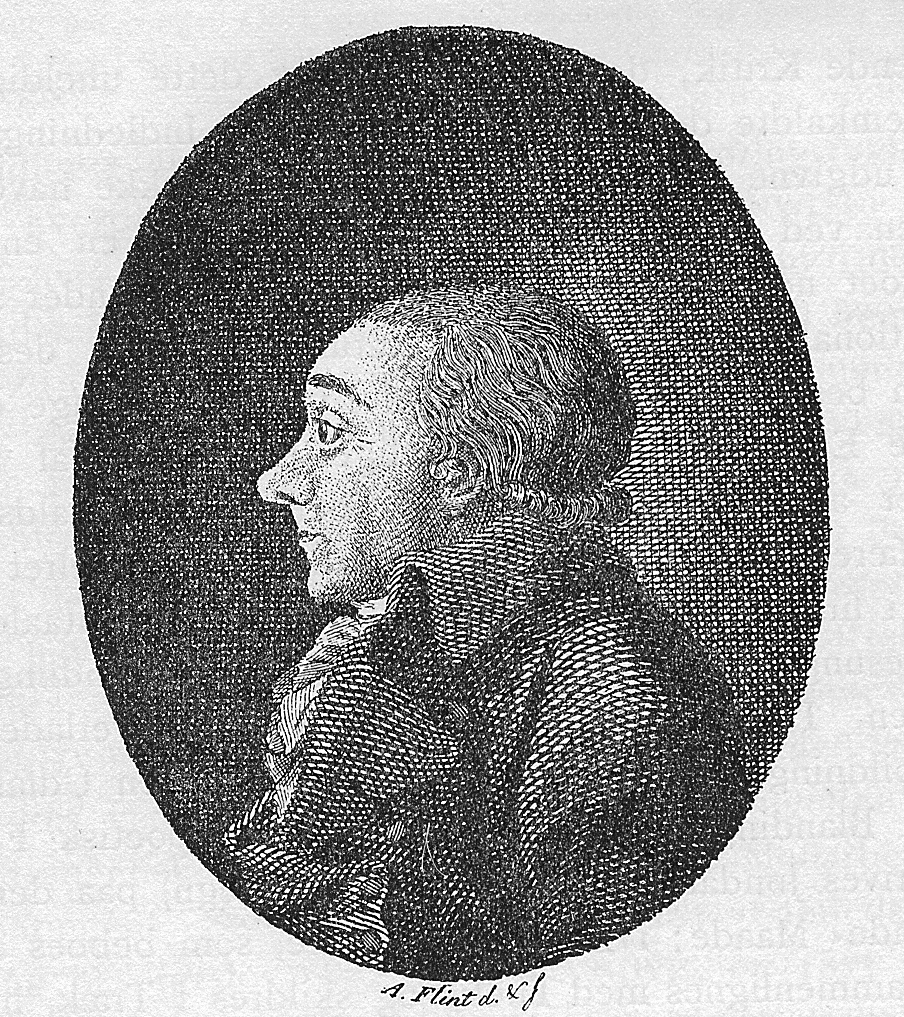
The poet who originally wrote the visa is Edvard Storm (1749–1794). Edvard STORM. STORM! This may have been the deciding factor in the name Wongraven and Nagell chose for their band after a previous study trip to Pillarguritoppen near Otta.
This battle at Kringen, where invaders were defeated by Norwegian peasants in national romantic surroundings, enhanced by dramatic paintings by Adolph Tidemand and Morten Müller (1876), and Georg Nielsen Strømdal (1856–1914), as well as the artist’s insistence on how dangerous the Norwegian mountain dweller is, must have appealed to barricade-storming black metallers like Wongraven and Nagell in the fight against the Christian invaders who thwarted the Norwegian (Norse) folk soul.
But not only these. The Battle of Kringen also inspired Theodor Kittelsen. In 1900 he made the drawing “Op under Fjeldet toner en Lur” which depicts Pillarguri blowing the musical instrument lur.
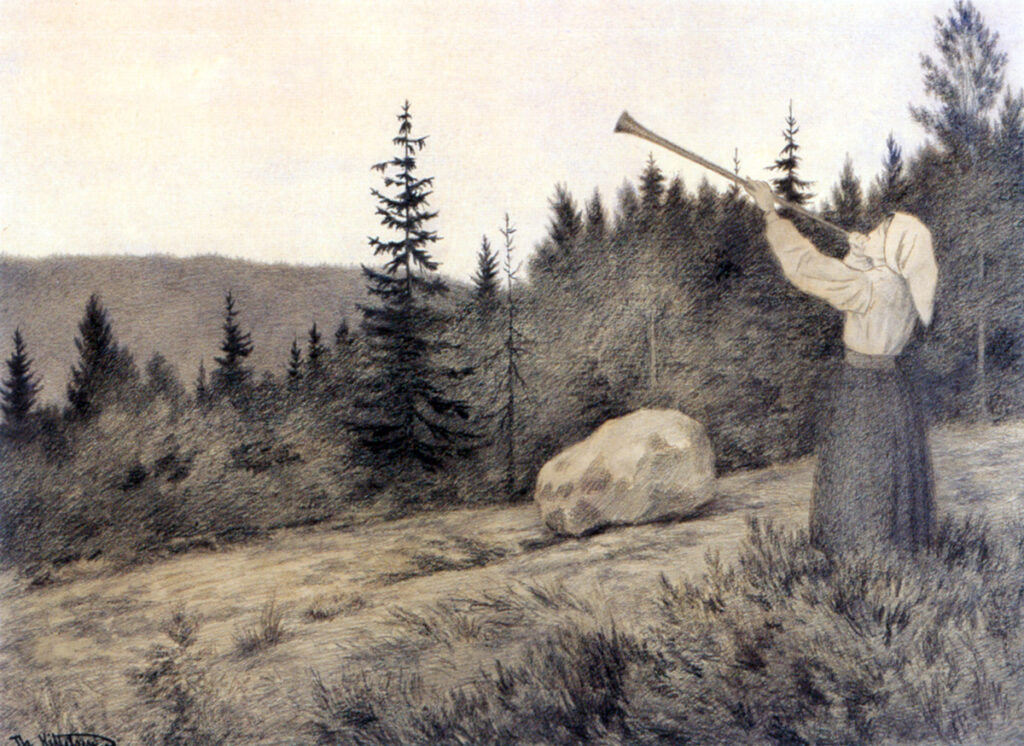
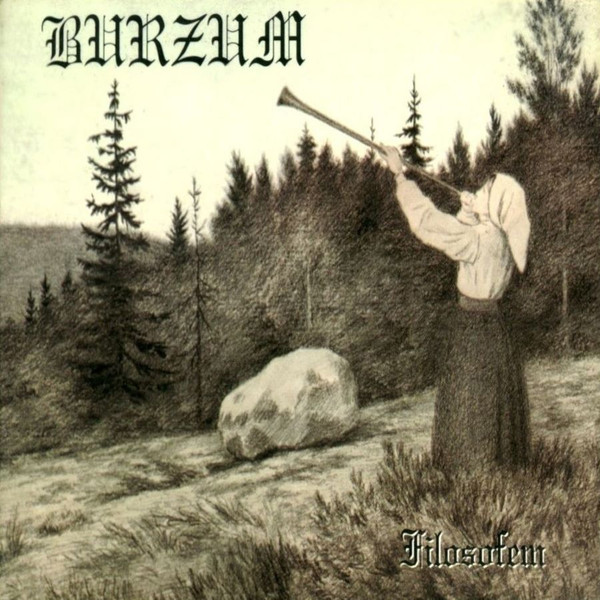
The Battle of Kringen and Kittelsen’s drawing of Pillarguri must also have inspired a fellow musician of Wongraven and Nagell, namely Varg Vikernes. On January 31, 1996, he released his fourth studio album Filosofem under the name Burzum. And on the front cover, it was Kittelsen’s drawing “Op under Fjeldet toner en Lur” that was used. This is the second of three Burzum releases to use Kittelsen’s art, and the cover of Filosofem uses many of his drawings.
Edvard Storm wrote “Zinklars vise” in 1781. Storm was a trained priest, born and raised in Vågå in Gudbrandsdalen. The song about the Scottish march soon became popular, and helped to incite the patriotic struggle leading up to and in the years after the Norwegian secession from Denmark in 1814. The Norwegian poet Henrik Wergeland refers to “Zinklars Vise” in a few scriptures, and the song is included in school and songbooks well into modern times.21 It is almost to be counted as a folk song, and many folk musicians have recorded it.22
In Norway, the song is known with two different melodies. The oldest folk tune has been found since ancient times in Gudbrandsdalen, and is used in the verses of the song itself. Folque uses a different melody than this, one that originates from the Faroe Islands, and which was previously not known in Norway. Folque’s variant has a Faroese dance rhythm and chorus, a chorus that is not found in Edvard Storm’s original text, and they have cut twelve of the original verses. Below are the differences between Folque’s “Sinclairvise” and the original song “Zinklars vise” written by Edvard Storm highlighted.23
«Sinclairvise»
Folque

Herr Sinclair drog over salten hav,
Til Norrig hans kurs monne stande.
Blant Gudbrands klipper han fant sin grav,
Der vanket så blodig en panne.

Vel opp før dag,
De kommer vel over den hede.

Ved Romsdals kyster de styrte til land,
Erklærte seg for en fiende.
Han fulgte fjorten hundrede mann
Som alle hadde ondt i sinne.

Vel opp før dag,
De kommer vel over den hede.

De skjændte og brente hvor de dro frem,
All folkeret monne de krenke
Og oldingens avmakt rørte ei dem,
De spottet den gråtende enke.

Vel opp før dag,
De kommer vel over den hede.

Barnet blev drept i moderens kjød,
Så mildelig det enn smilte.
Men ryktet om denne jammer og nød
Til kjernen av landet ilte.

Vel opp før dag,
De kommer vel over den hede.

Og baunen lyste og budstikken løp
Fra grande til nærmeste grande
Og dalens sønner i skjul ei krøp,
Det måtte herr Sinclair sande.

Vel opp før dag,
De kommer vel over den hede.

De bønder fra Vågå, Lesja og Lom
Med skarpe økser på nakke
I bredebygd tilsammen kom,
Med skotten ville de snakke.

Vel opp før dag,
De kommer vel over den hede.

Frem bønder, frem I norske menn
Slå ned, slå ned for fote!
Da ønsket seg skotten hjem igjen,
Han var ei rett lystig til mote.

Vel opp før dag,
De kommer vel over den hede.

Ei noen levende sjel kom hjem,
Som kunne sin landsmann fortelle
Hvor farlig det er at besøke dem
Der bor i blandt Norriges fjelde.

Vel opp før dag,
De kommer vel over den hede.
«Zinklars vise»
Edvard Storm

Herr Zinklar drog over salten Hav;
Til Norrig hans Cours monne stande;
Blant Guldbrands Klipper han fant sin Grav,
Der vanked så blodig en Pande.

Herr Zinklar drog over Bølgen blaa
For Svenske Penge at stride:
Hjælpe dig Gud du visselig maa
I Græsset for Nordmanden bide.

Maanen skinner om Natten bleg,
De Vover saa sagtelig trille:
En Havfrue op av Vandet steg
Hun spaaede Herr Zinklar ilde.

Vend om, vend om, du Skotske Mand!
Det giælder dit Liv saa fage,
Kommer du til Norrig, jeg siger for sand,
Ret aldrig du kommer tilbage.

Leed er din Sang, du giftige Trold!
Altidens du spaaer om Ulykker,
Fanger jeg dig en gang i Vold
Jeg lader dig hugge i Stykker.

Han seiled i Dage, han seiled i tre
Med alt sit hyrede Følge,
Den fierde Morgen han Norrig mon see,
Jeg vil det ikke fordølge.

Ved Romsdals Kyster han styred til Land
Erklærende sig for en Fiende,
Ham fulgte fiorten hundrede Mand
Som alle havde ondt i Sinde.

De skiendte og brændte hvor de drog frem,
Al Folkeret monne de krænke,
Oldingens Afmagt rørte ei dem,
De spotted den grædende Enke.

Barnet blev dræbt i Moderens Skjød,
Saa mildelig det end smiled;
Men Rygtet om denne Jammer og Nød
Til Kjernen af Landet iled.

Baunen lyste og Budstikken løb
Fra Grande til nærmeste Grande,
Dalens sønner i Skjul ei krøb
Det maatte Hr. Zinklar sande.

Soldaten er ude paa Kongens Tog,
Vi maae selv Landet forsvare;
Forbandet være det Niddings Drog,
Som nu sit Blod vilde spare!

De Bønder av Vaage, Lessøe og Lom,
Med skarpe Øxer paa Nakke,
I Bredebøigd tilsammen kom,
Med Skotten vilde de snakke.

Tæt under Lide der løber en Stie,
Som man monne Kringen kalde,
Laugen skynder sig der forbi,
I den skal Fienderne falde.

Riflen hænger ei meer paa Væg,
Hist sigter graahærdede Skytte,
Nøkken opløfter sit vaade Skieg,
Og venter med Længsel sit Bytte.

Det første Skud Hr. Zinklar gialdt,
Han brøled og opgav sin Aande;
Hver Skotte raabte, da Obersten faldt:
Gud frie os af denne Vaande!

Frem Bønder! Frem, I norske Mænd!
Slaaer ned, slaaer ned for Fode!
Da ønsked sig Skotten hiem igjen,
Han var ei ret lystig til Mode.

Med døde Kroppe blev Kringen strøet,
De Ravne fik nok at æde;
Det Ungdoms Blod, som her udflød,
De Skotske Piger begræde.

Ei nogen levende Siel kom hiem,
Som kunde sin Landsmand fortælle,
Hvor farligt det er at besøge dem,
Der boe blandt Norriges Fielde.

End kneiser en Støtte paa samme Sted,
Som Norges Uvenner mon true.
Vee hver en Nordmand, som ei bliver heed,
Saa tidt hans Øine den skue!
Even though Folque’s “Sinclairvise” is not included on Storms Nordavind, there is much to suggest that this song may have been decisive for Storm to embark on such a risky project as making a folk metal album. This impression is reinforced, as we will see later in the article, by the fact that fragments of melodies from Folque are used on Storms Nordavind. There is thus little doubt that Folque has been a major and very important source of inspiration for Storm on Nordavind.24
A little more about the fonts
Before we move on to the rest of the booklet, there is one more clue I would like to follow up on that I believe closely links Storm’s Nordavind to Folque. Then we will return to the fonts used on the cover and in the booklet of Nordavind. As we recall, I was told by designer Halvor Bodin that the font used for the band name “STORM” on the cover is San Marco Roman by Karlgeorg Hoefer, while “Nordavidind” is written in the font Pabst, designed by Frederic Goudy. Both fonts are used throughout the entire cover design.
First, we’ll look at the Pabst font. It looks like this in uppercase:

And so in lowercase:

If we then compare this font to the font used for the “folque” logo on Folque, a striking similarity is revealed.
Likheten blir tydeligere om vi skriver ut «folque» med Pabst:

As we can see, it is not a complete match, but it is similar enough that one can suspect some influence on the choice of font on Storm’s Nordavind. Halvor Bodin, the designer of Nordavind, denies such influence in an email to me, at least on his:
I’ve probably seen that album, I have no relationship with the band, but there’s no conscious connection, no, not even subconsciously, I think.
Email from Halvor Bodin, February 9, 2022.
Even more interesting is the font San Marco Roman, which is a more Gothic-looking font. We do not find it used on Folque’s Folque, at least not on the releases that were available at the time Storm created Nordavind. But as we will see, Folque uses a similar font on later releases. Here is first an overview of San Marco Roman:
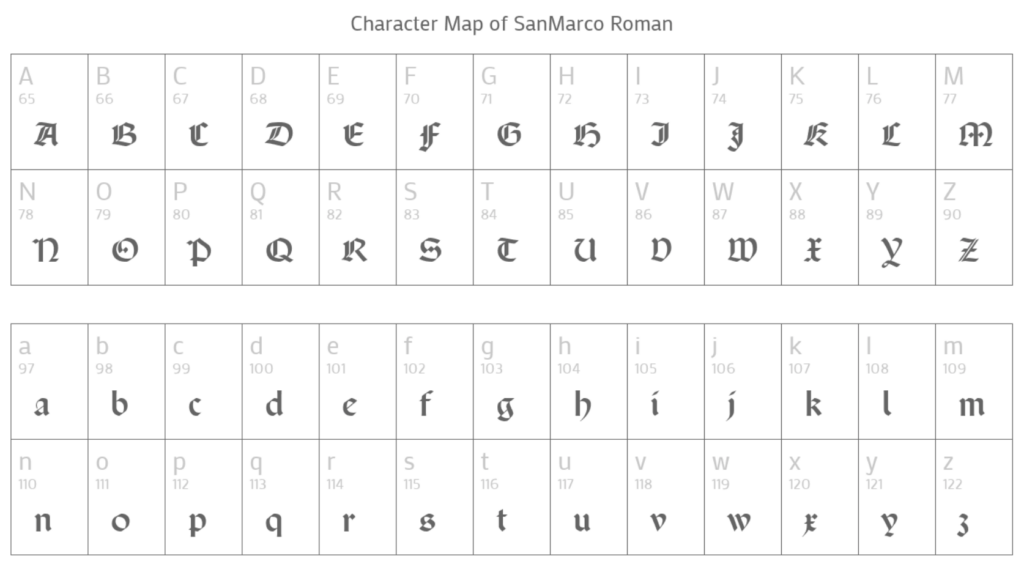
We can clearly see that this is the font Storm has used on its own logo:

If we print “Folque” with the same font, we get this expression:

A similar font was used on Folque’s next release, Vardøger, from 1977.:
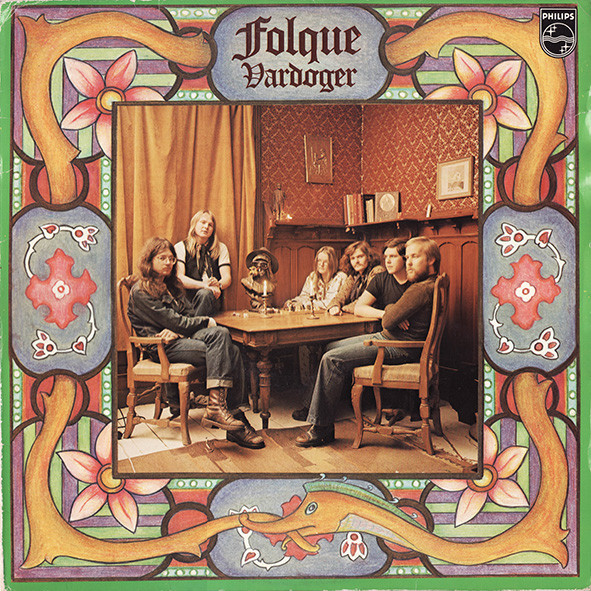
These two fonts are certainly not identical, but there are particular similarities between the Fs in the two. One could argue that this is coincidental. It is possible, but nevertheless striking.
On his next two releases, Dans, Dans, Olav Liljekrans from 1978 and Fredløs from 1980, Folque used a different Gothic font. Both of these albums have an aesthetic that suggests they could just as easily have been black metal releases.
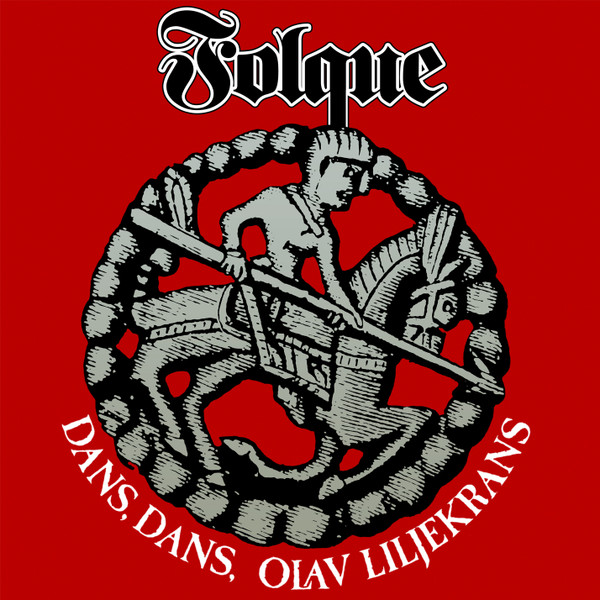
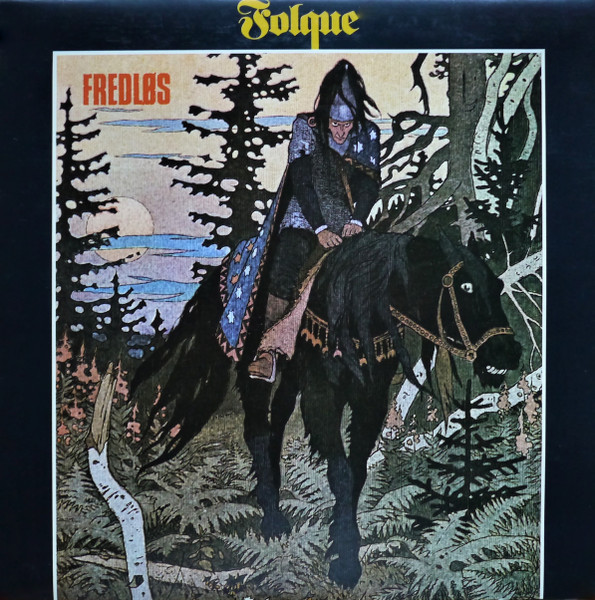
The rest of the booklet
So back to the booklet for the CD version of Storms Nordavind.
Page 5 shows two large blocks of text in capital letters, both beginning with the word “Storm”, on a photographic background of dry trees with outstretched bare branches against a sky in shades from black, purple, blue, and to pink, yellow and red. It is a Norwegian text, and a rough translation of this into English.
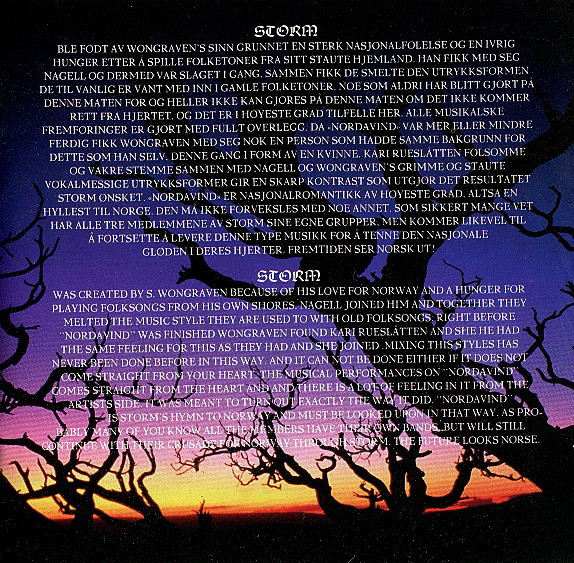
I have quoted the English text earlier in the article, but I will reproduce it here again:
Storm was created by S. Wongraven because of his love for Norway and a hunger for playing folksongs [sic.] from his own shores. Nagell joined him and together the melted the music style they are used to with old folksongs [sic.]. Right before “Nordavind” was finished Wongraven found Kari Rueslåtten and she he [sic.] had the same feeling for this as they had and she joined. Mixing this [sic.] styles has never been done before in this way, and it can not be done either if it does not come straight from your heart. The musical performances on “Nordavind” comes straight from the heart and and [sic.] there is a lot of feeling in it from the artists side. It was meant to turn out exactly the way it did. “Nordavind” is Storm’s hymn to Norway and must be looked upon in that way. As probably many of you know, all the members have their own bands but will still continue with their crusade for Norway through Storm. The future looks Norse.
Storm, Nordavind (1995), p. 5 in the CD booklet.
Page 6 lists the songs on Nordavind in the same text type that “Storm” is written in, namely San Marco Roman. The text is set against a photographic background of a dramatic cloudy sky with the Sun descending over a rooftop.
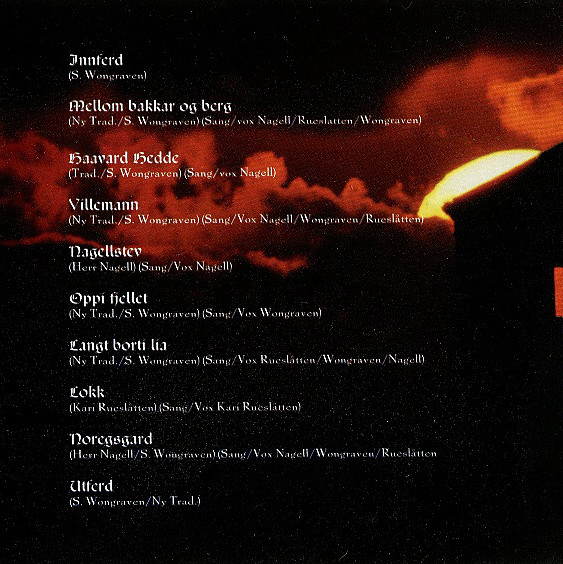
Under each title it says who wrote the song in the font Pabst, and who contributes vocals. I will go through this in connection with each of the songs later. But it is worth noting one overarching thing. Lyricists are not credited on Nordavind, precisely because many of the songs consist of lyrics borrowed from others who are not credited. This also agrees well with something Nagell says in the commentary track for the song “Over de syngende øde moer” on Isengard’s album Høstmørke:
Lyrics again taken from Norwegian poets, so they will not be printed. There is a reason why I chose to just have two lyrics printed on this album. So, you gotta respect that, and I gotta respect my choice from back then too.
Isengard, Høstmørke (1995), the commentary track to “Over de syngende øde moer”.
The lyricists are not credited on Høstmørke either, and only two of the lyrics are printed on the cover, namely those written by Nagell himself. It is therefore highly likely that the same considerations were the basis for the absence of lyrics and lyric credits on Nordavind as well.
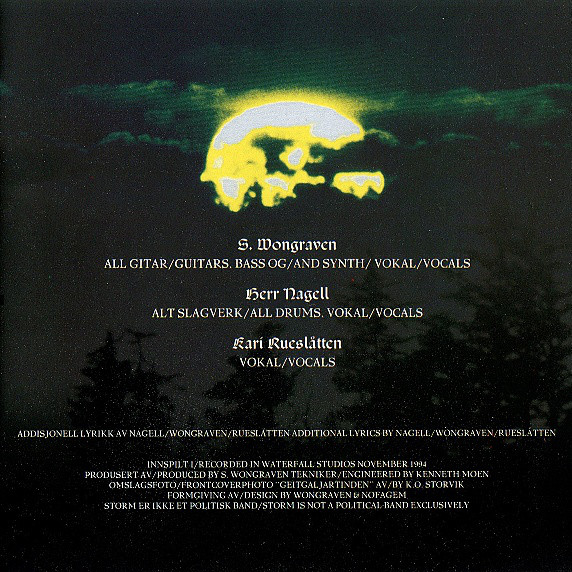
On page 7 of the booklet there is a picture of a moon or sun, partially covered by clouds with several spruce treetops in front. In the text there are the credits that I have reviewed earlier.
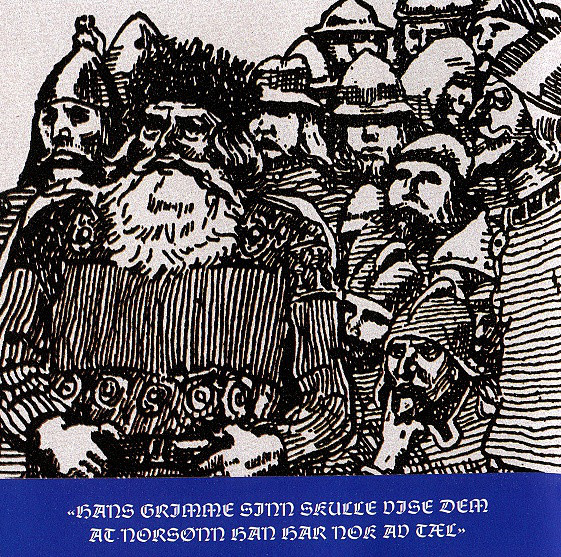
Page 8 shows a section of a drawing made by Christian Krogh, taken from Hakon the Good’s Saga in Snorri Sturluson’s Heimskringla.25 The drawing shows Asbjørn from Medalhus (Melhus) in Gauldalen standing up in front of King Haakon in Frostating with his peasant colleagues behind him. And again we will dig a little deeper. Why did Storm choose to have a drawing of Asbjørn from Medalhus, taken from Snorre, on the last page of the booklet on Nordavind?
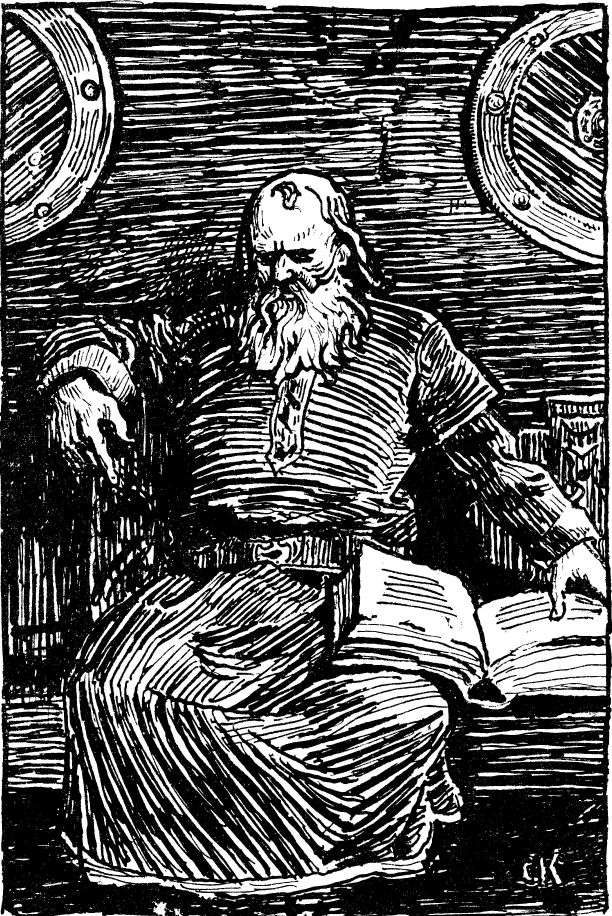
Asbjørn from Medalhus
As we have already seen, Storm pays tribute to the farmers from Vågå, Lesja and Lom who rise up and stand up against the Scottish invaders. Asbjørn from Medalhus also rises up, and that against the king himself, Håkon I the Good Adalsteinsfostre (918–961), youngest son of Harald Fairhair and Tora Mosterstong.
Haakon was raised and apprenticed in England by King Adalstein (Aethelstan). There he was baptized, and when he returned to Norway at the age of fifteen, Christianity was firmly planted in his soul. Nevertheless, he is portrayed in later times as someone who returned to paganism. This comes from some episodes in Trøndelag sometime between 950–954, when Haakon visited the great man Sigurd Jarl, and things were set. In short, Haakon’s Christian faith is put to the test by the pagans of Trøndelag.
In his opening speech at Frostating, King Haakon, according to Snorri, says:
it was his message and entreaty to the bondes and householding men, both great and small, and to the whole public in general, young and old, rich and poor, women as well as men, that they should all allow themselves to be baptized, and should believe in one God, and in Christ the son of Mary and refrain from all sacrifices and heathen gods; and should keep holy the seventh day, and abstain from all work on it, and keep a fast on the seventh day
Sturluson (1225), Heimskringla, https://www.gutenberg.org/cache/epub/598/pg598-images.html#link2H_4_0076.
But then there was great unrest among the farmers at the Thing. Snorri writes further:
Asbjorn of Medalhus in the Gaulardal stood up, and answered thus to the king’s proposal:—
“We bondes, King Hakon, when we elected thee to be our king, and got back our udal rights at the Thing held in Throndhjem, thought we had got into heaven; but now we don’t know whether we have really got back our freedom, or whether thou wishest to make vassals of us again by this extraordinary proposal that we should abandon the ancient faith which our fathers and forefathers have held from the oldest times, in the times when the dead were burnt, as well as since that they are laid under mounds, and which, although they were braver than the people of our days, has served us as a faith to the present time. We have also held thee so dear, that we have allowed thee to rule and give law and right to all the country. And even now we bondes will unanimously hold by the law which thou givest us here in the Frosta-thing, and to which we have also given our assent; and we will follow thee, and have thee for our king, as long as there is a living man among us bondes here in this Thing assembled. But thou, king, must use some moderation towards us, and only require from us such things as we can obey thee in, and are not impossible for us. If, however, thou wilt take up this matter with a high hand, and wilt try thy power and strength against us, we bondes have resolved among ourselves to part with thee, and to take to ourselves some other chief, who will so conduct himself towards us that we can freely and safely enjoy that faith that suits our own inclinations. Now, king, thou must choose one or other of these conditions before the Thing is ended.”
The bondes gave loud applause to this speech, and said it expressed their will, and they would stand or fall by what had been spoken..
Sturluson (1225), Heimskringla, https://www.gutenberg.org/cache/epub/598/pg598-images.html#link2H_4_0076.
After the Thing dissolves with a fragile agreement, the farmers spend the autumn and winter trying to get King Håkon to sacrifice – that is, sacrifice in a pagan way – and eat horse meat. Eating horse meat had been forbidden in the Catholic Church since the first half of the 8th century because it was linked to the pagan rituals of the Germans.26 Finally, the next winter, the king reluctantly ate a few pieces of horse liver and «and emptied all the goblets the bondes filled for him without the sign of the cross». Then the king left Trøndelag in anger.
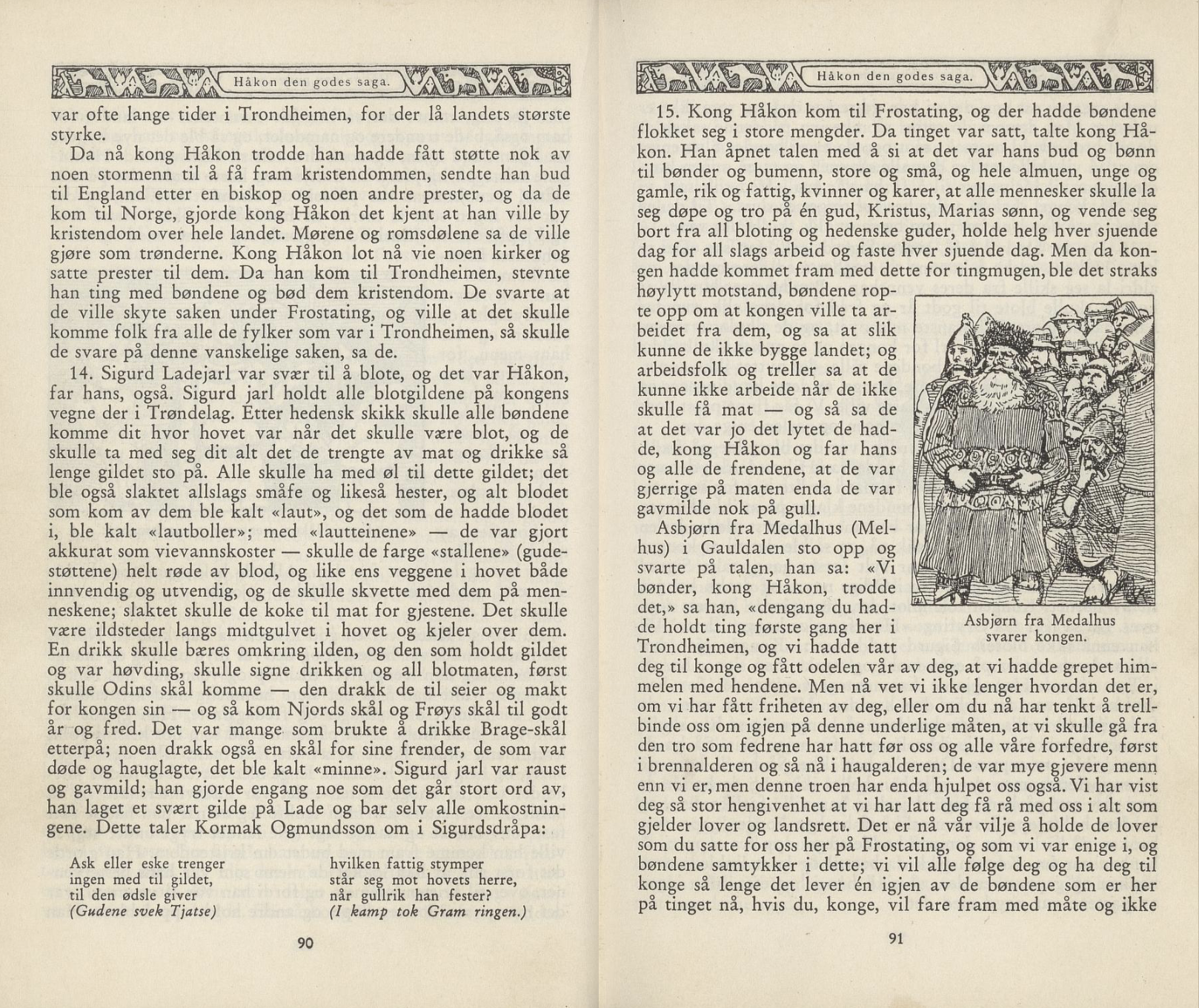
The reason why the farmers from Trøndelag, led by Asbjørn from Melhus, were able to force the king to his knees was not only the persistent diplomacy of Earl Sigurd, but also that these were energetic chieftains who, around Christmas time sometime in the years 950–54, decided to destroy Christianity and make the king sacrifice to the Norse gods:27
The four first [from without the Throndhjem district] went in four ships southwards to More, and killed three priests, and burnt three churches, and then they returned.
Sturluson (1225), Heimskringla, https://www.gutenberg.org/cache/epub/598/pg598-images.html#link2H_4_0078.
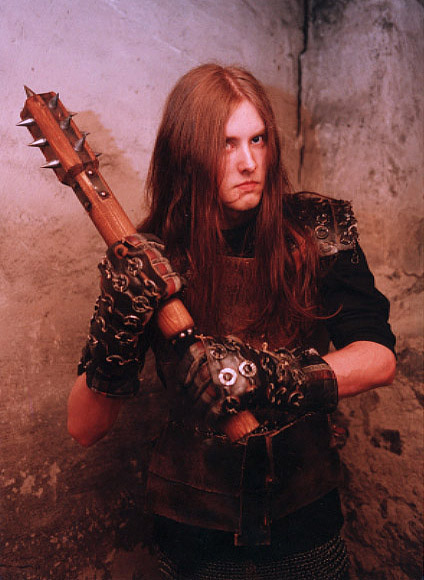
It is fascinating that this way of fighting Christianity, apart from the priest murders, is what the same parts of the black metal community – but not Nagell or Wongraven, mind you – chose. And the one who led the way here was the black metal Asbjørn from Melhus, namely Varg “Greven” Vikernes. He started the burning of churches in Norway on May 27, 1992 when he tried to burn down Storetveit Church in Bergen. He succeeded in burning down Holmenkollen Chapel in Oslo, Skjold Church in Vindafjord near Haugesund, and crowned the feat by burning down Åsane Church in Bergen on Christmas Eve 1992. He was suspected, but not convicted, of having burned down Fantoft Stave Church in Bergen. It was the first church to burn down to the ground, on the not coincidentally chosen date of 06.06.92.
Asbjørn from Melhus stands up to superior power and defends the old Norse pagan faith on behalf of the farmers. This is why he is depicted in Storm’s album Nordavind.
Under the drawing of Asbjørn from Melhus on page 8 of the booklet of the album Nordavind it says “Hans grimme sinn skulle vise dem at norsønn han har nok av tæl” (His grim mind should show them that the Norse son has enough grit) written in capital letters on a blue background in the San Marco Roman font. This sentence is taken from the song “Noregsgard” on Nordavind. “Noregsgard” connects Asbjørn from Melhus’ speech against the monarchy and Christianity, the farmers from Vågå, Lesja and Lom who rise up and stand up against the Scottish invaders, and black metal’s fight against callous rationalism and diluted secularized Christianity, petty-bourgeois conformity and unfree moralism in a society in decline of values. More about “Noregsgard” later.
After this meticulous review of the cover and booklet of Nordavind, it is time to go through the songs on Storm’s album Nordavind. What is missing from the cover are the lyrics to the songs. We know that several of the songs are based on well-known folk tunes, but we also know that several of the songs deviate from the original, with several additions by Storm. We also know that there are often several different versions of the folk tunes, depending on when the text was taken from and from which publisher, which makes the work of locating the deviations greater. But we will have to make an attempt.
The songs
One of my motivations for delving into the songs of Storm’s Nordavind is, as mentioned, that it is unclear to most people the actual mix of folk tunes and Storm’s own added material that is on the release. Another motivation is that since the lyrics are not printed on the cover of Nordavind, there are several incorrect versions of the lyrics on the Internet. In fact, there are no correct versions online, and one of the reasons is that the errors are copied from service to service, another is that those who enter the lyrics in many cases do not know Norwegian well enough. In the course of what follows, I will in any case correct most of the errors in the lyrics. A third reason why I want to delve into the lyrics is that it is interesting from a cultural-historical perspective why it was precisely these songs that Storm chose.
Throughout the work on this text, I have had a hypothesis that the entire corpus of texts has been found collected in a songbook that Storm has used, either as something they have brought with them from school – songs had a large place in music and Norwegian education at the time Storm’s members were growing up – or as something they have obtained and researched later. Access to song texts at this time was exclusively via books – the Internet was not yet widespread – which means that Storm has either picked songs from a limited number of sources, or has had a larger book collection to pick from. I have not been able to find – even after countless searches on the Norwegian National Library’s pages – to find one source that contains all the songs on Nordavind, which suggests that they have picked the songs from several sources, without me being able to definitively point out which these are. However, the writing style of some of the songs reveals something about the sources, and it is largely more modern songbooks that have probably been used as sources.
Nordavind is not available on Spotify or iTunes, but can be listened to on YouTube if you search for it there.
Storm, Nordavind (1995)
| # | Song | Written by | Vocals | Length |
|---|---|---|---|---|
| 1 | Innferd | S. Wongraven | Instrumental | 1:36 |
| 2 | Mellom Bakkar Og Berg | S. Wongraven, Ny Trad. | Nagell, Rueslåtten, Wongraven | 2:43 |
| 3 | Haavard Hedde | S. Wongraven, Trad. | Nagell | 3:19 |
| 4 | Villemann | S. Wongraven, Ny Trad. | Nagell, Rueslåtten, Wongraven | 2:14 |
| 5 | Nagellstev | Herr Nagell | Nagell | 1:03 |
| 6 | Oppi Fjellet | S. Wongraven, Ny Trad. | Wongraven | 4:02 |
| 7 | Langt Borti Lia | S. Wongraven, Ny Trad. | Nagell, Rueslåtten, Wongraven | 7:15 |
| 8 | Lokk | Kari Rueslåtten | Kari Rueslåtten | 0:54 |
| 9 | Noregsgard | Herr Nagell, S. Wongraven | Nagell, Rueslåtten, Wongraven | 8:13 |
| 10 | Utferd | S. Wongraven, Ny Trad. | Instrumental | 1:58 |
First of all, a short comment on the title Nordavind. Firstly, it plays well with the name of the band, namely Storm. Secondly, the title has the same aim as Darkthrone’s title A Blaze In The Northern Sky (1992), namely to tell that something new and important comes / blows / lights up from the north; implicitly the Norse and black metal itself.
Innferd
“Innferd” (Entry/entrance) is the first song on Nordavind. It has a length of 1:36 minutes, and is an instrumental introduction made by Sigurd “Satyr” Wongraven. The sound of a rush, a storm, lies beneath the simple notes made on the synthesizer that make up “Innferd”. The storm seems to be near the sea, but is otherwise indeterminate. The sound from the synthesizer has a melancholic sound, which is reinforced by the medium-long notes and the calm tempo, and is similar to the sound found in folk tunes, although it is clear that they are made on a synthetic instrument, and are not indicated as an original folk tune.
As the last note fades away, the next song starts right away with much more punch.
Mellom bakkar og berg
The traditional song “Mellom bakkar og berg” (Between hills and mountains) is the second song on Nordavind. It is a proud tribute to Norway and the tough country that the Norwegian calls home.
In Storm’s version, the song is 2:43 long. All three, Nagell, Rueslåtten and Wongraven are listed as singers. Wongraven is listed as the composer, after the phrase “Ny Trad.” This phrase is used several times on Nordavind and possibly indicates that it is a traditional folk tune of recent date where the author is known, in contrast to “Haavard Hedde” which is marked with “Trad.” This should not prove to have been carried out consistently. It is also not the case that the songs where the text has been adjusted have been labeled “Ny Trad.”, while those with lyrics that have not been adjusted have been labeled “Trad.” The whole thing therefore seems a bit random.
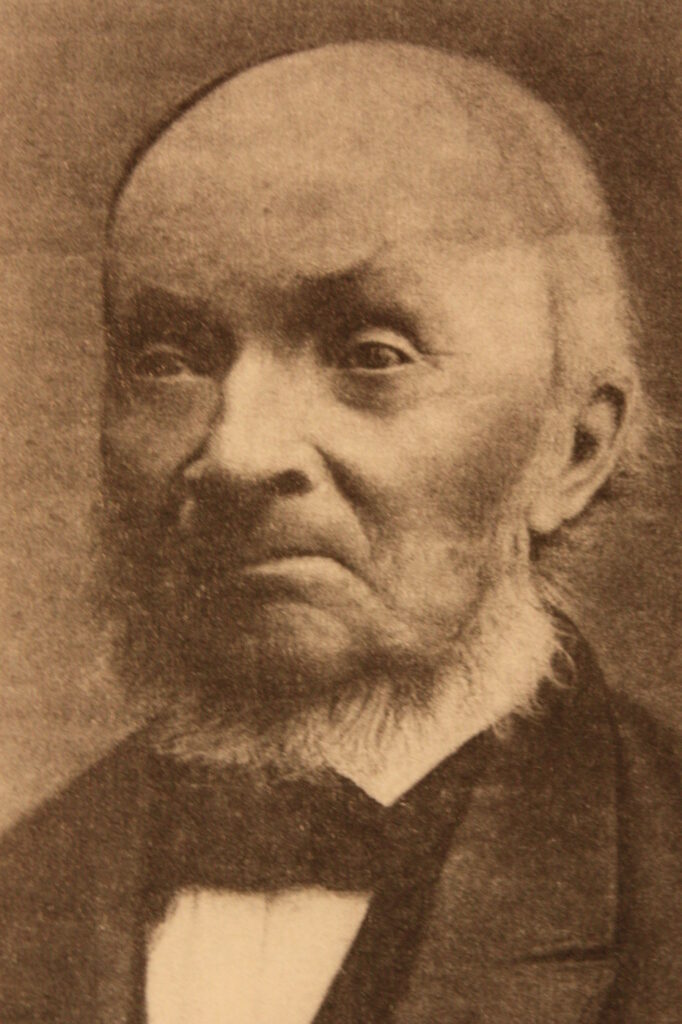
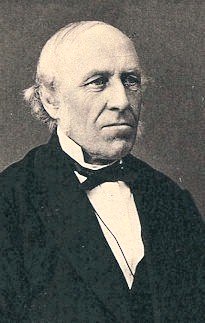
In this case, it is Ludvig Mathias Lindeman (1812–1887) who composed the song that he called “Mellom bakkar og berg” in 1871. The melody was composed for the poem “Nordmannen” by Ivar Aasen. Aasen wrote five versions of the poem from 1863 before it found its final form in 1875. Aasen himself wanted the melody “Dei skal alltid klaga og kyta” (They will always complain and whine) to accompany the poem. He called the poem he set to music “Nordmannen” after the poem. Ivar Aasen’s melody was the most common until the 1960s–70s, before Lindeman’s melody took over. And so it was the one that found its way onto Storm’s album Nordavind 120 years later.
There are a number of different versions of Ivars Aasen’s “Nordmannen” as mentioned. Some of the verses that were not included in the final version from 1875 have continued to be used. As Norwegian Wikipedia writes:
Some of the lesser-known verses are still used by the Socialist Youth, the Center Youth, the Norwegian Mål Youth, the Red Youth and Nature and Youth. The last of these verses in particular was used during the referendum on membership in the EU in 1994.
Wikipedia: https://no.wikipedia.org/wiki/Nordmannen. My translation.
Before we move on to the analysis of the Norwegian text, I will provide a poetic translation of this song as it is reproduced on English Wikipedia.
The Norwegian

1. Amidst hills and mountains, out with the sea
has the Norwegian founded his home,
there, by himself, foundations he dug
and by himself, his houses, there built upon.

2. He looked on to the stoney beaches;
there was no one there who had built.
«Let us clear and build a homestead,
and as such, own the bend ahead.»

3. He looked out on to the stormy ocean;
there, rough to lay out upon;
but there played fish in the ocean,
and that play, he wanted to look upon

4. Into the winter, at times he wondered:
Give that I were in a warmer land!
But when the spring’s sun on the hills shone,
his soul would long for his coastal home

5. And when mountainsides grow green like gardens,
when overcome with flowers, budded on their straws,
and when nights are as bright as days,
there is no prettier place he ever saw.28
So on to the Norwegian text. There are a number of different versions with different spellings that have appeared over the years. I have found a version modernized by Ivar Grimstad og Terje Aarset29 that fits well with what Nagell, Rueslåtten and Wongraven sing.
We quickly notice that Storm has radically changed the penultimate verse, and cut out the fifth and last. What is different between the two texts is marked in bold.
«Mellom bakkar og berg»
Storm


Mellom bakkar og berg utmed havet
heve nordmannen fenge sin heim,
der han sjølv heve tuftene grave
og sett sjølv sine hus oppå deim.

Han såg ut på dei steinute strender;
det var ingen som der hadde bygt.
”Lat oss rydja og byggja oss grender,
og so eiga me rudningen trygt.”

Han såg ut på det bårute havet,
der var ruskut å leggja utpå;
men der leikade fisk nedi kavet,
og den leiken, den ville han sjå.

Hill nordmann!
Hill nordmann!
Hill nordmann!

Fram på vetteren stundom han tenkte:
Giv eg var her til evig tid
Og når nordljoset skinner frå oven
blir hans stålhjerte fylt med grusomt savn.
«Nordmannen» / «Mellom bakkar og berg»
Ivar Aasen / Ludvig M. Lindeman

Mellom bakkar og berg utmed havet
heve nordmannen fenge sin heim,
der han sjølv heve tuftene grave
og sett sjølv sine hus oppå deim.

Han såg ut på dei steinute strender;
det var ingen som der hadde bygt.
”Lat oss rydja og byggja oss grender,
og so eiga me rudningen trygt.”

Han såg ut på det bårute havet,
der var ruskut å leggja utpå;
men der leikade fisk nedi kavet,
og den leiken, den ville han sjå.


Fram på vetteren stundom han tenkte:
Giv eg var i eit varmare land!
Men når vårsol i bakkane blenkte,
fekk han hug til si heimlege strand.

Og når liene grønka som hagar,
når det laver av blomar på strå,
og når netter er ljose som dagar,
kan han ingen stad venare sjå.
Between the third and fourth verses, Storm has inserted three repetitions of the phrase “Hill Norman!”. The expression “hill” has the same origin as “heil” and “hel” which originally meant not broken, unharmed, in good condition. These expressions can be used to express a wish for good luck or tribute, as in “hill deg, konge”, “heil Hitler” or “Sieg Heil!” (which means “hail, victory!”).
During World War II, Vidkun Quisling introduced what is known as the “Roman salute”, with the arm raised at 45 degrees with the palm facing down, while saying “heil og sæl”, which means “healthy and happy”. It is again obvious that Storm is toying with dangerous ideological material. This is reinforced by the fact that the phrase “Hill normann!” is repeated three times in the lyrics, which was the number of times Hitler demanded that people shout “Sieg Heil!” at the large Nazi rallies.
Again, I assume that this exclamation is intended as an old tribute from before it was tainted by fascist ideology, but I can’t find any use of “hill” or “heil” or “hail” in Snorri’s Heimskringla. There are, however, two instances of “Hill deg, konge” in a Norwegian translation of J. R. R. Tolkiens Lord of the Rings volume The Return of the King. And Tolkien has had a great influence on the Norwegian black metal universe of ideas.
Nagell’s solo project Isengard is named after Tolkien’s fictional place Isengard, more recently translated as “Jarnagard” in Norwegian, which means an enclosure of iron. Isengard is located on the outskirts of Rohan, and consists of a large ring of stone with the tall tower Orthanc in the center. Here lives the wizard Saruman, who has gone over to the evil enemy Sauron. Isengard is interpreted as an industrialized hell to illustrate the homogeneity of evil in contrast to the freer natural societies of Middle-earth.30
That Storm’s “Hill nordmann!” is a respectful greeting to the Norwegian is beyond any doubt, but that it is also added to provoke seems reasonable to think.
Storm chooses to use only the first line of Ivar Aasen’s penultimate verse, the one called “Fram på vetteren stundom han tenkte:” (Into the winter, at times he wondered:), before adding three new lines of their own: “Giv eg var her til evig tid / Og når nordljoset skinner frå oven / blir hans stålhjerte fylt med grusomt savn” (If only I were here forever / And when the northern lights shine from above / his steel heart is filled with cruel longing).
These lines replace Aasen’s longing for southern regions and warmth, as well as what makes him think differently, namely the bright days of the northern spring with flowers and greening grass. The black metallers in Storm couldn’t have a longing for the light. The Northern Lights and cold are more than enough, and fit much better into their ideological universe.
But what is the real longing that fills the Norwegian’s steel heart, according to Storm? It seems to be the longing for the true and proud earthbound life prior to the takeover of Christianity and the subsequent alienation of the Norse tradition. Here we dive right into what is called black metal millenarianism, a belief in a previous golden age for the true pagan Norwegian that one longs to return to and wants to restore.
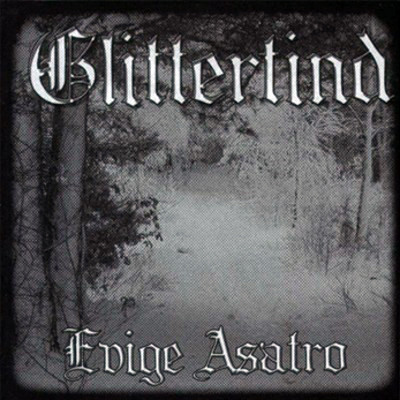
The band Glittertind, which was a solo project at the time, has also recorded a folk metal version of “Mellom bakkar og berg”. Torbjørn Sandvik uses Ivar Aasen’s lyrics, but repeats the first verse at the end of the song, and Aasen’s original title “Nordmannen” on the release Evige Asatro (2004). Glittertind also uses Lindeman’s melody, and not Aasen’s preferred “Dei skal alltid klaga og kyta”. We can probably say with great certainty that Glittertind’s version probably won’t come out that well given Nagell’s strict definition of what is good folk metal and what is bad folk metal. Glittertind’s version is a somewhat soulless heavy rock version of the folk tune. But then you’re always going to complain and whine.
Haavard Hedde
“Haavard Hedde” is the third song on Storms Nordavind. In Storm’s version, it is 3:19 long, and has Nagell on vocals. The source of the music is given as “Trad.” in addition to the work Wongraven has done with adaptations to modern instruments. This folk song is also widely known, and sung by many at school. I myself remember it made a big impression on me. The melody is an old folk melody with no stated origin, but the text is possibly written by Håvard Hedde himself, or Haavard Folkesson Helle as his name was. “Helle” is pronounced “Hedde” in Vallemål, the language they spoke in his birthplace in Valle parish in Setesdal.
Haavard was born in 1758 and died in 1802. He drowned in the north of Bygland when he was on his way to visit the girl he once proposed to and who chose another over him. And it is precisely this tragic aspect of Håvard’s life that the folk song depicts. Or as Landstad (1853) writes:
The ballad describes a true incident. Håvard Helle, a man from Setesdal, was so deeply affected by his beloved preferring another over him that he subsequently, as the story goes, became an unhappy man.
Landstad (1853), p. 724. My translation.
There is one more thing that is interesting about events in Haavard Folkesson Helle’s life in this context. He was enlisted in the 2nd Råbyggelag Company of the 1st Vesterlen Infantry Regiment in 1778. From the same source, we know that he deserted on September 19, 1788. After ten years of service, Haavard thus left the company to work in forestry in Kragerø, and did so without the captain’s permission. At that exact time, the company was about to march to Sweden to participate in the so-called Lingonberry War or Theatre War, the unflattering names for a campaign where Denmark-Norway attempted to invade Sweden in 1788.31 It is quite interesting that in both “Sinclairsvise” and “Håvard Hedde,” a military campaign to Sweden is involved.32
Here is first an English translation of the song:
My name is Håvard Hedde
And I'm a handsome boy
Now I want to get married
And build myself a farm
– I live underneath a mountain
I dearly love my girl
And I won't let her down

My name is Håvard Hedde
I live close under a mountain
Now I want to get married
I won't live alone anymore
– I live ... [Repeat chorus]

Yes, the farm is small
But the wood is good
There I have two firs
And they shall not be touched
– I live ... [Repeat chorus]

When the children get numerous
And the debts are increasing
Then I'll cut the one tree down
The other one I'll leave alone
– I live ... [Repeat chorus]

But when we are getting old
And everything should be settled
Then I'll cut down the other tree
And then all debt will be done with
– I live ... [Repeat chorus]

No wonder
That Håvard's spirits fell low
He left Lanjei
In the dark autumn night
– I live ... [Repeat chorus]

He left Lanjei
And then the girl was engaged
But that was to another man
That's what caused him so deep a sorrow
– I live ... [Repeat chorus]
There are many Norwegian versions of this folk song with a varying number of verses, as well as different versions written according to various orthographic standards. In several places, it is also titled “E heiter Håvard Hedde” rather than just “Håvard Hedde.” The version that most closely resembles the one used by Storm can be found in Askeland, Askeland & Knudsen (1986), p. 148. The final line of the last chorus is particularly worth noting, as it deviates from the final line of the other choruses in this version: “she betrayed me nonetheless.” Storm repeats this line once more at the end of their version. Otherwise, Storm’s version is identical to the reference version.
«Haavard Hedde»
Storm

Eg heiter Håvard Hedde og er so ven ein kar; no vil eg bort og gifta meg og rydja meg ein gard.
– Eg bur oppunder fjell, og jenta hev eg lova, eg svik ho ikkje hell.

Eg heiter Håvard Hedde og bur oppunder nut; no vil eg bort og gifta meg, eg vil kje ganga gut.
– Eg bur oppunder fjell, og jenta hev eg lova, eg svik ho ikkje hell.

Garden den er liten, men skogen, den er god; der heve eg to furer, og dei skal stå i ro.
– Eg bur oppunder fjell, og jenta hev eg lova, eg svik ho ikkje hell.

Når borni dei vert mange, og skuldi aukar på, so høgg eg ned den eine, den andre ho lyt stå.
– Eg bur oppunder fjell, og jenta hev eg lova, eg svik ho ikkje hell.

Men når me verte gamle, og kvar skal hava sitt,
så høgg eg ned den andre, og då er skogen kvitt.
– Eg bur oppunder fjell, og jenta hev eg lova, eg svik ho ikkje hell.

Det var no ikkje undrands at Håvard totte vondt. Han reiste ifrå Lanjei den mørke haustenott.
– Eg bur oppunder fjell, og jenta hev eg lova, eg svik ho ikkje hell.

Han reiste ifrå Lanjei, og då var jenta fest,
men det var med ein annan, det hev han trega mest.
– Eg bur oppunder fjell, og jenta hev eg lova – ho sveik meg likevel.

Ho sveik meg likevel.
«Håvard Hedde»
Folkevise

Eg heiter Håvard Hedde og er so ven ein kar; no vil eg bort og gifta meg og rydja meg ein gard.
– Eg bur oppunder fjell, og jenta hev eg lova, eg svik ho ikkje hell.

Eg heiter Håvard Hedde og bur oppunder nut; no vil eg bort og gifta meg, eg vil kje ganga gut.
– Eg bur oppunder fjell, og jenta hev eg lova, eg svik ho ikkje hell.

Garden den er liten, men skogen, den er god; der heve eg to furer, og dei skal stå i ro.
– Eg bur oppunder fjell, og jenta hev eg lova, eg svik ho ikkje hell.

Når borni dei vert mange, og skuldi aukar på, so høgg eg ned den eine, den andre ho lyt stå.
– Eg bur oppunder fjell, og jenta hev eg lova, eg svik ho ikkje hell.

Men når me verte gamle, og kvar skal hava sitt,
så høgg eg ned den andre, og då er skogen kvitt.
– Eg bur oppunder fjell, og jenta hev eg lova, eg svik ho ikkje hell.

Det var no ikkje undrands at Håvard totte vondt. Han reiste ifrå Lanjei den mørke haustenott.
– Eg bur oppunder fjell, og jenta hev eg lova, eg svik ho ikkje hell.

Han reiste ifrå Lanjei, og då var jenta fest,
men det var med ein annan, det hev han trega mest.
– Eg bur oppunder fjell, og jenta hev eg lova – ho sveik meg likevel.
It is difficult to say why Storm chose to include this folk song on Nordavind. They likely place more emphasis on the fact that Håvard Hedde lived at the foot of the mountains than on him being betrayed by his sweetheart. The dream he carries is once again down-to-earth and quintessentially Norwegian, while also serving as a description of the passage of life. And yet, he is still betrayed.
At the same time, it is possible to take the interpretation further and view this treacherous girl as a personification of Christianity. In this interpretation, it is Christianity that betrays the Norwegian clinging to the mountain peak, who does not achieve the life he dreams of. Christianity takes from him the life he wanted for himself.
“Håvard Hedde” has also been recorded by the experimental metal and electronic band Sunn O))) under the title “The Gates of Ballard” on the 2003 release White1. The “Ballard” in “The Gates of Ballard” likely refers to the science fiction author J. G. Ballard. However, what this Ballard has to do with the fate of Håvard Hedde will have to be the subject of a future article. It is interesting that Sunn O))) pronounces both “heiter” and “ven” in the same idiosyncratic way as Nagell does on Storm’s version. He incorrectly pronounces them as “heitar” and “vein,” and Sunn O))) does the same, even though the lyrics provided on the release’s Bandcamp page are written correctly.33 This suggests that Sunn O))) has definitely listened to and referenced Storm’s version.
Villemann
The fourth track on Nordavind is “Villemann,” which is 2:14 minutes long. Nagell, Wongraven, and Rueslåtten provide vocals on the song. It is labeled as “Ny Trad.” in the Nordavind booklet, with an addition by Wongraven. It is also an old medieval ballad that goes by many names and reportedly exists in over 100 variations. The labeling of the song as “Ny Trad.” deviates from the hypothesis that this indicates the song has a known author, which in this case it does not.
The song is also known by the titles “Gaute and Magnhild”, “Gudmund and Signeliti”, and “Harpespelet tvingar nykken” (The Harp Playing Compels the Nix). It is most commonly known as “Villemann and Magnhild” or “Villemann and Magnill”, but rarely just “Villemann” as on Nordavind.34 We might wonder whether it is intentional that Storm has shifted the focus away from the woman in this story.
“Villemann and Magnhild” is a nature-mythical ballad, as we can read in Solberg (1999), p. 201:
The ballad tells the story of a young girl named Magnhild who “lets down her hair,” signifying that she is about to be married, but who weeps because fate has decreed that she will fall into the river and drown. Her fiancé, Villemann—who is called Gaute in some versions of the ballad—tells her she can feel safe. He promises to build a bridge on pillars of lead and steel, and his soldiers will guard her as they ride to the wedding feast. However, in the middle of the bridge, the horse stumbles, and Magnhild falls into the river, just as fate foretold. Then Villemann sends for his harp and plays so powerfully that nature itself is moved, forcing the neck to release both Magnhild and her two sisters who had previously drowned.
Solberg (1999), pp. 201–202. My translation.
So a wedding is to be held between the two lovers, Magnhild and Villemann, but Magnhild does nothing but weep. She says she will fall into the river and die, for it has been foretold.
Central to this story is the belief in fate. The neck represents an evil fate. He is known for being particularly dangerous to young people in the transition from childhood to adulthood. Using a magic harp – a symbol drawn from the Greek myth of Orpheus and Eurydice – Villemann succeeds in playing his beloved out of the neck’s arms. “Furthermore, the river represents paganism and death, an unconsecrated graveyard,” writes Solberg in my translation.
Solberg employs the literary concept of the splitting of the self to analyze what he believes takes place in the ballad on several levels. Magnhild has two sisters whom the neck has already taken. These can be seen as two immature and failed versions of herself. At the same time, Villemann and the neck can be viewed as two versions of her image of man.
The neck expresses a type of forbidden love that must be suppressed, while the love for Villemann is lawful and socially accepted. Villemann is rich in property and gold, but this is of no help against the neck. The harp and the music, however, are; they serve as symbols of submission and self-sacrificing love. The bridge Magnhild must cross is a symbol of the transition from childhood and carefree playfulness to marriage and a stable life together. Her two sisters – representing her former selves – allowed themselves to be lured by forbidden love (the neck) and were unwilling to commit.
As in all rites of passage where much is at stake, the transition from an unmarried to a married woman was considered a vulnerable period in folklore, and the road to the church where the wedding was to take place was populated by beings that could harm the bride. In this case, it is the neck who poses the danger. It is easy to read into Magnhild’s weeping her fear of not being happy and of not being able to remain faithful to her future husband, but instead falling for the temptation of other men.
The version recorded by Storm differs from the one most frequently printed in Norway.35 The role of the runes is particularly different in this version. It states: “For de runerne de lyster han å vinne” (For those runes he desires to win). This line functions as a refrain and is repeated after each verse in this version, but not in the most common version.
Espeland, Ressem & Prøysen (2010) point out that in the language of ballads, runes signify magical arts. Villemann thus wishes to take over the neck’s seductive sorcery, and he does so by enchanting the neck with music.
According to Espeland, Ressem & Prøysen (2010), Grundtvig created a restoration of this ballad and composed a new verse, the final one. This was then included in Ole Vig’s book Sange og Rim for det norske Folk (1854), and it has been part of the tradition ever since.
Storm adheres strictly to the wording of the version I have found.
«Villemann»
Storm

Villemann gjekk seg te storan å
Hei fagraste lindelauvi alle
Der han ville gullharpa slå
For de runerne de lyster han å vinne

Villemann gjenge for straumen å stå
Hei fagraste lindelauvi alle
Mesterleg kunne han gullharpa slå
For de runerne de lyster han å vinne

Han leika med lente, han leika med list
Hei fagraste lindelauvi alle
Og fugelen tagna på grønande kvist
For de runerne de lyster han å vinne

Han leika med lente, han leika med gny
Hei fagraste lindelauvi alle
Han leika Magnhild av nykkens arm
For de runerne de lyster han å vinne

Men då steig trolli upp or djupaste sjø
Hei fagraste lindelauvi alle
Det gjalla i berg og det runga i sky
For de runerne de lyster han å vinne

Då slo han si harpe til bonns i sin harm
Hei fagraste lindelauvi alle
Og utvinner krafti av trollenes arm
For de runerne de lyster han å vinne
«Villemann og Magnhild»
Folketone

Villemann gjekk seg te storan å
Hei fagraste lindelauvi alle
Der han ville gullharpa slå
For de runerne de lyster han å vinne

Villemann gjenge for straumen å stå
Hei fagraste lindelauvi alle
Mesterleg kunne han gullharpa slå
For de runerne de lyster han å vinne

Han leika med lente, han leika med list
Hei fagraste lindelauvi alle
Og fugelen tagna på grønande kvist
For de runerne de lyster han å vinne

Han leika med lente, han leika med gny
Hei fagraste lindelauvi alle
Han leika Magnhild av nykkens arm
For de runerne de lyster han å vinne

Men då steig trolli upp or djupaste sjø
Hei fagraste lindelauvi alle
Det gjalla i berg og det runga i sky
For de runerne de lyster han å vinne

Då slo han si harpe til bonns i sin harm
Hei fagraste lindelauvi alle
Og utvinner krafti av trollenes arm
For de runerne de lyster han å vinne
We should remember, as Mentz Schulerud says in an old NRK radio recording, that:
Nature’s great, dangerous fiddler, that is our neck – just as Pan was for the Greeks. In legend, the neck is the master teacher; the fiddler goes to him to capture the melody, but many are those enchanted by his beguiling, beckoning strings, allowing themselves to be swept away into the current, down into his watery realm. Yet the legend also tells of the master musician, the one who has overheard the neck’s playing and now creates melodies that surpass those of his teacher; in the folk ballad, this master musician is called Villemann.
From the radio program De ni muser – Euterpe. Et program om musikkens og sangens muse (The Nine Muses – Euterpe. A program about the muse of music and song). Broadcasted on NRK Radio, May 3, 1953.
The neck is thus both the master and the one overcome by the apprentice. There is no doubt that there is something distinctly erotic about this. It is also intriguing when we remind ourselves that Wongraven’s stage name is Satyr, and that Pan in Greek mythology was accompanied by satyrs. A desire to enchant through music is therefore clearly present in Storm.
Nevertheless, this interpretation of why Storm included “Villemann” on Nordavind seems somewhat thin. Perhaps it was the runes – that is, the sorcery – and the interaction with the trolls (the neck) and their magic that appealed to Nagell and Wongraven, far more than Magnhild’s rite of passage from an unmarried to a married woman. This may also explain why Magnhild has largely been removed from their narrative, appearing only as a minor prize in the interplay with mythical nature.
Nagellstev
The fifth track on Nordavind is the 1:03-minute-long “Nagellstev”. As the title indicates, this is Gylve Fenris Nagell’s musical work, and he performs the vocals himself. However, he did not write the lyrics himself; they are taken from “Aagots Fjeldsang” (Aagot’s Mountain Song), which was written by Henrik Anker Bjerregaard (1790–1828).
“Aagot’s Mountain Song” is part of the two-act singspiel Fjeldeventyret (The Mountain Adventure), with music by Waldemar Thrane (1792–1842) and lyrics by Henrik Anker Bjerregaard. The piece was first performed in Oslo in 1825.36
The plot of the play unfolds as a classic comedy of errors. Roaming thieves are in the neighborhood, and Deputy Sheriff Mons Østmoe gathers a group of farmers to arrest them. The sheriff’s daughter, Marie, has little respect for her father, the sheriff, viewing him as a boastful, selfish coward. At the end of the first act, the setting is a mountain pasture where the milkmaid Aagot calls to her cows by singing “Aagots Fjeldsang”. At the same time, three students – Albek, Finberg, and Hansen – descend from the mountains. They are attacked by the farmers, who believe they are the roaming thieves. When the students realize they have been mistaken for scoundrels, they decide to play along and allow themselves to be arrested. Together with Aagot, they are taken to the lockup.
In the second act, the sheriff is very pleased that Deputy Mons has caught the thieves. However, the sheriff’s daughter Marie is distraught to see the student Albek among those arrested, as she is in love with him. Albek lets her in on the joke, and she promises not to reveal it. The local magistrate arranges for the prisoners to be interrogated. First up is Finberg, who says his name is Ole and that he comes from the highlands. The magistrate’s conclusion is obvious: this must be the master thief Ole Høiland! However, the magistrate is shocked when Albek steps forward, for Albek is his own nephew. The entire prank is now revealed. The students then threaten to sue the sheriff and his deputy unless Albek is allowed to marry the sheriff’s daughter, Marie. He is granted his wish. Their happiness increases when the sheriff also announces that his niece, Ragnhild, will marry Mons.37
The music for Fjeldeventyret is primarily of an international character, and it is only in the aria “Aagots Fjeldsang” that the national element becomes evident.
«Nagellstev»
Storm

Eg steve så

Sole går bak Åse ne
Skuggan blir så lange
Natta kjem snart att
tekje meg i fange
Krøtteret uti kveen står:
eg åt seterstøle går.

Mørkt det er i kvar ei Bygd
i dei djupe daler
her på fjell har sole drygd
med å gå te Gare,
test eg kvile under Tak;
Morgo er ho tidleg vak.

Snart eg gjer ho klar i kveld,
Så går eg til Kvile
«Aagots fjeldsang»
Henrik Anker Bjerregaard


Sola går bak Åse ne
Skuggan bli så langje.
Notta kjem snart atteve,
tæke meg ti Fangje.
Krytran uti Kvien står:
eg åt Sæter-stuli går.

Myrkt de æ ti kvar ei Bygd,
ti de djupe Dale;
her på Fjeld ha Sola drygd
me å gå tå Gare,
test eg kvile onde Tak;
Morgå æ ho tile vak.

Snart eg æ no klar i Kvæld,
så går e te Kvile,
søv så roleg onde Feld
test i Morgå tile;
når eg da ha somna in,
drøjme eg om Guten min.
If you listen to Kirsten Flagstad singing “Aagots Fjeldsang” on the release Kirsten Flagstad, Vol. 1: The Early Recordings 1914-1941 (1995), her melody is completely different from the one Nagell performs.
Nagell calls his version of “Aagots Fjeldsang” a stev. It is not, according to the criteria established for what constitutes a stev, in either its old or new form. According to the Great Norwegian Encyclopedia, the criteria are as follows:
In Norway, the term “stev” is now primarily used to refer to a single four-line stanza, often lyrical in nature. There are two types: old stev and new stev. In the old stev, the first and third lines rhyme; the new stev has longer lines that are linked in pairs – the first two with a feminine rhyme and the last two with a masculine rhyme.
Great Norwegian Encyclopedia: https://snl.no/stev. My translation.
In Bjerregaard’s original version, end rhyme is used, but here the first and third lines rhyme, as do the second and fourth lines – both being feminine rhymes – before the fifth and sixth lines rhyme in a masculine rhyme. The original also has six rather than four lines in each stanza. Therefore, as far as I can judge, the original is not a stev and is likely more accurately described – as the title indicates – as a song. In Nagell’s version, the rhymes are broken in several places because the pronunciation of various words does not follow the original text.
The Great Norwegian Encyclopedia claims that the original “Aagots Fjeldsang” is a lokk (cattle call). Incidentally, it is the first time a Norwegian composer has used a cattle call in a classical composition. I do not think it sounds like a typical cattle call because the cows are already in an enclosure and are not being called anywhere. A cattle call is defined as a song or shout used to summon livestock.38 The only thing that appeals is likely the simple life on the mountain farm and Aagot’s longing for her boyfriend.
Nagell’s lyrics deviate somewhat from the original. Aside from the fact that the last four lines have been removed, the deviations are mostly minor linguistic errors. Particularly egregious is the error in the second line of the final verse, where the original says, “Snart eg æ no klar i Kvæld,” while Nagell sings, “Snart eg gjer ho klar i kveld.” The original meaning is intended to be that Aagot is ready for the evening, rather than the sun, which the “ho” (her) in Nagell’s version must refer back to. It makes little sense for Aagot to be making the sun ready. It might be easier to grasp the meaning of the song if I modernize the language somewhat, and translate it to English.
«Aagots fjeldsang»
Henrik Anker Bjerregaard (modernized by Helge Kaasin)

Solen går ned bak åsen
Skyggene blir så lange.
Natta kommer snart tilbake,
tar meg til fange.
Kuene står i innhegningen:
jeg går til seteren.

Mørkt er det i hver bygd,
i de dype dalene;
her på fjellet har solen drøyd
med å gå ned,
til jeg hviler under tak;
I morgen er hun tidlig våken.

Snart er jeg klar for kvelden,
så går jeg til hvile,
sover så roleg under fjell
til i morgen tidlig;
når jeg da har sovnet inn,
drømmer jeg om gutten min.
The sun is setting behind the hill,
And the shadows are growing long.
Night will be here soon,
Closing in around me.
The cows are in the paddock;
I’m walking back to the mountain farm.

It’s dark in all the villages
And down in the deep valleys,
But the sun lingered here on the mountain
A little longer before setting.
I’ll soon be resting under my roof;
Tomorrow, she’ll be up early again.

I’m getting ready for the evening,
And then I’ll head to bed,
To sleep peacefully beneath the mountains
Until the morning comes.
Once I’ve fallen fast asleep,
I’ll be dreaming of my boy.
But after all this, we must ask ourselves: Why on earth has “Aagots Fjeldsang” found its way into Storm’s Nordavind?
Firstly, in Nagell’s version – where the woman Aagot and her dream of her lover have been removed, and the narrative voice replaced by Nagell himself – it appears as though it has become a pure pastoral; a poem of praise for the simple life up in the mountains where the light of knowledge resides, high above the dark valleys. Thus, it may seem that “Nagellstev” is a poem about how the person who has ascended the mountain finds a wisdom that the ordinary people down in the valley do not possess. Like Nietzsche’s sage Zarathustra. This interpretation aligns well with black metal’s self-glorification and solitary knowledge of the true path.
The sun – as the light of knowledge – sets later on the mountain than down in the valley, and the cows are in their enclosure, as the good darkness of black metal’s inverted worldview returns and the milkmaid – the black metal character – can finally go to rest.
Oppi fjellet
Now we have come to the sixth track on Nordavind, and the heart of the conflict in the controversy between Kari Rueslåtten and Wongraven/Nagell. “Oppi fjellet” (Up in the mountains) is 4:02 long. The music is presented as “New trad.” and is based on a folk tune that was one of the most popular during the 19th century. Wongraven provides the vocals. However, the lyrics are not the same as those Kristofer Janson (1841–1917) wrote and published as a 20-year-old for the first time in Studenterblade on April 20, 1861. At the time, the poem was titled “Paa fjellet,” which is what the song is usually called, only modernized to “På fjellet” (In the mountains).
«Oppi Fjellet»
Storm

Eg høyrde vindsuset kalle meg
Oppi fjellet oppi fjellet
Den tok meg vekk i fra folksam gard
Oppi fjellet oppi fjellet

Og om dykk ikkje har hørt det før
Eg blir i Norges land eg til eg dør
Oppi fjellet oppi fjellet

Her i vårt rike er alt vårt savn
Oppi fjellet oppi fjellet
Kring masse skoger vi slår vår favn
Oppi fjellet oppi fjellet

Og er det nokon som ikkje ser
Kvifor vi alltid til mor Noreg ber
Oppi fjellet oppi fjellet

Ja, berg og gråstein det eter vi
Oppi fjellet oppi fjellet
Vi skjems av blåmenn, vi går i hi
Oppi fjellet oppi fjellet

Og friske elva den er for oss
Hvis du vil ha den så må du slåss
Oppi fjellet oppi fjellet
Oppi fjellet oppi fjellet

En grusom død venter hver en mann
Oppi fjellet oppi fjellet
Som ikke hyller vårt faderland
Oppi fjellet oppi fjellet

Ja vi er norske og stolte av det
De kristne kjøtere vil jo ikke se
Oppi fjellet oppi fjellet

Nå har vi sagt det vi ville si
Oppi fjellet oppi fjellet
For norske brødre som alt vil gi
Oppi fjellet oppi fjellet

Skogtroll varsler en grusom død
Der Fenrisulven hørte samme glød
Oppi fjellet oppi fjellet
Oppi fjellet oppi fjellet

Hey!
Hey!
Hey!

Kan dere se han?
Kan dere se han?
Se den kristne kjøteren!

Deng ham opp!
Deng ham opp!

Og om du noen gang lukter kristenmanns blod, oppi fjellet. Ja, hent øksa og kutt dem ned!
«På fjellet»39
Kristofer Janson

Hu hei! kor er det vel friskt og lett
opp på fjellet!, opp på fjellet!
her leikar vinden i kåte sprett
opp på fjellet! opp på fjellet!
og foten dansar, og auga lær,
og hjarta kveikjande hugnad fær opp på fjellet! opp på fjellet!

Kom opp! kom opp frå den tronge dal
opp på fjellet! opp på fjellet!
her bles ein blåster so frisk og sval opp på fjellet! opp på fjellet!
og lii skin utav blomar full, og soli drys alt sitt fagre gull opp på fjellet! opp på fjellet!

I dalen starvar du tung og heit, kom på fjellet! kom på fjellet! kor fint her er, inkje nokon veit, her på fjellet! her på fjellet!
ditt auga flyg over nut og tind, det er som flyg det i himlen inn opp frå fjellet, opp frå fjellet.

Og når no soli til kvila gjeng
attom fjellet, attom fjellet,
då reia skuggane opp si seng
attmed fjellet, attmed fjellet,
då gidrar alt i ein strålestraum, og hjarta sveiper seg inn i draum opp på fjellet, opp på fjellet.
The late Kristoffer Janson can therefore not be blamed for the lyrics Storm replaced his poem with. As we recall from the interview with Puls, Wongraven says straight out that Nagell has written the lyrics.40
Thus, it is in all likelihood Nagell who wrote the lyrics for “Oppi fjellet,” even though Wongraven sings it—something he is both credited for on the cover and also mentions in the interview (in my translation): “It is an extreme mode of expression, which I have reinforced vocally”.41
Since these lyrics are considered the most controversial, let us go through them verse by verse, including an English translation done by me.
Verse 1
Eg høyrde vindsuset kalle meg
Oppi fjellet oppi fjellet
Den tok meg vekk i fra folksam gard
Oppi fjellet oppi fjellet
I heard the rustling wind calling me
Up in the mountains, up in the mountains
It took me away from the crowded farm
Up in the mountains, up in the mountains
In the first verse, the protagonist feels a call from the mountains, away from the crowded village. One interpretation is that this call is felt as a liberation from the hustle and bustle of the city, but also as a call away from the present and back to a simple Norse, pre-Christian life. Here, the mountains function the same way as in the previous track, “Nagellstev,” as something exalted – a place one goes to find great wisdom, where one can live in accordance with one’s own values, and where one does not follow the herd like those down in the valley. This first verse more or less summarizes the entirety of “Nagellstev,” or at least what I believe Storm intends to express with that track.
Verse 2
Og om dykk ikkje har hørt det før
Eg blir i Norges land eg til eg dør
Oppi fjellet oppi fjellet
And if you haven't heard it before
I'll stay in the land of Norway until I die
Up in the mountains, up in the mountains
This second verse points directly back to the second track on Nordavind, “Mellom bakkar og berg,” where Storm added some of their own lines to the end of Ivar Aasen’s poem. There, the lyrics state, “Giv eg var her til evig tid” (Would that I were here for all eternity). This establishes the protagonist’s national sentiment and sense of belonging.
From this verse onwards, it no longer seems as if the mountains are separate from the rest of Norway; instead, they become the defining characteristic of a free and natural Norway. The populous farm in the previous verse now appears more generally as society outside of nature.
Verse 3
Her i vårt rike er alt vårt savn
Oppi fjellet oppi fjellet
Kring masse skoger vi slår vår favn
Oppi fjellet oppi fjellet
Here in our kingdom is all our longing
Up in the mountains, up in the mountains
Around many forests we wrap our embrace
Up in the mountains, up in the mountains
The first line must mean that everything the protagonist longs for—that is, desires—is located in the country of Norway. In the third line, the phrasing gets a bit muddled in Norwegian, as one does not “slår” “vår favn” around anything. You either embrace something or wrap your arms around it. Regardless, this means that the protagonist is protecting the forest. Also note that in the third verse, the lyrics shift from the singular personal pronouns “I” and “me” to the plural personal pronoun “we.” This continues for the rest of the song.
Verse 4
Og er det nokon som ikkje ser
Kvifor vi alltid til mor Noreg ber
Oppi fjellet oppi fjellet
And is there anyone who doesn't see
Why we always pray to Mother Norway
Up in the mountains, up in the mountains
Here, the protagonist poses a rhetorical question about whether there is anyone who cannot see why we honor the land of Norway.
Verse 5
Ja, berg og gråstein det eter vi
Oppi fjellet oppi fjellet
Vi skjems av blåmenn, vi går i hi
Oppi fjellet oppi fjellet
Yes, rocks and grey stones we eat
Up in the mountains, up in the mountains
We’re ashamed of the blue men, we go into our dens
Up in the mountains, up in the mountains
This verse is quite cryptic. In a direct interpretation, since “blåmenn” (bluemen) was the Old Norse term for dark-skinned people,42 one could imagine that the protagonist and their companions eat rock and stone – meaning they make do with very little – while hiding in the mountains (i.e. in Norway) because they are ashamed of dark-skinned people. However, this interpretation seems a bit off, especially the bit about being ashamed.
Snorri mentions “blåmenn” in two contexts: once at the beginning of the Ynglinga saga, and several times in the Saga of Sigurd the Crusader and His Brothers Eystein and Olaf. Large parts of this latter saga concern one of the sons of Magnus, King Sigurd – the one who traveled to Jorsal (Jerusalem) and was later known as Sigurd the Crusader. At one point during his Odyssey-like journey, he and his men sailed south of Spain along Serkland (Morocco) and arrived at a small island called Formentera, the southwesternmost of the Balearic Islands, in the chain that also includes Ibiza and Mallorca. This is how Snorri describes what the men encountered. In the English version of Snorris text, the bluemen are also called, more accurate, the Moors:
There a great many heathen Moors had taken up their dwelling in a cave, and had built a strong stone wall before its mouth. They harried the country all round, and carried all their booty to their cave.
Snorri (1225), https://www.gutenberg.org/cache/epub/598/pg598-images.html#link2H_4_0692.
King Sigurd and his men make a coastal raid and attack. Thus sang Haldor Skvaldre from the pen of Snorri:
Stridslystne fredsbryter
snart fikk se
framfor stavnen
Forminterra
Der hær av blåmenn
før bane de fikk
måtte egg
og ild tåle.43
Forminterra lay
In the victor's way;
His ships' stems fly
To victory.
The bluemen there
Must fire bear,
And Norsemen's steel
At their hearts feel.44
It is somewhat problematic if Storm uses the term “blue men” to refer to dark-skinned North Africans, Moors, since they were, after all, Muslim and not Christian in the Saga of Sigurd the Crusader and His Brothers Eystein and Olaf, and therefore heathens. If this point about the “den” is to hold true – that is, seeking refuge from blue men – then these blue men must actually be Christians. Wongraven is also clear in the 1995 interview with Puls that people are of equal worth regardless of where they come from, and that black metal is:
It is a showdown against the Christians. Against the state racism that Christianity is.
Puls (1995), no. 8, p. 7. My translation.
This racism Wongraven refers to must be that in the social-democratic state-church Norway of 1995, there was a feeling that even with religious freedom – something we also had in 1995, although it has since been further strengthened45 – it wasn’t really acceptable to have any values other than Christian ones.
But who does Storm mean by “blåmenn”?
Bluemen are also mentioned in the Song of Roland, the 12th-century Old French epic poem, at least in a Norwegian version:
Kong Karl, vår drott, den store styresmannen, bar hærskjold mot det fagre Spanialandet sju fulle år, og vann det heilt til havet. Med hardhug han mot heidne blåmenn bardest; kvar mur, kvar borg, kvar minste by var fallen, forutan Zaragoza høgt på kampen. Der råder kong Marsile, heidningbranden som ofrar til Apollon og Muhammed. Men alt var fåfengt, både gand og galder.
Rolandskvadet (1965), p. 17.
King Charles and Roland fought the Saracens in the land of the Saracens, which in Old Norse came to be called Serkland after the clothing worn by the people in the region. This designation covers several lands, such as the countries along the Euphrates and Tigris, Mesopotamia, and North Africa. These people are called heathens because they are non-Christians – not because they believe in Norse gods, but because they are Muslims.
Is it then the Muslims who are the bluemen, the ones Storm is ashamed of and hides from?
Those who fought against the Moors during the Crusades from the 11th to the 13th century were, after all, Christians, so the framing seems a bit strange. Why involve the Moors at all when it is the Christians who are the enemy? Unless, of course, it is all religious people who are the enemy here?
One can conceive of “blåmenn” as a designation for intruders and troublemakers in general who plague and destroy the established order—in this context, Old Norse culture. We find such a connection in fairytales and folklore.
There are many accounts of tusser, mound-folk, nisser, and other “tuftefolk”—invisible, social nature spirits that lived wherever people dwelt. These also include those known as “blåkall” and “blåmenn.” The folklorist Ørnulf Hodne mentions an intrusive “blåkall” who tried to get into bed with a girl from Frei in Nordmøre, and whom she had to physically push away.46
Hilde Løwe tells of a man from Herøy in Møre og Romsdal who recounted how one had to protect oneself against “subterranean bluemen” who only wished harm upon humans.47
Blåmenn are essentially small gnomes that pester humans, create messes, and cause trouble for them.
Christian Poulsen also has a fairy tale in his 1931 book Nye norske eventyr (New Norwegian Fairy Tales) titled “Blåmennene” (The Bluemen). In it, the bluemen help an enchanted troll and a princess escape from captivity, while at the same time getting rid of some troublesome trolls who live in the innermost part of their cave in the mountain.48
The question then is whether these are the “blåmenn” Storm refers to when they sing about them in this verse. In all likelihood, the matter is far simpler than that. If we disregard the reference to the “blåmenn” in verse five, it is clear that this is a fairly simple text about love for the Norwegian land – a national-romantic tribute that highlights the mountains and forests, and seeks to shield Norway from intruders. Norway is defined as being “up in the mountains,” and the intruders are the Christians. This interpretation is reinforced from verse six onwards.
Verse 6
Og friske elva den er for oss
Hvis du vil ha den så må du slåss
Oppi fjellet oppi fjellet
Oppi fjellet oppi fjellet
And the fresh river is for us
If you want it, then you must fight
Up in the mountains, up in the mountains
Up in the mountains, up in the mountains
In verse six, it is clear that the protagonist and his companions feel a sense of ownership over Norwegian nature and do not want to share it with those who cannot take care of it.
Verse 7
En grusom død venter hver en mann
Oppi fjellet oppi fjellet
Som ikke hyller vårt faderland
Oppi fjellet oppi fjellet
A cruel death awaits every man
Up in the mountains, up in the mountains
Who does not hail our fatherland
Up in the mountains, up in the mountains
In verse seven, it is confirmed that a gruesome death awaits anyone who does not recognize the value of our ancestors’ land. The ancestors referred to here are likely the Norse.
Verse 8
Ja vi er norske og stolte av det
De kristne kjøtere vil jo ikke se
Oppi fjellet oppi fjellet
Yes, we are Norwegian and proud of it
The Christian curs refuse to see
Up in the mountains, up in the mountains
In verse eight, it is pointed out that the Christians do not recognize Norway the way the protagonist and his companions do, and that they do not belong in the mountains, i.e., Norway.
Verse 9
Nå har vi sagt det vi ville si
Oppi fjellet oppi fjellet
For norske brødre som alt vil gi
Oppi fjellet oppi fjellet
Now we have said what we wanted to say
Up in the mountains, up in the mountains
For Norwegian brothers who will give everything
Up in the mountains, up in the mountains
In verse nine, a brotherhood between the protagonist and his companions is revealed. It appears that the individual is male. Mother Norway (verse 4) has, throughout the verses, been transformed into the fatherland (verse 7), and it is this brotherhood that will give everything for Norway (verse 9).
Verse 10
Skogtroll varsler en grusom død
Der Fenrisulven hørte samme glød
Oppi fjellet oppi fjellet
Oppi fjellet oppi fjellet
Forest trolls herald a gruesome death
Where the Fenris Wolf heard the same glow
Up in the mountain, up in the mountain
Up in the mountain, up in the mountain
Then the forest troll and the Fenris wolf appear in verse 10, which is the last actual verse. The rest consists of shouts. It says that the forest troll heralds a cruel death, and the Fenris wolf heard the same glow. What does that mean? I believe the forest troll testifies to how strongly folk belief stands in the struggle against Christianity. The troll’s presence in the forest is evidence of something primal that must be reclaimed. And the Fenris Wolf likewise, as a representative of the Old Norse. Gylve Fenris Nagell took his middle name and his stage name “Fenriz” from this mythological wolf.
The monstrous Fenris wolf is the son of the giant Loki and the giantess Angrboda, brother of the Midgard Serpent and Hel, and half-brother of Sleipnir. He threatens the Aesir – the gods – and they therefore bind him. When Ragnarok comes, the end of the world, the Fenris wolf breaks free from his chains and kills Odin before being killed by Odin’s son Vidar.49
In this respect, the Fenris wolf heralds a new Ragnarok in the lyrics of “Oppi fjellet” – the final battle and downfall of the Christian world and the rebirth of a new world following the Norse model.
But we must linger a moment on the forest troll. Theodor Kittelsen has a piece of writing titled “Skogtrollet” (The Forest Troll). It begins like this, first in the original Norwegian:
Skogen, det ensformige ville i skogen, har satt sitt stempel på oss, vi blev et stykke av samme natur. Vi elsker den, som den er – sterk og tungsindig.
De susende graner og furuer har vi stirret op i som barn. Vi har fulgt de mektige stammer med øine og med sjel, har klatret om mellem de sterke vredne armer og havnet i de høieste topper, – i de svingende susende topper, der oppe i det deilige blå.
Når solen gikk ned, bredte ensomheten og stillheten sig over de lange moer, tyst og tett. Det var som om de ikke våget å dra ånde, som om skogen lå i stille taus forventning. Da hamret det i vårt hjerte. Vi vilde ha mere – vi tigget og bad om eventyr, sterke ville eventyr, for oss fattige barn.
Og skogen ga oss eventyret.
Kittelsen, 1945, “Skogtrollet”, p. 215.
And here in English:
The woods, the wild monotony of the woods, has left its mark on us, we have become one with Nature. We love it for what it is, with its melancholy power.
As children, we used to stare up into the rustling fir and pine trees, following their mighty trunks with our eyes and our soul. We climbed about in the strong, twisted branches, until we reached the very tops – in the swaying, rustling treetops, up there in the beautiful blue.
When the sun set, solitude and piece descended over the great woods, a dense silence. It was as if they dared not breathe, as if the woods were lying in quiet, silent expectation. Then our hearts would pound. We wanted more – we begged and pleaded for adventures, exciting, wild adventures for us poor children.
And the forest gave us an adventure.
Kittelsen, 2000, “The Forest Troll”, p. 8.
In this excerpt from Kittelsen lies the seed of not only black metal’s identification and sense of belonging with the forest, but also the yearning for adventure that black metal seeks. It is not difficult to read the jaded boredom and culturally impoverished, gnawing suburban ennui of 1980s Norwegian youth into Kittelsen’s sentence that “we begged and pleaded for adventures, exciting, wild adventures for us poor children”.
Kittelsen’s sentence, “Når solen gikk ned, bredte ensomheten og stillheten sig over de lange moer, tyst og tett / When the sun set, solitude and piece descended over the great woods, a dense silence,” points toward the Norwegian poet Hans Børli’s poem “Over de syngende øde moer / Across the singing desolate barrens” from the poetry collection Isfuglen (The Kingfisher) (1970). This poem forms part of the lyrics to Isengard’s composition “Over de syngende øde moer” from the release Høstmørke (1995). As previously mentioned, Isengard is the solo project of Gylve Fenris Nagell.
Over de syngende øde moer
Stien –

Stor
må ensomheten bli
og stille som himmelrendene
før alle nølende føtter i skogen
slår inn på samme tråkk
og skaper en sti
over de syngende øde moer
Across the singing desolate barrens
The path —

Vast
must the loneliness become
and still as the sky-rims
before all hesitant feet in the forest
turn into the selfsame track
and create a path
across the singing desolate barrens50
I write about the connection between Børli and Isengard in the book Snø og granskog: Språk, ideologi og nasjonalromantisk raseri i norsk svartmetall (Snow and Spruce Forest: Language, Ideology, and National Romantic Rage in Norwegian Black Metal) from 2023.
Both Nagell and Wongraven must have been familiar with Kittelsen’s writing on the forest troll. In any case, they are well-acquainted with Kittelsen. This is clearly evident, for example, in Darkthrone’s song “Inn i de dype skogers favn” from Under a Funeral Moon (1993), where the Black Death ravages in line with how Kittelsen drew and described it.
Sigurd “Satyr” Wongraven expressed his fascination with Kittelsen in a newspaper interview with Arbeiderbladet on March 26, 1994.
– The neck and trolls are incredibly fascinating. I believe in trolls and the neck. They might not exist now, but I am convinced that they have existed. Kittelsen must have seen trolls and the Nix before he made his drawings, says Satyr, who cites Theodor Kittelsen as one of his great sources of inspiration.
Sigurd «Satyr» Wongraven in Svingen (1994), p. 29.
With Christianity, the trolls and the water sprite more or less disappeared from the Norwegian forests.
Last part
«Hey!
Hey!
Hey!

Kan dere se han?
Kan dere se han?
Se den kristne kjøteren!

Deng ham opp!
Deng ham opp!»

Og om du noen gang lukter kristenmanns blod, oppi fjellet. Ja, hent øksa og kutt dem ned!
"Hey!
Hey!
Hey!

Can you see him?
Can you see him?
Look at that Christian cur!

Beat him up!
Beat him up!"

And if you ever smell the blood of a Christian man, up in the mountains. Yes, fetch the axe and cut them down!
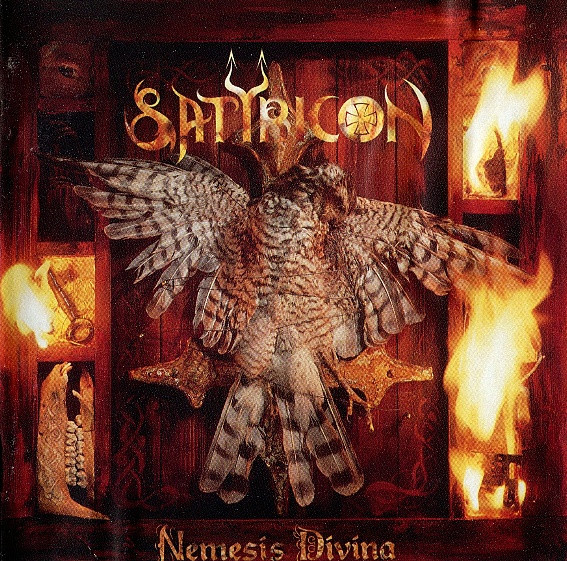
The final part of Storm’s “Oppi fjellet” consists of shouts from a mob made up of the protagonist and his companions who see a Christian and want to beat him up. And yes, the verse encourages violence, and the ultimate fate the Christian shall suffer in the rebirth of the new world – a world full of trolls and fairytales.
The same theme can be found in Satyricon’s “Mother North” on Nemesis Divina (1996). The song is, as the album title also indicates, about the loss of Norse culture and the acceptance of Christianity, which has destroyed a magnificent Norse culture.
Langt borti lia
The seventh track on Storm’s Nordavind is the second longest, with a duration of 7:15 minutes. At the same time, it has the shortest lyrics. Kari Rueslåtten provides the lead vocals here, while Nagell and Wongraven provide backing vocals. The music is credited as “New Trad. / S. Wongraven,” which I previously interpreted to mean a traditional folk song of a more recent date with a known composer or lyricist. In this case, that does not seem to be the case either.
The title “Langt borti lia” (Far Away in the Hillside) which Storm gave their version of this song, is not the original title; it is “Såg du noko” (Did you see anything). “Såg du noko” is a Norwegian folk song that exists in several textual variations, but they all share the opening line, “Såg du noko te kjerringa mi / langt borti lia i lia” (Did you see anything of my wife / far away on the hillside, on the hillside). In the version used by Storm, the lyrics continue with “Svart hatt, raud stakk, og lita, gammal og låghalt” (Black hat, red skirt, and small, old, and limping), but there are alternative endings, such as “Stutt stakk, svart hatt og noko lite låghalt” (Short skirt, black hat, and slightly limping).
«Langt borti lia»
Storm

Såg du noko te kjerringa mi
langt borti lia i lia

Svart hatt, raud stakk, og lita, gammal og låghalt.

Vegen går heimat
Natta ho er lång
Dyr51 kviskrar i mørkret
Eg høyrer ein song

Vegen går heimat
Og natta ho er lång
«Såg du noko»
Folkevise

Såg du noko te kjerringa mi
langt borti lia i lia

Svart hatt, raud stakk, og lita, gammal og låghalt.
The continuation is not from the original text and must have been added by Storm. In any case, it cannot be found published anywhere else, even when searching the Norwegian National Library’s collections for various phrases and sentences using different spellings. However, a search for “vegen går heim” (the road leads home) yields a result in Einar Økland’s 1974 book Det blir alvor (It’s getting serious). On pages 45–51, there is a story titled “Skogen som står der” (The forest that stands there). It is about a boy named Endre who is alone in the forest and experiences the sounds of the woods. The third sound he hears is “ei syngjande susing langt bortanfrå” (a singing soughing from far away). Then he finds a path, and “vegen går heim” (the road leads home). There he meets “ei gammal kone” (an old woman) whom he joins. “Kona har ein mørk stakk og eit grått arbeidsforkle og plagg på hovudet” (The woman wears a dark skirt and a grey work apron and a garment on her head). It is possible that Nagell had read this children’s story and it stayed with him in such a way that he combined these two stories. Regardless, Økland’s story is quite similar to Theodor Kittelsen’s story “Fattigmanden” (The Pauper), where the poor man, while listening to the sounds of the forest, encounters Pesta, the Black Death personified, on the path. The story is taken from Svartedauen / The Black Death (1900), a work that both Nagell and Wongraven were well acquainted with.
In the third line of the added text, it sounds as though Rueslåtten is singing “Dyr kviskrar i mørkret” (Animals whisper in the dark). It is unclear whether she is actually singing “dyr” (animals) or something else that sounds similar. It seems a bit odd for it to be animals whispering in the dark, at least when the protagonist is hearing a song. I have not been able to make out exactly what she is singing.
Musically, it’s an interesting track, but lyrically it falls somewhat short. The connection between the original lyrics and the added text feels shaky. And the reasoning for including the song at all – at least with the original lyrics – seems somewhat odd, unless it is as I have suggested above. In any case, the lyrics do not seem to support any of the classic black metal themes.
Nevertheless, we can find some clues that point us in the right direction. Which way home are we talking about here? And which night are we talking about?
Shortly after the Black Death had finished its first ravaging of Norway in 1350, political turmoil had led to internal unrest, and a common heir to the three kingdoms of Norway, Sweden, and Denmark remained after countless alliance marriages, Norway entered into a union with Denmark (and initially also Sweden) in 1380 – a union that, in various constellations, lasted until the liberation from Denmark and the union with Sweden in 1814.
Henrik Ibsen – albeit ironically – referred to this period as “the 400-year night” in his 1867 play Peer Gynt, which was based on a series of folk tales about the hunter Per Gynt, who also appeared in Asbjørnsen’s Norwegian Fairy Tales and Folk Legends (Ibsen 1867/1906 and Asbjørnsen 1845). The expression became widely used and is still regarded today as the popular narrative of the period of Danish rule. In reality, Norway experienced a period of prosperity during this time, with both population and economic growth, but this was sacrificed for symbolic effect in the re-establishment of Norway leading up to and after 1814.
Although the Christianization of Norway was completed by the mid-11th century, it is easy to imagine that the period of union with Denmark, Christianity, and the Black Death coincide in time, together forming a long night in cultural history after the glorious Vikings passed out of time. It is this night that I believe it is possible Storm depicts in “Langt borti lia” – that is, the oppressive and freedom-depriving forces of unions, Christianity, and the Black Death. And what lies far away in the hillside is, of course, Norway.
Let us return to the music. Since I first published this article, knowledgeable readers have pointed out that the connection to the folk music group Folque, and particularly their debut album Folque (1974), is stronger than I first assumed, even beyond the purely conceptual. Not only is Storm deeply inspired by Folque, they have indeed also borrowed some of the melodic lines from that release. This is particularly evident on “Langt borti lia.”
Starting at 0:41 of “Langt borti lia,” Storm used the melody from the song “Reven og bjørnen” by Folque. From 4:44, they use the melody from “Heimat låta” while the second part of the lyrics of “Vegen går heimat” is being sung.
It is quite possible that there are more such borrowings, not only on “Langt borti lia,” which consists of several different musical parts, but also on the other songs on Nordavind that do not have a known origin—i.e., “Lokk,” “Noregsgard,” and “Utferd.” I have tried to find other borrowings with my limited musical ear without success, but I would welcome any tips.
I called my former NRK colleague Jørn Jensen, who played guitar and sang in Folque, to hear his thoughts on these musical borrowings. He was able to confirm that both “Heimat låta” and “Reven og bjørnen” are used as parts of Storm’s “Langt borti lia”. He then sang the entire “Reven og bjørnen” for me over the phone, giving me an exclusive concert right then and there, which was very pleasant. He could say little about the origin of the songs, but he believed that others from Folque could shed more light on the matter if I asked.
Jørn also mentioned that he was aware that Folque is close to the hearts of many metalheads. He experienced this particularly clearly at a Folque reunion concert in 2014 at the concert venue John Dee in Oslo. There were many metalheads there with long hair who both stood out visually in the crowd, but who also knew the lyrics to all the songs and sang along.
Lokk
The eighth track, “Lokk”, is the shortest on Nordavind at just 53 seconds. On this track, Kari Rueslåtten handles both the music and the vocals. We do not know who wrote the lyrics, other than that they must be Storm’s own original work. I cannot find any fragments or anything else from these lyrics published anywhere. However, it is of course quite possible that they have a different lyricist.
«Lokk»
Storm

Eg veit eit sted oppe i mellan åsen
Kor måsen er mjuk og trea kaster skugge
Eg veit ein gut, den stautaste tå alle
Auge ljose i mørket, "Vil du staden sjå?"

Eg ventar til dagen er omme før eg til staden fer
Set meg ned på hella, tru om han kjem?
Eg vert så varm, kjenner kor hjartet banker
Kom, kom hit hjå meg, ta meg i di favn.
Here in an English translation:
I know a place up among the hills
Where the moss is soft and the trees cast shadows
I know a boy, the finest of them all
Eyes bright in the dark, "Do you want to see the place?"

I wait until the day is over before I go to the place
Sit down on the flat stone, I wonder if he will come?
I grow so warm, feel how my heart beats
Come, come here to me, take me in your arms.
Once again, it is a somewhat atypical text in which it is difficult to find any black metal ideology. It may be the celebration of a “place” one is fond of and wants to share with someone. And this attachment to places, particularly in connection with the forest, is something black metal frequently points toward. Nevertheless, a different desire is the main theme of the text.
The protagonist, a girl, knows of a place up in the hills where the moss is soft and the trees provide shade. She tells a boy she has a crush on about the spot and enticingly asks if he wants to see it. The next day, she goes up there to wait for him. Hun er seksuelt opphisset og lokker gutten til seg slik at hun kan ligge i hans favn.
The re-enchanting ambitions of black metal can lead us to view this pastoral image as something more than two lovers sneaking away in secret. Perhaps it is the hulder who lures the boy to her with her dangerous desire, thereby restoring the mystery of the forest to him? It is this romantic conception of the world, this fairy-tale world, that the boy is enticed to reclaim by taking this hulder girl into his embrace. Or perhaps it is also the case that on this song, which is hardly black metal-ideological, Kari Rueslåtten’s divergent ambition with the release of Nordavind shines through: as a purer tribute to folk music and old Norway in a metal version.
The alluring tone – very well conveyed by Rueslåtten’s fantastic voice – has likely given rise to the song’s title, namely “Lokk.” Otherwise, it has little in common with the traditional herding call intended for livestock; see the comments on “Nagellstev” above.
Noregsgard
In the ninth and final proper track before the outro “Utferd,” we once again encounter the bluemen. “Noregsgard” is the longest song on Nordavind with 8:13 minutes. Both Nagell and Wongraven are credited with the melody, so in this case, they did not use a traditional folk melody. In fact, it is the same melody used in the Darkthrone song “Quintessence” from Panzerfaust (1995). Panzerfaust was recorded in February and April 1994 at Necrohell Studios, but was not released until June 6, 1995. As we recall, Nordavind was recorded in November 1994, six months after Panzerfaust was recorded. There is therefore no doubt that Nagell brought the melody and the riff over from Darkthrone to Storm.
Some even claim that the “Quintessence” riff is also the basis for the melody of the a cappella song “Nagelstev.”
All three band members – Nagell, Wongraven, and Rueslåtten – are credited with vocals on this track, but Nagell provides the lead vocals. Lyrically, it also appears that the entire piece is self-composed.
The word “Noregsgard” is very rarely used. It is a compound word consisting of the words “Noreg” and “gard.” “Noreg” is the Nynorsk form of Norway. “Gard” is derived from the Old Norse garðr, which means “fence, enclosed plot of land, fortified place, farm, or garden,” according to the Norwegian Academy Dictionary. Fundamentally, we can interpret “Noregsgard” as being Norway, but with a meaning that emphasizes its archaic, agricultural, and enclosed nature.
Virtually all search results on the word “Noregsgard” on the internet point to Storm’s song. According to the Norwegian National Library’s collection, the word can be found in published text in only two other places. One instance is as part of teacher Tomas Hæreid’s prologue for the Indre Sogn branch of the Norwegian Farmers’ Union’s annual meeting in Årdal on April 15, 1939, as reprinted in Sogns Avis on Tuesday, May 2, 1939.53 The second time in the poem “Triklangen,” which is found in Hallvard Tveiten’s poetry cycle Fjellharpa (The Mountain Harp) from 1952.54
Searching Tveiten’s Fjellharpa for signal words such as “dugal,” “staut,” “traurig,” and “norsønn” yields only one hit in the poetry collection for “staut,” without the context revealing that the word was taken from this specific source and incorporated into the text of Storm’s “Noregsgard.”
We shall dwell a little on the word “staut” (stout) in particular. It is mentioned twice in the booklet for Nordavind: “staute hjemland” (stout homeland) and “staute vokalmessige uttrykksform” (stout vocal form of expression). The word is also mentioned once in the song “Lokk”: “stautaste tå alle” (the most stout of them all), and once in “Noregsgard”: “staut hans gange var” (stout his gait was).
We find the expression used in Old Norse skaldic poems, such as in Tormod Kolbrunarskald’s Stiklestad poem – Tormod who, incidentally, died in the Battle of Stiklestad in 103055 – and in Glymdrápa by Thorbjorn Hornklofi from around the year 900.56 And once again, Hallvard Tveiten is behind it, this time not as a poet, but as a translator. No fewer than four times do we find “staut” or “staute” mentioned in various Norse poems.
The Norwegian author Knut Hamsun (1859–1952) uses it no fewer than 14 times in the novel Men livet lever / The Road Leads On (1933).
The word “staut” originates from the Dutch “stout,” meaning proud. In Norwegian, it has come to mean sturdy and tall in stature, with “proud” remaining as an associated connotation.
The Norwegian poet Arne Garborg (1851–1924) uses the expression three times in the poetry cycle Haugtussa. Here, he also spoke of bluemen. In the poem “I Blåhaug” (In Blue Mound) Veslemøy wanders astray on the wild heath in fog and storms.
Upp or dei djupe hyljar
stig som glidande skuggar
nøkken blå på sin halve hest
og vasstroll med våte luggar.
Dei okar seg fram som dei orkar best.57
And in my English translation:
Up from the deep pools
rise like gliding shadows
the blue neck on his half-horse
and water trolls with wet forelocks.
They heave themselves forward as best they can.
Suddenly she is standing in the courtyard of what looks like a castle of a royal estate.
Veslemøy ser den haugkallen blå
konge staut i svalgangen stå.58
And in my English translation:
Veslemøy sees the blue mound-man
a stately king, standing in the gallery.
The hulder people wait on her, promising that she will forget her heartbreak. But then Veslemøy comes to her senses and breaks free from her enchantment. She does not want to lose the capacity to feel deeply.
Ingin annan gær meg i famn;
no riv eg meg laus i Jesu namn.
– Alt er burte. I skodda sansar
ho liksom ein skimt av kvervande svansar.59
And in my English translation:
No one else takes me in their arms;
now I break free in the name of Jesus.
– Everything is gone. In the mist, she senses
something like a glimpse of vanishing tails.
The blue mound people lure Veslemøy to them when she is at her weakest. The same cannot be said of the capable fellow who is the protagonist in Storm’s “Noregsgard.” He is stout and carries stones up the hill toward the viewpoint he seeks. Along the way, he cleaves the intruders’ blueing skulls and reclaims his beloved Norway through battle.
Rather than mound people and North Africans, it is possible that the bluish skulls belong to the Scottish expedition this time. As we can see from the map below and the painting “The Battle of Kringen” (1897) by Georg Nielsen Strømdal, Kringen is situated approximately 150 meters in elevation above the Lågen river, which flows through the Gudbrandsdalen valley. On the map, we also see the Pillarguri peak to the west, on the other side of the valley. From here, there must have been a clear view directly toward the Scottish army as it moved up the hillside toward the 400 Norwegians lying in ambush at Kringen. Pillarguri herself would also have been difficult to spot and safe from the wrath of the Scots.
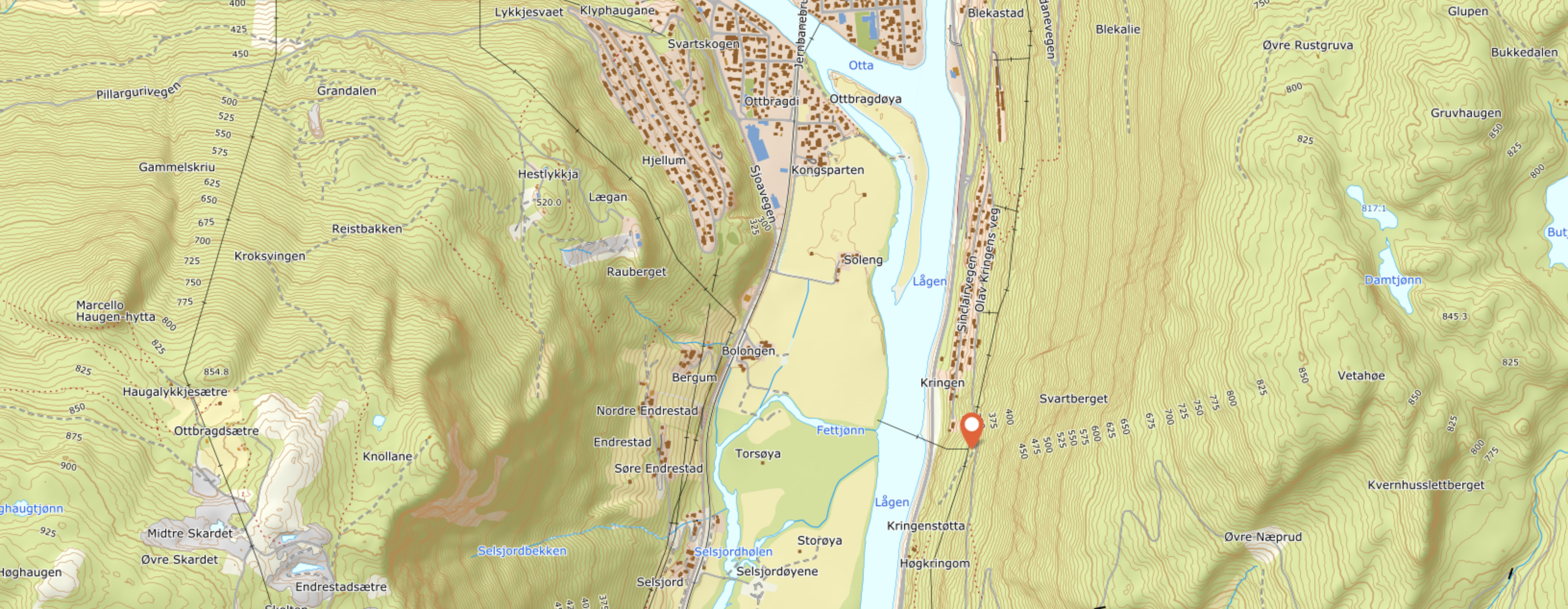
The lyrics to “Noregsgard” – as is the case with all the tracks on Nordavind – are incorrectly rendered in various online sources, and at several crucial points.
The fifth verse is often rendered incorrectly, or more commonly, the second line is omitted:
Der blant Norges skog og mark
Var fienden grell og fæl
Hans grimme sinn skulle vise dem
At norsønn han har nok at tæl
There among Norway’s forests and fields
The enemy was harsh and foul
His grim spirit would show them
That the son of Norway has plenty of grit
The same applies to the seventh and final verse. In several places, the second line is rendered as: “Norsonn tapte noregsgard for ein haer” or “Norsonn tapte noregsgard for ein han sigers hær” (Norsonn lost Noregsgard to an army), neither of which makes sense. I have tried stripping away the music and listening to the lyrics repeatedly, but it seems impossible to determine what is actually being said in that line. Therefore, it is written as “[…]”. I have kept the word “Norsønn” in the English translation. It means “son of the north”.
Norsønn tapte Noregsgard
For ein [...] hær
Stolt han var da han kom igjen
For å kløyve dem med sitt sverd
Norsønn lost Noregsgard
Against a [...] army
Proud he was when he returned
To cleave them with his sword
In one sense, this seems to be the crux of the matter. What kind of army are we talking about? Is it Sinclair’s army, the Scottish expedition? It is hardly stated outright. Regardless, this is a simile for black metal’s struggle against the false Christian light.
After this article was published, the answer came in the form of a comment on the Norwegian article from Jonatan Håbu, who believes that the word I couldn’t figure out is “landssvikers.” I believe he is absolutely right! Håbu also points out, correctly again, that since “Noregsgard” is supposed to be written in Nynorsk, it should have been sung as “landssvikars,” which it is not. It must be said—and Håbu makes a point of this as well—that the Nynorsk is far from textbook-perfect, either in “Noregsgard” or in the other tracks on Nordavind.
Where I disagree with Håbu is in his claim that the third line of the first verse should not be “Opp gjennom åsen gråstein han bar” (Up through the hill, gray stones he carried), but rather “Opp gjennom åsen gråstein og bark” (Up through the hill, gray stone and bark). I believe it is clear that what is sung is “gråstein han bar” (gray stones he carried), and although it may seem strange to carry stones on a hike – this capable man has, after all, just left his farm where he was surely used to clearing stones from his fields – it doesn’t seem to make any sense for it to say “Opp gjennom åsen gråstein og bark” (Up through the hill, gray stone and bark). Here, I think we should instead look at the purpose of the stones he is carrying. He is, after all, going to reach his goal on the heights: namely, to defeat this traitor’s army by any means necessary, and stones are a widely used weapon.
Thus, with the help of Jonatan Håbu, I can finally present the complete text of “Noregsgard.”
"Noregsgard"
Storm

Ein dugal kar fra garden dro
Han fulgte furuas sus
Opp gjennom åsen gråstein han bar
Staut hans gange var

Svøpt i morgengry
Under ein helnorsk himmel
Hans føtter traurig vandres hen
Mot sitt mål opp på høyden

Ein værbitt hand griper sverdet fatt
Og kløyver den blånende skalle
Hans kjeft den vrir seg i ulmende hat
Ufrender kommer at falle

Så stod han der på utkikkstopp
Hans øyne ei fekk kvile
For han søkte reint eit syn
Men det ble ein grusom pine

Der blant Norges skog og mark
Var fienden grell og fæl
Hans grimme sinn skulle vise dem
At norsønn han har nok at tæl

Ein værbitt hand griper sverdet fatt
Og kløyver den blånende skalle
Hans kjeft den vrir seg i ulmende hat
Ufrender kommer at falle

Norsønn tapte Noregsgard
For ein landssvikers hær
Stolt han var da han kom igjen
For å kløyve dem med sitt sverd
"Noregsgard"
Storm

A capable man left the farm
He followed the rustling of the pines
Up through the hill he carried gray stone
Stout was his gait

Wrapped in the dawn
Under a purely Norwegian sky
His feet wander wearily onward
Toward his goal upon the heights

A weather-beaten hand grips the sword
And cleaves the bluing skull
His mouth twists in smoldering hate
Enemies are bound to fall

There he stood upon the lookout peak
His eyes found no rest
For he sought a pure sight
But it became a cruel torment

There among Norway's woods and fields
The enemy was garish and foul
His grim mind would show them
That norsønn has plenty of grit

A weather-beaten hand grips the sword
And cleaves the bluing skull
His mouth twists in smoldering hate
Enemies are bound to fall

Norsønn lost Noregsgard
To a traitor's army
Proud he was when he returned
To cleave them with his sword
Who, then, is the traitor in this text, who conquers Noregsgard with his army? It is, of course, the Christian saga kings who brought Christianity to Norway – or Noregsgard, as Norway is called in the song. It is thus also clear that it is the bluing skulls of Christianity that are split by Norsønn’s sword.
Utferd
Just as “Innferd” opens Storms Nordavind, the tenth song “Utferd” (exit/journey) closes the album.
The words innferd and utferd consist of two parts: inn/ut and ferd, where the adverb inn (in) means “a direction from something external to something internal”, the adverb ut (out) means “a direction from something internal to something external”, and the noun ferd (journey) describes “a journey”. All three words are from Old Norse. The word ferd is used quite often in black metal to describe a journey, often a figurative mental journey, a transformation from something to something, which is so important in black metal.
The use of the words innferd and utferd as titles for the songs that start and end Nordavind indicates that one is entering something at the beginning that one is leaving at the end. The words also have a solemnity that is reinforced by the instrumentation.
«Utferd» is 1:58 minutes long; it is an instrumental featuring finger-picked acoustic guitar—with nylon strings and recorded with an external microphone(?)—over a soft bed of long synthesizer tones. Wongraven is responsible for the arrangement of an old melody marked “Ny Trad.,” as well as the instrumentation.
But which traditional tune is ‘Utferd’ based on?
There is no answer to that on the internet, or at least I haven’t found the answer.
The music recognition app Shazam only gives the obvious answer, namely “Utferd” by Storm.
I therefore sent the song to my NRK colleague, folk music authority, and multi-instrumentalist Leiv Solberg. Leiv has hosted the folk music program Folkemusikktimen on NRK P2 since 1988.60 He holds a master’s degree in music and helped establish the folk music program at the University of South-Eastern Norway in 1987.61
Leiv writes to me in an email:
This is hard to pinpoint off the top of my head, but it sounds like the second phrase of a folk melody, with a closing turn. I assume it’s the slow three-beat track with the guitar melody on top of the synth you’re thinking of. It’s a clear contrast to what came before – almost like walking out of an intense party with a loud PA system and wandering home feeling a bit empty. That specific sense of numbness is reinforced by this slightly romantic theme repeating over and over without you ever hearing the main theme, the first phrase. It makes your head spin, really. As for exactly where this theme comes from, no bells are ringing so far. I can run it by a few people here and there.
Email from Leiv Solberg, January 31, 2022.
That’s where things stand now, so we’ll see.
When the sound of “Utferd” fades out, we are essentially finished with Nordavind, and thus also Storm, as Nordavind was the only release they put out. Or not quite. There is one more track released under the name Storm. Therefore, I am also including the story behind it.
Oppunder skrent og villmark
On December 13, 1996, a year and a half after Storm released Nordavind, the double compilation Crusade from the North was released on Wongraven’s record label, Moonfog. It is a compilation featuring the bands Satyricon, Darkthrone, Storm, Wongraven, Isengard, and Neptune Towers. As previously mentioned, Satyricon and Wongraven are Sigurd “Satyr” Wongraven’s bands, along with Storm, which he shares with Gylve Fenris Nagell. Nagell, for his part, is represented by four bands – primarily Darkthrone and Storm, but also his solo projects, Isengard and Neptune Towers. As noted earlier in the article, Neptune Towers is a dark ambient project, and Isengard is a folk metal project.
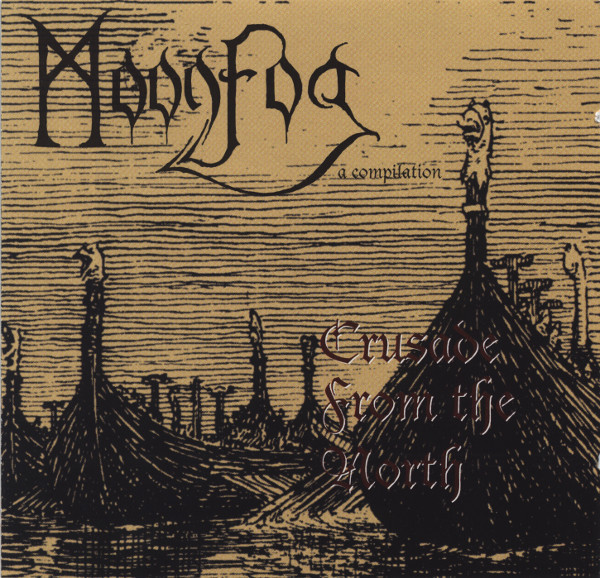
In the interview with Wongraven in the Norwegian fanzine Nordic Vision from the spring of 1995, he says the following at the very end of the interview when asked if Storm will be playing live:
– I don’t think you will see us live. We have received offers but it is not possible to play live since we handle so many instruments at the same time in the studio. Just listen to Nordavind and the upcoming EP instead.
Sigurd «Satyr» Wongraven, Nordic Vision, 1995(3).
The EP Wongraven mentions here never materialized. However, one more Storm track was released, appearing on Crusade from the North in December 1996. That track is titled “Oppunder skrent og villmark” (At the foot of cliffs and wilderness). It was either written for Nordavind and omitted from that release, or it was recorded for the aforementioned EP. Since Rueslåtten sings on “Oppunder skrent og villmark” and had a falling out with Nagell and Wongraven even before the release of Nordavind, it is perhaps most plausible to assume that this track was recorded during the Nordavind sessions. However, there may have been talk of a follow-up EP as early as the recording of Nordavind; we simply don’t know.
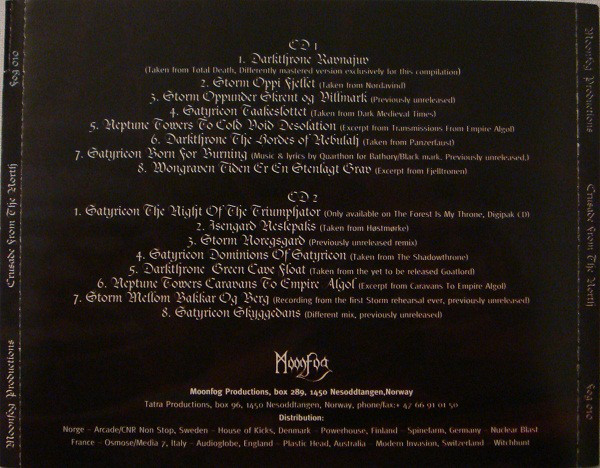
Crusade from the North (1996)
| # | Band | Song | Release | Information | Length |
| Disc 1 | |||||
| Side A | |||||
| 1. | Darkthrone | «Ravnajuv» | Total Death (1996) | «Taken from Total Death. Differently mastered version exclusively for this compilation» | 04:21 |
| 2. | Storm | «Oppi fjellet» | Nordavind (1995) | «Taken from Nordavind» | 04:02 |
| 3. | Storm | «Oppunder skrent og villmark» | Previously unreleased | «Previously unreleased» | 05:58 |
| 4. | Satyricon | «Taakeslottet» | Dark Medieval Times (1993) | «Taken from Dark Medieval Times» | 05:47 |
| Side B | |||||
| 5. | Neptune Towers | «To Cold Void Desolation» | Transmissions from Empire Algol (1995) | «Excerpt from Transmissions from Empire Algol» | 05:41 |
| 6. | Darkthrone | «The Hordes of Nebulah» | Panzerfaust (1995) | «Taken from Panzerfaust» | 05:34 |
| 7. | Satyricon | «Born for Burning» | Bathory cover, The Return…… (1985) | «Music & lyrics Quorthon for Bathory/Black Mark. Previously unreleased.» | 05:20 |
| 8. | Wongraven | «Tiden er en stenlagt grav» | Fjelltronen (1995) | «Excerpt from Fjelltronen» | 08:07 |
| 44:50 | |||||
| Disc 2 | |||||
| Side A | |||||
| 1. | Satyricon | «The Night of the Triumphator» | The Forest is my Throne / Yggdrasill (1995) | «Only available on The Forest Is My Throne, Digipak CD)» | 05:16 |
| 2. | Isengard | «Neslepaks» | Høstmørke (1995) | «Taken from Høstmørke» | 05:32 |
| 3. | Storm | «Noregsgard» | Nordavind (1995) | «Previously unreleased remix» | 06:11 |
| 4. | Satyricon | «Dominions of Satyricon» | The Shadowthrone (1994) | «Taken from The Shadowthrone» | 09:27 |
| Side B | |||||
| 5. | Darkthrone | «Green Cave Float» | Goatlord (1996) | «Taken from the yet to be released Goatlord» | 04:06 |
| 6. | Neptune Towers | «Caravans to Empire Algol» | Caravans to Empire Algol (1994) | «Excerpt from Caravans to Empire Algol» | 06:31 |
| 7. | Storm | «Mellom bakkar og berg» | Nordavind (1995) | «Recording from the first Storm rehearsal ever, previously unreleased» | 03:05 |
| 8. | Satyricon | «Skyggedans» | Dark Medieval Times (1993) | «Different mix, previously unreleased» | 03:54 |
| 44:02 |
Crusade from the North is adorned with another illustration from Snorri’s Heimskringla, just like Nordavind, but this time it is placed on the front cover rather than second to last in the booklet. The illustration is taken from the King Olaf Trygvason’s Saga, was drawn by Erik Werenskiold, and bears the caption “Seierherrenes skip vender hjem etter slaget ved Svolder” (The victors’ ships return home after the Battle of Svolder). The Battle of Svolder was a naval battle fought in the western Baltic Sea in September of the year 999 or 1000.
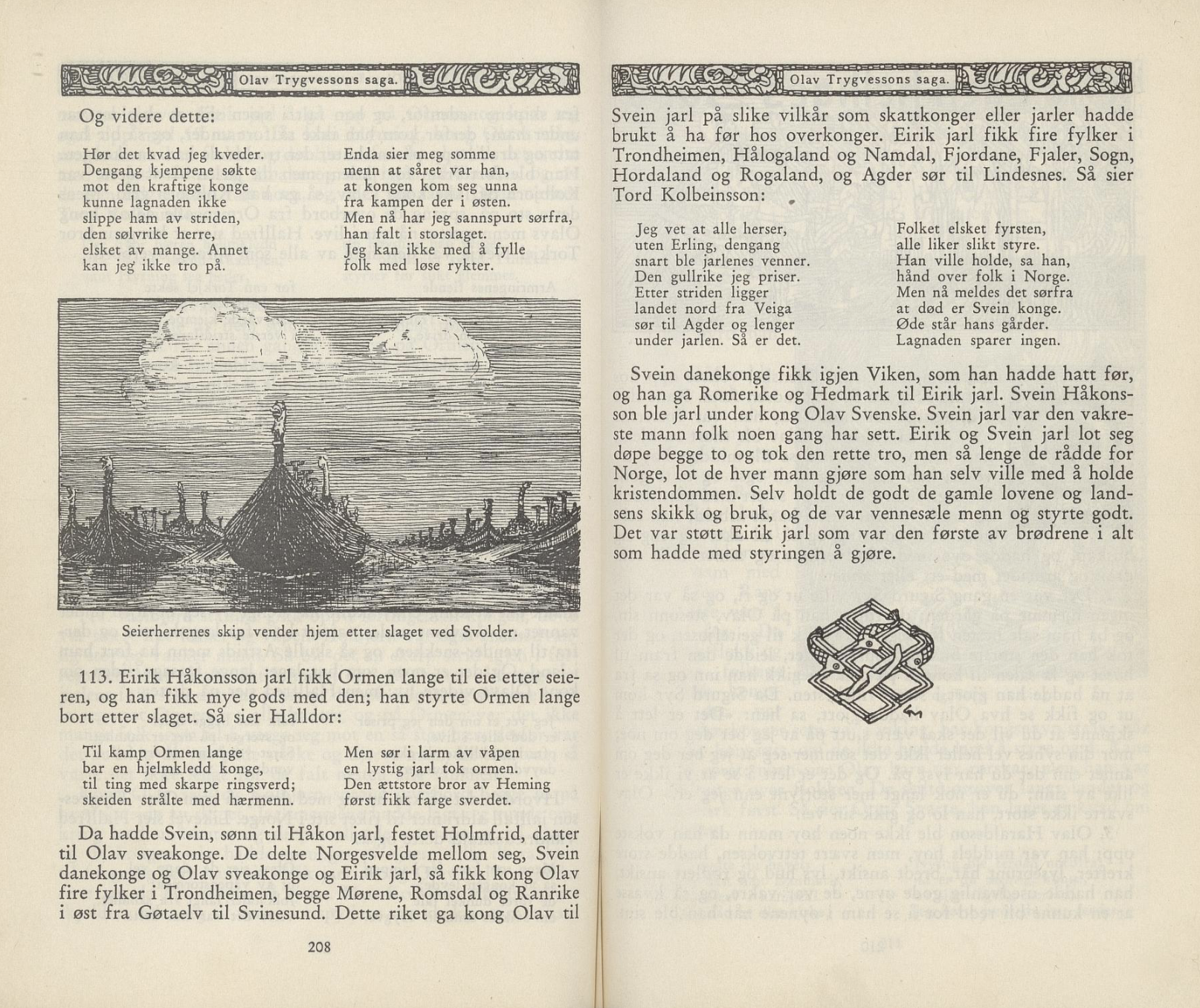
Olav Tryggvason was the first of the two great Norwegian missionary kings. His successor was Olav II Haraldsson, Saint Olaf. King Olav Tryggvason died at the Battle of Svolder, which set back the further development of Norway as a Christian nation.62 Here is what Wikipedia says about the battle:
King Olaf Tryggvason was sailing to, or home from, an expedition in Wendland (Pomerania), when he was ambushed by an alliance of Svein Forkbeard, King of Denmark, Olof Skötkonung (also known as Olaf Eiríksson or Olaf the Swede), King of Sweden, and Eirik Hákonarson, Jarl of Lade. According to the Saga of King Olaf I Tryggvason, he had 60 warships plus the contribution of 11 warships from the Jomvikings. His ships were captured one by one, last of all the Ormen Lange, which Jarl Eirik captured as Olaf threw himself into the sea. After the battle, Norway was ruled by the Jarls of Lade allied (as a suzerain) to both the Danish Crown and the Commonwealth of Uppsala, Sweden.
Wikipedia: https://en.wikipedia.org/wiki/Battle_of_Svolder.
It was therefore Eirik Håkonsson, the Earl of Lade from Trøndelag, who was one of the victors of the Battle of Svolder. It is clear that the victory over the Christian missionary king Olav Tryggvason was a major motivation for Nagell and Wongraven’s use of the victors’ ships as an illustration for the release Crusade from the North. However, the struggle against the king was likely not a battle over Christianity. According to Snorre Sturlasson, Eirik Håkonsson was more of a realpolitician than a dogmatist and held a pragmatic view of religion. Nevertheless, the image of the victors’ ships returning home after the Battle of Svolder – where the Christian missionary king Olav Tryggvason fell to superior forces – provides a fitting symbol of black metal’s mission and its dream for the future.
Let us return to the song “Oppunder Skrent og Villmark”.63 The track is 5:58 long and features bass, drums, guitar, and vocals. The majority of the vocals are performed by Kari Rueslåtten, though both Nagell and Wongraven contribute backing vocals. The final lines are sung by Nagell. In fact, the backing vocals on “Oppunder Skrent og Villmark” are more sophisticated than on Nordavind and sound good. The music is taken from Edvard Grieg’s “Solveig’s Song”, which is part of Grieg’s incidental music for the production of Henrik Ibsen’s play Peer Gynt. The music was composed in 1874–1875.64
The text of “Oppunder Skrent og Villmark” is thus taken from Ibsen’s Peer Gynt. It reads (in Norwegian):
(Sommerdag. Høyt oppe mot nord. En hytte i storskogen. Åpen dør med en stor trelås. Rensdyrhorn over døren. En flokk geiter ved husveggen.)
(En middelaldrende kvinne, lys og smukk, sitter og spinner utenfor i solskinnet.)
Kvinnen (kaster et øye ned over veien og synger):

Kanskje vil der gå både vinter og vår,
og neste sommer med, og det hele år; —
men en gang vil du komme, det vet jeg visst;
og jeg skal nok vente, for det lovte jeg sist.
	(lokker på geitene, spinner og synger igjen.)
Gud styrke deg, hvor du i verden går!
Gud glede deg, hvis du for hans fotskammel står!
Her skal jeg vente til du kommer igen;
og venter du hist oppe, vi treffes der, min venn!
And in an English translation:
Outside a hut in a forest in the far north of Norway. It is a summer's day.
The door, which stands open, is furnished with a massive wooden bolt; above the door a pair of reindeer horns is  fixed. A herd of goats are feeding by the wall. SOLVEIG, now a fair and handsome middle-aged woman, is sitting spinning in the sunshine.

SOLVEIG [looks down the path and sings].

It may not be till winter's past,
And spring and summer — the whole long year;
But I know that you will come at last,
And I shall wait, for I promised you, dear.

[Calls to her goats, then resumes her spinning and singing.]

God guard you, dear, where'er you be!
If in Heaven, God have you in His care!
I shall wait till you come back to me;
If you're waiting above I shall meet you there!65
However, only parts of the text on “Oppunder Skrent og Villmark” are taken from Ibsen. The rest was written by Storm. Deviating text is highlighted.
«Oppunder Skrent Og Villmark»
Storm

Kanskje vil der gå både vinter og vår, både vinter og vår.
Og neste sommer med og det hele år, og det hele år.
Men en gang vil du komme det vet jeg visst, det vet jeg visst.
For her har du landet og den du har kjær, og den du har kjær

Kanskje vil der gå både vinter og vår, både vinter og vår
Før jeg igjen se det ganske land, det ganske land
Der forfedre kjempet for retten til liv, for retten til liv

Skal jeg atter se utover mektige fjell, og li og dal og skog og fjord

Her vil jeg bo, her skal jeg leve
Oppunder skrent og villmark

Her vil jeg bo, her skal jeg leve
Oppunder skrent og villmark

Her vil jeg bo, her skal jeg leve
Oppunder skrent og villmark

Her vil jeg bo, her skal jeg leve
Oppunder skrent og villmark

Jeg skal atter se utover mektige fjell, og li og dal og skog og fjord
Her i vårt rike stor og høy

"Ja, selv guder må dø, når alteret synker i støv og de som tror på dem er døde."
«Solveigs sang»
Henrik Ibsen / Edvard Grieg

Kanskje vil der gå både vinter og vår, både vinter og vår.
Og neste sommer med og det hele år, og det hele år
Men en gang vil du komme det vet jeg visst, det vet jeg visst,
og jeg skal nok vente, for det lovte jeg sist, for det lovte jeg sist.

Gud styrke deg hvor du i verden går, i verden går!
Gud glede deg hvis du for hans fotskammel står, for hans fotskammel står!
Her skal jeg vente til du kommer igjen, du kommer igjen, og venter du hist oppe vi treffes der, min venn, vi treffes der, min venn!
Solveig is Peer Gynt’s faithful love who waits for him throughout an entire lifetime, and in “Solveig’s Song”, this longing and faithfulness are expressed while Peer is simultaneously in Egypt.
As on several previous occasions, Storm is once again quite bold, displaying a great deal of self-confidence as they expand and alter a classic text to support their own message. This clearly demonstrates a lack of respect for authority, while the use of these old texts simultaneously links Storm’s and black metal’s agenda closely to the National Romantic project. It should be noted that Ibsen’s relationship with National Romanticism is not entirely settled and remains a subject of ongoing debate.
There is also a clear break between Ibsen’s text and the section added by Storm. For one thing, there are differences in quality, but there is also a shift in perspective. Ibsen’s “men en gang vil du komme det vet jeg visst / But I know that you will come at last” expresses Solveig’s longing for Peer, and the “du/you” in the sentence refers to him. Storm then removes Ibsen’s subsequent line, “og jeg skal nok vente, for det lovte jeg sist / And I shall wait, for I promised you, dear”, replacing it with the sentence, “For her har du landet og den du har kjær / For here you have the land and the one you hold dear”. Consequently, the focus shifts far beyond Solveig’s longing and toward the nation itself. The National Romantic perspective is thus introduced through a single sentence. The reference to Peer as “du/you” in “her har du landet / here you have the land” and to Solveig in “den du har kjær / the one you hold dear” – where Solveig seemingly still addresses Peer about waiting for him – is the last we hear of the relationship between Solveig and Peer in Storm’s version.
The rest of the text is a tribute to the country, and Peer is forgotten in the National Romantic absorption. We understand that not only Peer, but also Solveig and her profound longing have disappeared from this version, and that the “du/you” in Ibsen’s “men en gang vil du komme det vet jeg visst / But I know that you will come at last” does not refer to Peer, but to the land as it was before Christianization. In this light, the sentence “For her har du landet og den du har kjær / For here you have the land and the one you hold dear” stands as a strange anomaly between Ibsen’s and Storm’s perspectives—a transitional sentence that could have been handled more smoothly. Ideally, that sentence should have been cut so that “du / you” could more unambiguously refer to this promised land of old. Alternatively, the subordinate clause “den du har kjær / the one you hold dear” could have been written as “det du har kjært / that which you hold dear,” which would have provided the correct reference.
That it is the ancient Old Norse Norway being longed for is clearly evident in the next three lines added by Storm, included my English translation:
Før jeg igjen se det ganske land, det ganske land
Der forfedre kjempet for retten til liv, for retten til liv
Skal jeg atter se ut over mektige fjell, og li og dal og skog og fjord
Before I again see the whole land, the whole land
Where ancestors fought for the right to life, for the right to life
I shall once more look out over mighty mountains, and hillsides and valleys and forests and fjords.
The front line is clear that they are waiting for this bygone land to return, where people fought for their lives in a more authentic way.
The third line seems to me to be inspired by another poem set to music by Edvard Grieg, namely Aasmund Olavsson Vinje’s poem “Ved Rundarne” from the collection Ferdaminni fraa Sumaren 1860.66 This poem begins like this, included my English translation:
No seer eg atter slike Fjøll og Dalar
Now I see such mountains and valleys again.
Eller i Olav Midttuns mer moderne form med tittelen «Ved Rondane»:67
No ser eg atter slike fjell og dalar
This is a poem that most people are familiar with, or at least the first line, and it is not unlikely that it was in the back of the minds of the members of Storm when they wrote the lyrics for “Oppunder Skrent og Villmark”.
I also consider it quite likely that the phrase that gave the song its name, “Oppunder skrent og villmark” (At the foot of cliffs and wilderness), was inspired by the line “Eg bur oppunder fjell” (I live at the foot of the mountain) from the song “Haavard Hedde”.
In the following lines: “Jeg skal atter se utover mektige fjell, og li og dal og skog og fjord / Her i vårt rike stor og høy” / “I shall once again gaze out over mighty mountains, and hillside and valley and forest and fjord / Here in our kingdom great and tall”, the last line is a bit strange. What does “stor og høy / great and tall” actually refer to here? If it were “vårt rike / our kingdom,” it should have been inflected in the neuter form as “stort og høyt / great and tall” If we are to take what is written literally, it must point back to the “I” in “Jeg skal atter se utover / I shall once again gaze.” If this is correct, it reaffirms the black metal protagonist’s feeling of standing above others.
“Oppunder Skrent og Villmark” concludes with the words: “‘Ja, selv guder må dø, når alteret synker i støv og de som tror på dem er døde.’ / “‘Yes, even gods must die, when the altar sinks into dust and those who believe in them are dead’”. These are placed in quotation marks in my rendition of the text because the lines come from a different perspective than the rest of the song, as if sub specie aeternitatis—from the viewpoint of eternity. I cannot find these lines reproduced anywhere other than in this song, so they must be Storm’s own original creation, and it is Nagell who delivers them. It is reminiscent of Anne Holtsmark’s account of the Völva’s vision from Völuspá, as presented in the book Norrøn mytologi: Tro og myter i vikingtiden (Old Norse Mythology: Beliefs and Myths in the Viking Age):68
Ragnarok er guders undergang; vår verden og våre guder må dø og vike plassen for nye:
    Opp ser hun stige     for annen gang
    jord av havet,      eviggrønn
Sønner av de gamle guder skal bo i den nye verden.
And now in my English translation:
Ragnarok is the doom of the gods; our world and our gods must die and make way for new ones:
    Now do I see     the earth anew
    Rise all green     from the waves again;
Sons of the old gods shall live in the new world.69
The god who in Storm’s case must die is the Christian God, and it is the altars to his honor and his faithful followers who shall pass out of time along with this god. Out of the dust, a new world shall arise, with new values and moral codes.
Conclusion
Storm’s Nordavind is a renowned release. It represents the pinnacle of Norwegian black metal’s quest for National Romantic roots to which it could cling, in order to anchor and justify its re-enchanting millenarianism, irrationality, and individualism.
Black metal’s National Romanticism points back to a time when the stout individual stood against the suggestive power of the herd, natural forces, and fate – like Norsønn against the Scottish expedition, like Haavard Hedde in his life’s struggle against nature and betrayal, like Asbjørn of Medalhus against royal power and Christianity, like Pillarguri’s heroic signal of attack against the invaders, like the milkmaids who seek refuge from the crowds in the valley and fight against intruders and Christian blood, and who, with the cows finally in the enclosure, can rest in the dark, good night, in a long night’s journey toward a new day, a new re-enchanted future built upon the Old Norse past concealed by Christianity.
Black metal also points away from the rationality of the Enlightenment, into the re-enchanted forests of Romanticism where sprites and trolls are once again brought to life – like Villemann’s interaction with his master, the neck; like the girl, or is it the huldra, who lures her boy to her special, mystical place up on the hill where the trees cast shadows, the moss is soft, and fairytales still live; like the Norwegian’s fascination with the playful fish in the churning depths of the sea; and like the life of the superman on the foot of cliffs and wilderness, gazing out upon the transience of gods.
The new re-enchanted era shall cultivate a human being who is close to nature, upright, capable, and stout, fighting hard for primordial Norwegian core values, with a solid code of honor, sincerity, and – not least – a strong resistance to following the herd. The forests shall once again hold the mystery and the depths of the human soul, where goblins and trolls tumble, satyrs entice, and where the neck plays you into a state of intoxication.
Black metal, as it manifested in Norway in the 1990s, represents a turn away from modernity and back toward former glory, but also toward a re-enchanted world where mysticism and sensuality – the pre-theoretical experience – thrive; much as political philosopher Arthur M. Melzer describes, albeit in a different context, how the modern mindset is built on a progressive understanding of theory that detaches it from the richness of lived experience:
Modern thought is built on the opposite hope that by its success in transforming, enlightening, and disenchanting the world and by its continual progress in explaining the kind of things that it can explain, it will cause all testimony to or experience of the kind of things that it cannot explain to simply wither away. The world of traditional society, with its spirits, gods, and poets, will simply disappear, refuted by history. In short, modern thought hopes to legitimize itself precisely through the obliteration of pretheoretical experience.
Melzer (2014/2017), p. 366.
Perhaps the most apolitical, nationalistic and, in a sense, unsettling aspect of black metal’s project – as evidenced in Storm’s Nordavind and the subsequent controversy – is the unwillingness to engage in discussion and dialogue about the project. This mirrors Darkthrone’s rejection of the criticism leveled against the release Transilvanian Hunger. It appears that Drew Daniel (2014) is onto something in his claim that black metal is anti-political; that it positions itself, as it were, in the shadows of political reality, in the night of obscurity, making it difficult to grasp.
Black metal is perceived more as a cult with a parallel worldview than as a genuine ideological opponent. This may be part of the reason why law enforcement and the press failed to get a proper grasp of black metal’s ideology during the era of church burnings and murders in the early nineties, quickly falling into a narrow, Satanic narrative.
Drew Daniel utilizes the French philosopher Alain Badiou’s concept of “occultation” to describe what Badiou calls “the descent of th[e] present into the night of non-exposition”.70 Badiou uses the term to describe three possible ways of encountering political events: by embracing them, denying them, or occulting them – that is, obscuring them.
Badiou claims that meeting political events with occultation means diving into a night of obscurity, where the possibilities for achieving political truths are suppressed. This night of obscurity, he argues, must be produced under entirely new conditions expressed through the bodies of the rebels and the use of symbols.
For Drew Daniel, the black metal protagonist’s corpse paint becomes a powerful symbol of the occultation of melancholy, or rather, the darkening of melancholy that he believes black metal represents. The black metal protagonist, Daniel claims, “chooses to drown the present in a fog of black bile”.71
Choosing melancholy thus becomes, for Daniel, a type of anti-political act, serving as a third alternative to either embracing or denying reality. Daniel describes the black metal protagonist’s temporal “revolt against living within the present as such, a flight not simply backwards, but out of time“.72 Through melancholy’s darkening of the present and a nostalgic, backward-looking movement, the black metal character positions itself beyond reality.
I am, however, tempted to say that Storm, through Nordavind, despite its violent outbursts against Christians, largely paints a more positive picture of a possible alternative reality than what Drew Daniel identifies as typical of black metal. And this essentially permeates the work of these two figures in particular, Nagell and Wongraven. Nagell considers humor to be the most important thing in his life, alongside music and nature. He is constantly changing his mind and believes it is important to be in a state of flux. When asked by Mode Steinkjer if he could imagine living in another era, he says that he thrives in the time he is in.
Wongraven er som Nagell på denne tiden sterkt i opposisjon, noe han som Nagell har tonet ned i senere år. Han er allerede da en seriøs og hardtarbeidende artist som stadig utfordrer seg selv både musikalsk og på andre arenaer, og med et helt annet kommersielt driv enn Nagell. Han er reflektert og søker seg tilsynelatende ut av de enkle sannhetene som ungdomstiden bærer med seg, men klarer ennå ikke på denne tiden å komme seg ut av opposisjonens tvingende nødvendighet. Han har som Nagell en sterk dragning mot naturen og det mørke i mennesket.
At this time, Wongraven, like Nagell, was strongly in opposition – a stance that he, like Nagell, has toned down in later years. Even then, he was a serious and hardworking artist who constantly challenged himself both musically and in other arenas, and he possessed a completely different commercial drive than Nagell. He is reflective and seemingly seeks to move beyond the simple truths of youth, yet at this point, he is not yet able to escape the compelling necessity of being in opposition. Like Nagell, he has a strong attraction to nature and the darkness within humanity.
That Nordavind is National Romantic is beyond any doubt. It is, after all, printed on the release itself. The question is, how nationalist is it?
In the interview with Mode Steinkjer in Puls,73 Wongraven is clear that he has nothing against Christian people, but rather objects to Christianity as an institution and a power structure that traps and oppresses people. However, the outbursts directed at Christianity and Christians by Storm on Nordavind might suggest otherwise. If there is anything Wongraven regrets, it is likely the way this struggle against Christianity is expressed as a fight against Christian people. In one sense, these are identical because Christianity does not exist without Christian people; however, it is possible to oppose Christianity without opposing its practitioners. Wongraven makes this distinction in the Puls interview with Mode Steinkjer during their dialogue about Israel and its inhabitants. In this respect, neither Wongraven nor Nagell seem to be against “de-Christianized” people. In a way, black metal ideology seems open to anyone who wishes to enter it, as long as they leave Christianity and slave morality behind, think for themselves, and are sincere in their embrace of it.
National Romanticism is a nationalist movement, but it is of a moderate type that we all recognize from Constitution Day, May 17th, and the description of Norwegian nature. Moderate nationalism, according to the Great Norwegian Encyclopedia, in my translation, “accepts immigration and the admission of new citizens, but expects adaptation to the country’s language and customs”.74
A more serious form of nationalism is called chauvinism or extreme nationalism. Again, according to the Great Norwegian Encyclopedia, proponents of this form of nationalism insist that, in my translation, “citizenship should be reserved for children of parents with the same citizenship and are against immigration from what they see as foreign cultural areas”.
An even more extreme nationalism may claim that ethnic homogeneity has intrinsic value, that its own form of ethnicity is superior to others, and lead to the oppression of minorities, ethnic cleansing, and genocide.
In this respect, Nordavind appears to express a fairly moderate form of nationalism – namely National Romanticism – with a linguistic style occasionally influenced by more extreme forms of nationalism.
Questions
Although this text answers a number of questions, the observant reader will have noticed that it also poses several questions. Some of these are the following:
- Who plays the synthesizer on Dødheimsgard’s album Kronet til Konge (1995)? Is it Gylve Fenris Nagell?
- Did Sigurd Wongraven actually regret that Storm portrayed Nordavind in a way that could be interpreted as nationalistic? (And here we must assume that extreme nationalism is meant.)
- What was the lead-up to Darkthrone’s dispute with the record label Peaceville; was it the phrase “Norwegian Aryan Black Metal” or the phrase “obviously jewish behaviour”?
- What is the meaning of the notations “Ny Trad.” versus “Trad.” in the source references for the tracks on Nordavind?
- Is the poet Edvard Storm’s surname the origin of the band name Storm?
- And are Edvard Storm’s “Zinklars vise” and Folque’s “Sinclairvise” the reason why Nagell and Wongraven traveled to Otta in September 1994?
- Have Nagell and Wongraven refrained from making versions of songs recorded by Folque out of respect for Folque?
- Which written sources did the band members of Storm use to find the songs they selected for Nordavind?
- Why did Storm choose to include the folk song “Haavard Hedde” on Nordavind?
- Is Storm’s version of “Haavard Hedde” the reason Sunn O))) recorded “The Gates of Ballard” with the same lyrics?
- Why did Storm choose to include the folk song “Villemann” on Nordavind?
- Which bluemen is Storm ashamed of in “Oppi fjellet”?
- What is actually being said in the line “[…] kviskrer i mørkret” from the section added by Storm to “Langt borti lia”?
- And does this added text come from an author other than the members of Storm themselves?
- Is there another lyricist for “Lokk” other than the members of Storm themselves?
- Who are the bluemen in the song “Noregsgard”? Is it the Scottish expedition?
- What is the text in the line “For ein […] hær” in “Noregsgard”?
- Which folk tune is “Utferd” based on?
- What happened to Storm’s follow-up EP to Nordavind?
- And is the song “Oppunder skrent og villmark” from this unreleased EP coming out?
If you know the answer to one or more of these questions, please write it in the comments section below. Do the same if you have other comments or input regarding this text. Comments that do not follow proper etiquette or are irrelevant will be deleted.
Sources
See: Kilder.
- Not to be confused with the heavy metal band Storm from Trondheim who were active from 1980–1983. They released a Norwegian-language album called Stille før stormen in 1982. Storm (1982). ↩︎
- The 3rd and the Mortals’ debut, the EP Sorrow (1994), was released on the record label Head Not Found, run by Jon “Metallion” Kristiansen who also released, among others, Gehennas EP First Spell (1994) [EP], and Ulvers Bergtatt – Et Eeventyr i 5 Capitler (1995) before Voices of Wonder Records took over. ↩︎
- The album was recorded in February 1995. ↩︎
- Nagell claims in several interviews that Sweet Freedom was an important source of inspiration for him ever since he received it as a birthday present as a three-year-old from his uncle. See e.g. https://en.wikipedia.org/wiki/Fenriz. Gary Thain is also one of the young people who died in rock. He died at the age of 27 from a heroin overdose on December 8, 1975. ↩︎
- Moonfog Productions was founded as a subsidiary of Tatra Productions/Records in 1993, by Tormod Opedal together with Sigurd Wongraven, for the release of black metal. ↩︎
- It seems likely that the use of a double ellipsis (…) after “Eternal Hails”, and without a space before the double ellipsis (which is incorrect in Norwegian and American English, and partly incorrect in British English since there are two contradictory practices there) points back to Bathory’s second album The Return…… from 1985. Thomas Börje “Quorthon” Forsberg explains the title of the album on Bathory’s official website as follows: “We wanted people to just read out The Return…… – as in a second album or a follow-up – and then flip the album over to look for a tracking list. Not finding one, what they got was this apocalyptic poem with the song titles woven into it. Only after listening through the album to the end would you get the full title of the album, The Return of the Darkness and Evil”. According to Wikipedia, Gylve Fenris Nagell has praised the album in several interviews and defined it as “the essence of black metal”. One can imagine that the last song on Eternal Hails……, “Lost Arcane City of Uppåkra” which refers to an old settlement from the Late Iron Age that shows traces of urban development in Sweden, precisely points towards Bathory and Quorthon who came from Sweden, but not Uppåkra. The lyrics refer to the good old days before Christianity. There are also certain similarities between the cover of Bathory’s The Return…… and Darkthrone’s Eternal Hails…… where a luminous celestial body is centrally placed on the cover. ↩︎
- Puls (1987), no. 12, December 1987, pp. 46–47. ↩︎
- Puls (1987), no. 12, December 1987, pp. 46–47. ↩︎
- See https://web.archive.org/web/20130112070200/https://peaceville.com/bands/2194/. ↩︎
- See https://en.wikipedia.org/wiki/Transilvanian_Hunger, visited 29.12.2021. ↩︎
- Black Metal: Evolution of the Cult (2013), pp. 202-203. ↩︎
- Sound engineer Kenneth Moen has made around 80 Norwegian releases, but only three metal releases, Storm’s Nordavind, Wongraven’s Fjelltronen, and Satyricon’s The Shadowthrone. See Discogs: https://www.discogs.com/artist/410758. ↩︎
- Discogs: https://www.discogs.com/release/373477-Storm-Nordavind. ↩︎
- https://www.p22.com/family-Pabst ↩︎
- Vidkun Abraham Lauritz Jonssøn Quisling was a Norwegian officer, diplomat and politician. During the German occupation of Norway, he led a German-backed government, and after the liberation in 1945, he was convicted of treason and executed by firing squad. Varg Vikernes claims to be a relative to Vidkun Quisling through his great-great-grandmother See https://www.burzum.org/eng/library/2011_interview_druvis.shtml. ↩︎
- See https://no.wikipedia.org/wiki/Solkorset. My translation. ↩︎
- Morgenbladet no. 3, 21–27 January 2022, pp. 42–43. My translation. ↩︎
- George Sinclair is incorrectly referred to as Colonel in the song. ↩︎
- Folque, Folque (1974), «Sinclairvise». ↩︎
- My translation. ↩︎
- Wikipedia: https://no.wikipedia.org/wiki/Zinklars_vise. ↩︎
- In 2008, Faroese Viking metallers Týr included their own version of Zinklars vise under the name “Sinklars Vísa” on their album Land. The former singer of Týr, Pól Arni Holm, is now the vocalist of Hamradun. They also recorded “Sinklars Visa” on their first album Hamradun (2015). Both of these versions, which should probably be called folk metal, would probably be characterized by Nagell as something that should have been deleted. And I have to agree with him. They are two terrible versions. ↩︎
- The song is taken from Skard, V. (1967) and Holst, H. P., Mellin, G.H. & Munch, A. (1870). ↩︎
- Another band with almost the same name as Storm, namely Stormti, also clearly inspired by Edvard Storm, made an album in 1993 called Edvard Storm – Viso I Gomol Og Ny Drakt where “Zinklars Vise” is included in a slightly different version than Folque’s version. In 1996 the album Tidlause Tonar was released where the song “Aagots Fjeldsang” is included. As we will see, Storm’s “Nagellstev” is based on a version of this song. I know nothing about Stormti, and there is nothing to be found online either. ↩︎
- Sturlason (1980), p. 91. ↩︎
- Frans-Arne H. Stylegar writes in my translation from Norwegian: “The church’s campaign against horse meat dates back to the first half of the 700s, when Pope Gregory III ordered St. Boniface, the apostle of Germany, to prohibit the eating of horse meat among the new converts because of the connection between the pagan rituals of the Germans and the eating of horse meat. Already in late antiquity, the Romans had considered eating horse meat to be something particularly pagan.” http://arkeologi.blogspot.com/2013/03/smaken-av-hest.html ↩︎
- “The winter thereafter the king prepared a Yule feast in More, and eight chiefs resolved with each other to meet at it. Four of them were from without the Throndhjem district—namely, Kar of Gryting, Asbjorn of Medalhus, Thorberg of Varnes, and Orm from Ljoxa; and from the Throndhjem district, Botolf of Olvishaug, Narfe of Staf in Veradal, Thrand Hak from Egg, and Thorer Skeg from Husaby in Eyin Idre. These eight men bound themselves, the four first to root out Christianity in Norway, and the four others to oblige the king to offer sacrifice to the gods.” https://www.gutenberg.org/cache/epub/598/pg598-images.html#link2H_4_0078. ↩︎
- https://en.wikipedia.org/wiki/Nordmannen. ↩︎
- See https://www.nynorsk.no/ivar-aasen/nordmannen/korrekt-versjon-nordmannen/. ↩︎
- See https://en.wikipedia.org/wiki/Isengard og https://no.wikipedia.org/wiki/Jarnagard. ↩︎
- See Wikipedia https://en.wikipedia.org/wiki/Theatre_War. ↩︎
- Another unflattering incident in Haavard Folkesson Helle’s life was that, at the age of 17, he narrowly escaped a sodomy conviction for having had sex with a cow. See https://lokalhistoriewiki.no/wiki/Håvard_Hedde. ↩︎
- See https://sunn.bandcamp.com/track/the-gates-of-ballard. ↩︎
- A version exists in Buen, Myhren & Garnås (1978), pp. 208–209. ↩︎
- See Buen, Myhren & Garnås (1978), pp. 208–209. ↩︎
- See https://snl.no/Fjeldeventyret. ↩︎
- Summary taken from https://snl.no/Fjeldeventyret. ↩︎
- See https://snl.no/lokk. ↩︎
- Semb (1922/1991), p. 303. Slightly modernized version of Janson’s original poem “Paa fjellet”, pp. 33–34. A fifth stanza has also been removed. The melody was one of the most famous folk tunes of the 19th century. ↩︎
- Puls (1995), no. 8, p. 7. ↩︎
- Puls (1995), no. 8, p. 7. ↩︎
- Norwegian Wikipedia states the following regarding blåmenn: “Blåmann (plural: blåmenn), or blámaðr in Old Norse, was the name used by the ancient Norse for people with dark skin, meaning ‘negroes’ and Moors, i.e., North Africans. The word is used, among other things, in folk ballads from the Middle Ages. In the past, blá could mean blue, dark blue, and black.” https://no.wikipedia.org/wiki/Blåmenn. ↩︎
- Snorri (1980), s. 611. ↩︎
- https://www.gutenberg.org/cache/epub/598/pg598-images.html#link2H_4_0692. ↩︎
- See https://snl.no/religionsfrihet. ↩︎
- Hodne (1995), pp. 29–30. ↩︎
- Løwe (2012), p. 86. ↩︎
- Poulsen (1931), pp. 43–48. ↩︎
- Retrieved from: https://snl.no/Fenrisulven. ↩︎
- Børli, 1970, p. 39. My translation. ↩︎
- It is unclear whether the text here is “dyr”. ↩︎
- Photo by Daniel Georg Nyblin (1826–1910) – Cropped versions of File:Portrett av Henrik Ibsen, 1863-64.jpg, Offentlig eiendom, https://commons.wikimedia.org/w/index.php?curid=92275309. ↩︎
- The report is written by E. H., p. 2. https://www.nb.no/items/514dc27e9822c46e00aebf96e0755154. ↩︎
- Tveiten (1952), p. 76. ↩︎
- Tveiten (1943), pp. 134–135. ↩︎
- Tveiten (1943), pp. 23–24. ↩︎
- Garborg (1895/1993), p. 127. ↩︎
- Garborg (1895/1993), p. 129. ↩︎
- Garborg (1895/1993), p. 130. ↩︎
- According to Wikipedia, Folkemusikktimen (which began as Folkemusikkhalvtimen) is one of the world’s oldest regular radio programs and has aired almost continuously since 1931. Leiv Solberg is the fifth host in the program’s history. ↩︎
- In 2021, Leiv Solberg was awarded the King’s Medal of Merit. He celebrated the occasion with, among others, his NRK colleague Jørn Erik Jensen, who once played guitar in Folque and was part of the release of their debut album Folque (1974). See https://www.folkemusikk.no/leiv-solberg-kongens-fortenstmedalje/. ↩︎
- The artist Erik Werenskiold gave King Olav a resemblance to Fridtjof Nansen in his illustrations, which likely reflects the importance of this king to Norway’s state formation and identity. ↩︎
- The song can be listened to here: https://youtu.be/g8VG1M2Wsj0. ↩︎
- See https://snl.no/Solveigs_sang. ↩︎
- Ibsen (1867), Peer Gynt: A Dramatic Poem, p. 167, https://archive.org/details/peergyntdramatic00ibseuoft/peergyntdramatic00ibseuoft/mode/2up. ↩︎
- Vinje (1861/1996), p. 59. ↩︎
- Vinje (1864/1948), p. 155. ↩︎
- Holtsmark (1970), p. 68. ↩︎
- The quote from Völuspá is taken from https://www.voluspa.org/voluspa56-60.htm. ↩︎
- Badiou (2009), p. 59. ↩︎
- Daniel (2014), p. 29. ↩︎
- Daniel (2014), p. 29. ↩︎
- Puls (1995), no. 8, p. 7. ↩︎
- https://snl.no/nasjonalisme. ↩︎
- 1Tegning av Christian Krogh fra Heimskringla, 1899-versjonen. ↩︎
Leave a Reply